Please enable JavaScript to view advertisements.
×
App Icon
The Standard e-Paper
Home To Bold Columnists
★★★★ - on Play Store
Download App

Kenya won't change until justice stops negotiating with power

Vocalize Pre-Player Loader

Audio By Vocalize

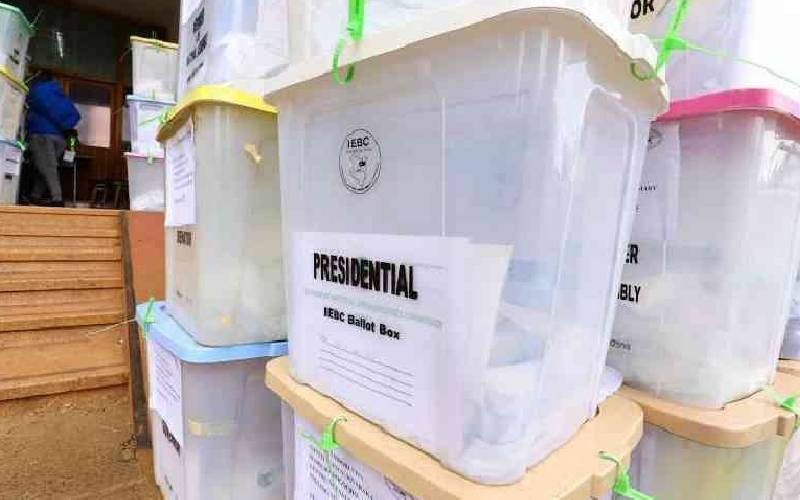
Ballot boxes at Ruaraka constituency tallying centre, Stima Club, Nairobi, on August 11, 2022. [File, Standard]

“Leo wacheni niseme kinitoke.” This Swahili slang means ‘allow me to free myself by saying it all!’ For far too long, we have believed that elections are the engine of change. They are not! Elections mainly change faces.

It is systems that determine outcomes. Until we confront this deep truth, Kenya will continue to recycle hope and reproduce disappointment. Yes!

For decades, we have placed our faith in the Presidency of Kenya, expecting that a new leader will unlock national progress. Yet every administration, no matter how well-intentioned, enters office already constrained. Campaigns are financed, and alliances are neatly negotiated.

Expectations are set long before the oath is taken. By the time leadership begins, it is already navigating obligations. This is not a failure of individuals but a quiet imprisonment of the system.

We then turn to the Parliament of Kenya, believing it will correct the course. Yet here too, incentives often distort purpose. Indeed, strong voices exist, but they operate within a structure where political survival competes with national duty.

It is interesting how, over time, debate becomes mere presentations, and reform becomes negotiation. Kenya has not lacked leaders, not at all! It has lacked a system that protects great resolutions from interference.

Here is our contradiction. Kenya has one of the world's most progressive constitutions, yet millions face delayed justice, stalled development, and broken accountability. We have laws and institutions that promise fairness, but systems that disappoint by diluting enforcement. That gap is where our future has been quietly lost.

Now we must change tack. The Judiciary of Kenya remains the most underutilised force for national transformation. It neither campaigns nor fundraises. It does not negotiate for survival but stands firmly on the Constitution. And when it acts, it does so with authority that no other arm can override.

History has shown us its strength. Courts have nullified presidential elections, stopped unconstitutional actions, and compelled compliance when other institutions hesitated. These are not routine decisions. They demonstrate a system capable of correcting power itself.

But here is the deeper truth we have ignored. The court, designed to enforce action, cannot move itself. It is activated by citizens and institutions willing to stand and test real matters against the Constitution. This is where the real shift must happen.

Imagine a Kenya where the citizenry and leaders are intentional about using the courts to guide national direction. Cases that demand timelines for public projects, enforce transparency in procurement, and protect public resources as a constitutional obligation, not as political favours in exchange for votes.

Sounds theoretical, right? You may be wrong. See this. Courts do not create budgets, but they can enforce constitutional duties that shape how budgets are used. They do not govern or attend mammoth political rallies, but they can ensure that governance follows the law and can structurally discipline leadership.

Power dreads the courtroom when the citizenry grasps the Constitution. This is the line Kenya must cross.

The Judiciary has remained largely an unsung force, often criticised, sometimes misunderstood, yet consistently holding the line where it matters most. Within it are men and women who carry the quiet burden of safeguarding the nation’s legal soul.

This is not a call to fight the government. No! It is a call to strengthen the nation. The Executive must lead. Parliament must legislate. But the Judiciary must be activated to ensure both remain aligned with the Constitution. Citizens must now view the court as a tool for progress, not a last resort.

Accordingly, Counties must respect and implement court orders as development instruments. National leadership must protect judicial independence and ensure the system is adequately resourced.

As we approach the 2027 elections, Kenya does not need endless political rallies or hidden interests masquerading as development promises. It needs stronger systems. Nimesema na kimenitoka. ‘I have said it all, and I am now at peace.’ What you do with that information is up to you! Think green. Act green.

Support Independent Journalism

Stand With Bold Journalism.
Stand With The Standard.

Journalism can't be free because the truth demands investment. At The Standard, we invest time, courage and skills to bring you accurate, factual and impactful stories. Subscribe today and stand with us in the pursuit of credible journalism.

Pay via
M - PESA
VISA
Airtel Money
Secure Payment Kenya's most trusted newsroom since 1902

Follow The Standard on Google News