×
App Icon
The Standard e-Paper
Kenya’s Boldest Voice
★★★★ - on Play Store
Read on the App

Uganda poll new ugly chapter in Africa's democratic experiment

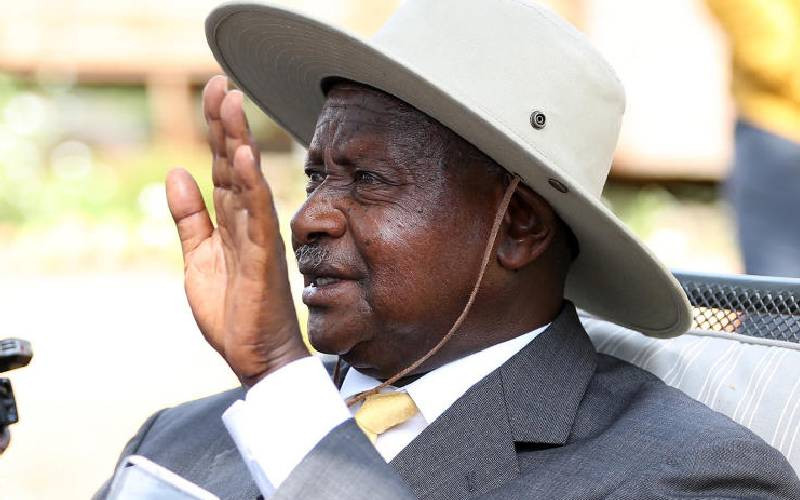
Uganda's President Yoweri Museveni addressing the media after casting his vote at a polling station during the presidential elections in Kirihura in western Uganda, February 18, 2016. [Boniface Okendo, Standard]

History just repeated itself in the presidential elections of January 15, 2026, in Uganda. Everything from a build-up dominated by the arrest and harassment of opposition figures and, sometimes, rights defenders to a polling-and-tallying process cloaked in the murk of an internet blackout lived up to expectations.

And the incumbent, Yoweri Kaguta Museveni, 81, of the National Resistance Movement party in power since 1986, and gunning for a controversial, ‘peculiarly African’ seventh term in office, won with about 70 per cent of the vote.

The polls in Uganda, coming on the heels of those in Cameroon, Côte d’Ivoire, Tanzania and Guinea only a few months ago, where incumbents, either forcing illegal new terms in office or seeking lawful re-election.

This prevailed under an atmosphere of systemic arm-twisting, targeted arrests of and attacks on opposition figures, as well as the weaponisation of security operations were but a continuation of the African democracy paying for ‘the curse of incumbency’, where long-time, autarchic rulers have almost always had their way despite change-promising, oppositional tidal waves.


Museveni’s campaign slogan in the just-concluded elections in Uganda,’ Protecting the Gains,’ was not only an exercise in paradox-based, political blurb-merchanthood but also an old, incumbent-employed refrain associated with long-serving, competition-fearful tyrants in and around Africa.

In Libya, where the late Muammar Gaddafi (1942-2011) ruled for 42 years beginning in 1969, institutional constitutionalism was abolished and supplanted with politburo-style, minion-packed committees that dared not challenge the incumbent. In Uganda, Museveni’s son, Muhoozi Kainerugaba, in his role as head of the army, is partly responsible for his father’s “ouster-proof” reign. And in Equatorial Guinea, 83-year-old incumbent Teodoro Obiang Nguema Mbasogo, in power for 44 years now, has since sought and, thus far, ‘found’ a ready and easy hedge against defenestration in his 57-year-old vice-president son Teodoro Nguema Obiang Mangue.

If the 2021 presidential race in Uganda that first pitted Museveni against his now-archrival, musician-turned-politician Robert Kyagulanyi Ssentamu (Bobi Wine), 43, of the National Unity Platform (NUP) party heralded a youth-led, old-versus-new electoral tug of war, the 2026 one was the rematch whose build-up and outcome made for a lessons-filled study in how democracy in Africa is and could be, for a long time to come, a travesty whose ultimate, incumbent-conceived goal is the illusion of choice.

In 2021, the Uganda parody featured, in addition to Mr Kyagulanyi, some eight other acts, including Patrick Amuriat of the Forum for Democratic Change, Norbert Mao of the Democratic Party, Gen Mugisha Muntu of the Alliance for National Transformation, Independents John Katumba, Willy Mayambala, Fred Mwesigye, Henry Tumukunde, and Joseph Kabuleta, as well as the sole female figure, Nancy Kalembe.

This year, Showman-in-Chief Museveni allowed the inclusion in the parody cast of new, obviously threat-blunt characters in Nathan Nandala Mafabi (Forum for Democratic Change), Mubarak Munyagwa (Common Man’s Party), Frank Bulira (Revolutionary People’s Party), Joseph Mabirizi (Conservative Party), and Robert Kasibante (National Peasants Party), safe in the knowledge that with Kizza Besigye shunted away in prison, and the Kainerugaba-commanded army brutes ready to ‘pulp’ Kyagulanyi into good-for-fixity meekness, the prize was his for the taking.

Such is, thus far, the much-echoed tale of the African democratic experiment. Often, it is as much about the spectacle of old, lassitude-worn men (rarely women) parlaying institutional capture into office-holding immortality as it is about the pathos of brutality-scarred, resource-exiguous opponents pitting themselves, hopelessly, against incumbent-beholden systems. The bodies tasked with managing elections are often incumbent-appointed, making their independence an illusion, if not impossible. And incumbent-associated malpractice in the build-up to, during, and in the aftermath of elections seldom elicits condemnation from either the African Union or such sub-regional bodies as the East African Community, the Economic Community of West African States, and the Southern African Development Community.

Then, incumbents-only congratulatory messages follow barefaced vote-rigging, after which gloat-filled speeches at glitz-marred inauguration ceremonies signal continuity of the familiar. Lucky opponents are spared imprisonment or exile, and allowed to indulge in the self-consolatory balm of a courtroom circus. What then follows is five, or seven, more years of public office teeming with the same old faces in countries of conflict-riven, plunder-pauperised and aid-dependent populations.

Progress in, and of, entire nations is deferred indefinitely, if not sacrificed outright, as incumbent rulers’ whims take precedence. And thus continues the story of Africa, one of informal, nothing-on-offer paternalism where the masses are forever palmed off with blandishments, even as the mock-practice of democracy keeps up the illusion of choice.