×

The Standard e-Paper
Kenya’s Boldest Voice
 The Standard Group Plc is a
multi-media organization with investments in media platforms spanning newspaper
print operations, television, radio broadcasting, digital and online services. The
Standard Group is recognized as a leading multi-media house in Kenya with a key
influence in matters of national and international interest.
The Standard Group Plc is a
multi-media organization with investments in media platforms spanning newspaper
print operations, television, radio broadcasting, digital and online services. The
Standard Group is recognized as a leading multi-media house in Kenya with a key
influence in matters of national and international interest.

Audio By Vocalize
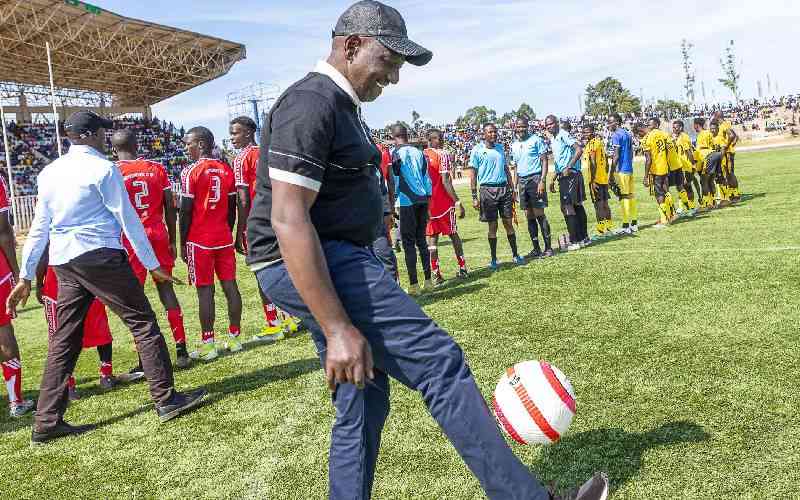
President William Ruto during the FCPA Barasa Governor’s Cup at Bukhungu Stadium, Kakamega County, on January 1, 2026. [PCS]
What does it take for a country to move from potential to prosperity? Kenya has spent decades designing development blueprints. However, the main challenge has always been the execution. As the Kenya Vision 2030 enters a critical phase, 2026 offers an opportunity to translate plans into measurable progress and lasting economic impact. Under the leadership of President William Ruto, Kenya is moving beyond aspiration into a phase of national renewal, where policy intent is increasingly matched by action and implementation.
Kenya’s long term development agenda is anchored on Vision 2030, which aims to transform the country into an industrialised and prosperous nation that offers high quality life to all its citizens. This vision has been re-energised through the Bottom-Up Economic Transformation Agenda which prioritises inclusive development, job creation, agricultural productivity, housing and settlement, healthcare, infrastructural development, digital superhighway and creative economy. It is driven by inspiration from countries that once stood where Kenya is today and rose to a global economic powerhouse through bold vision, disciplined planning and implementation.
At the centre of this transformation narrative is Singapore, a small country that leaped from third-world to first-world in just 20-25 years. At the time it gained independence in 1965, Singapore faced a myriad of challenges. It was a tiny, impoverished island with a diverse population of recent immigrants, had little shared history and no natural resources. Yet, through visionary leadership, an open-door policy to foreigners, relentless focus on strategic investment and good governance, Singapore became one of the world’s most competitive economies. During its first two decades, Singapore’s economy grew by about 10 per cent per year. As of 2025, Singapore was ranked the wealthiest country in the world, overtaking Luxembourg. Singapore’s GDP per capita reached US$156,760.
The journey of Singapore is instructive for Kenya, not because Kenya seeks to replicate the story wholesome, but because it shows what a country can achieve when it is committed to excellence and bold vision. At the time of independence, the two countries were at a comparable economic starting point, with Kenya having a GDP of about USD 926 million while Singapore at USD 917 million. The transformation of Singapore was propelled by clear policies, an education system that aligned with the future, world class infrastructure development and a system that rewards competency and innovation.
The journey from a middle-income economy to a first world country is not an overnight leap, it is a structured process that is driven by disciplined planning, policy coherence and sustainable execution. In his New Year’s address, Dr Ruto declared 2026 a decisive turning point for Kenya, outlining an ambitious economic agenda anchored on poverty reduction, job creation, major infrastructure investments, and a nationwide crackdown on alcohol and drug abuse.
Energy and infrastructure feature prominently in this agenda. Plans to expand electricity generation to support industrialisation and innovation by increasing energy production by additional 10,000 megawatts. The government also aims to use strategic investment to develop world class airports, ports, rail network and position Kenya as a net exporting economy.
Additionally, the President announced plans to dual 2,500 kilometres of highways and tarmac 28,000 kilometres of roads over the next ten years. Housing project is also a key feature with the government targeting 250,000 affordable housing units per year (of which so far 112,405 housing units are either completed or ongoing). Plans are also underway to extend the Standard Gauge Railway from Naivasha to Kisumu and later to Malaba starting January 2026 to strengthen regional trade links. These mega projects are not merely a construction blueprint but are economic arteries that will improve mobility of goods, services and talents, improve market access, and enhance Kenya’s competitiveness within East Africa and Africa.
History shows that development is not achieved by policy alone, proper implementation remains a decisive factor. Kenya’s transformation begins with the citizens, “US” - Our mindset, confidence and willingness to take ownership of our country’s future. No country has ever prospered by outsourcing its destiny to external saviours. Kenya’s transition from a third to a first world economy must be driven by Kenyan hands, ingenuity, and industry.
In this transformational journey, the unity of purpose matters. Implementation of policy will only become effective if citizens and leaders share a common vision. When Kenyans in the business, in public service and in communities align with this bold national agenda, then the pace of progress will be accelerated. Development, after all, is not a reserve for the government alone, it is a shared responsibility of every citizen who believes in a prosperous future for Kenya.
Kenya is not without its challenges. Public debt pressure, unemployment, inequality, and governance concern remains pressing. Acknowledging these challenges strengthens, not weakens, the credibility of Kenya’s transformation agenda. Addressing these challenges transparently is essential to sustaining the momentum and enhancing public confidence.
Yet, Kenya has a vast potential; a country rich in human capital, that is geographically strategic, with abundant natural resources, and a youthful population that is eager to innovate and excel. Countries that have successfully transformed their economies did so by acting decisively. They chose to act now, not later. They never waited for any external validation or permission, they simply seized their moment.
This is our Singapore moment. Not because Kenya will become a copy of another country but because Kenya has chosen to adopt proven principles of disciplined development in a uniquely Kenyan context. Let every citizen embrace this vision with unwavering resolve. We cannot wait for someone else to fix our country, we are the change Kenya has been waiting for and the responsibility to act is now.
Subscribe to our newsletter and stay updated on the latest developments and special offers!







 join
join