×
App Icon
The Standard e-Paper
Home To Bold Columnists
★★★★ - on Play Store
Download Now

Talanta Sports City is a brilliant reinvention of sporting culture

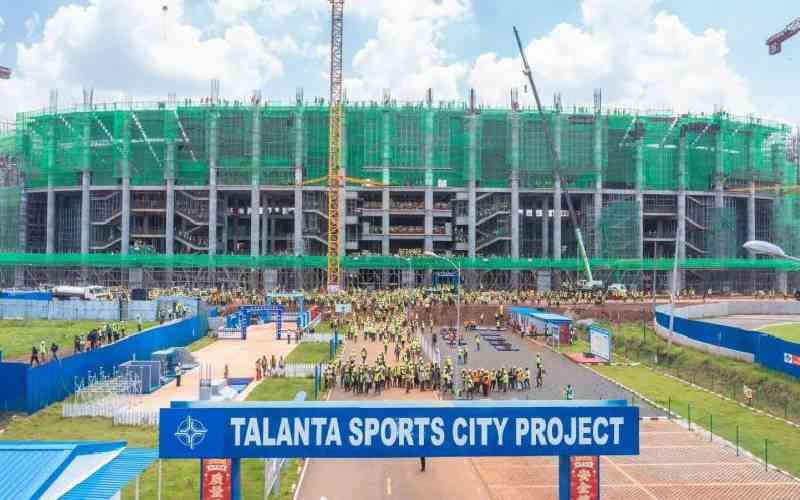
Ongoing construction of Talanta Sports Stadium in Nairobi. [File, Standard]

The aspirations of a country are often expressed through the scale and ambition of its infrastructure, and in Kenya, few projects embody this national vision as boldly as the Talanta Sports City.

Rising prominently at Nairobi’s Jamhuri Grounds, the Sh45.3 billion development is far more than a stadium. It represents a transformative reimagining of Kenya’s sports ecosystem, cultural identity and infrastructural future. Conceived in the wake of Kenya jointly winning the bid to host the 2027 Africa Cup of Nations (AFCON) alongside Uganda and Tanzania, the Talanta Sports City serves not just as an upgrade to existing facilities but as a strategic leap meant to establish Kenya as a leading sporting destination in Africa.

Kenya’s victory in the East African Pamoja bid brought renewed scrutiny to the country’s readiness to host high-level tournaments. With the last major public stadiums, Kasarani and Nyayo, having been built in the 1980s, the demand for a modern arena that meets international standards became undeniable. Talanta Sports City is Kenya’s answer to this challenge.

Designed to hold 60,000 spectators, it will be the nation’s largest stadium and is expected to replace Kasarani as the flagship national arena. It is also poised to host AFCON 2027’s opening ceremony and potentially the finals, making it a centerpiece of regional football in the coming years.


At the heart of the Sports City is the main stadium, engineered to comply with the rigorous standards of global football authorities such as FIFA and CAF. Its design takes a distinctly modern approach: unlike most of Kenya’s existing stadiums, it will not include an athletics track. By focusing exclusively on football and rugby, the structure brings spectators significantly closer to the field, heightening visibility and the overall match-day experience in line with the world’s top arenas.

The architectural concept merges advanced engineering with cultural symbolism. The fully covered, three-tiered stand ensures that all 60,000 attendees are sheltered from weather elements, enhancing comfort throughout events. Inside, the seating incorporates the bold colours of the Kenyan flag - black, red, and green - creating an unmistakably national aesthetic. The exterior design draws its inspiration from the Maasai shield and spears, reflecting unity, resilience and heritage. This fusion of modernity and tradition transforms the stadium into a cultural statement as much as a sports venue.

Beyond its appearance, the stadium integrates state-of-the-art technical features essential for world-class competitions. These include comprehensive medical and doping-control centres, high-end broadcasting rooms, corporate hospitality suites and VIP lounges.

What makes the Talanta Sports City particularly notable is the pace at which it is being constructed. After ground-breaking in March 2024, the government set an aggressive target to complete the project by December 2025 or early 2026. By late 2025, construction was reported to be between 40 and 60 per cent complete - remarkably fast progress for a project of this size in Kenya. Thousands of workers are deployed in both day and night shifts to ensure that the stadium meets the CAF inspection deadline of February 28, 2026.

One of the most debated aspects of the Talanta Sports City is its financing. Rather than relying on direct government budget allocations, the project uses a complex Public-Private Partnership (PPP) structure. The Sh45.3 billion cost is largely financed through a Sh44.79 billion infrastructure asset-backed security issued by the Linzi Finco 003 Trust, affiliated with the Liaison Group and listed on the Nairobi Securities Exchange. 

In practical terms, the project is funded by borrowing against the stadium’s anticipated future revenues. These include income from games, hospitality services, naming rights, concerts and other events. The model reduces immediate pressure on the national budget but shifts financial risk to the future commercial viability of the facility. Critics argue that such a massive sum could have funded several smaller stadiums across the country, potentially benefiting more regions. Supporters contend that Kenya must demonstrate its ability to mobilize private capital for large-scale infrastructure if it hopes to accelerate development. The financial performance of Talanta Sports City after completion will, therefore, serve as a significant test case for PPP-funded mega-projects in the region.

Once completed, Talanta Sports City is expected to reshape the sporting landscape in Kenya. National teams such as the Harambee Stars and the rugby squads, which have long been under served by deteriorating or non-compliant facilities, will finally have a modern home venue. This shift will enhance performance, increase morale, and eliminate the recurring challenge of hosting international matches abroad due to inadequate infrastructure. The impact on national pride and the country’s international sporting reputation will be substantial.

The economic ripple effects are equally promising. During construction, thousands of Kenyans have been employed, and once operational, the complex will support long-term jobs in event management, hospitality, security and facility maintenance. 

But the vision behind Talanta Sports City stretches beyond economics and athletics. The project aims to nurture talent by creating an integrated training ecosystem within the Sports City, where young athletes can train, compete and grow in a world-class environment. The availability of several training pitches, indoor facilities and technical amenities means that the complex will function as a cradle for sports development from the grassroots to elite levels.

Additionally, the stadium is designed to double as a hub for Kenya’s creative industry. With its capacity and advanced infrastructure, it will be ideal for concerts, festivals and other cultural megaprojects, helping to diversify revenue streams and ensure year-round activity. In this way, the Talanta Sports City is intended to be a vibrant, multifaceted landmark that symbolizes Kenya’s ambition and dynamism well into the future. This masterpiece is indeed the generational rebirth of the sporting culture through infrastructural transformation.

The writer is a mapping and research expert