×
App Icon
The Standard e-Paper
Truth Without Fear
★★★★ - on Play Store
Download Now

Justice Ibrahim stood for truth, colleagues say as he's laid to rest

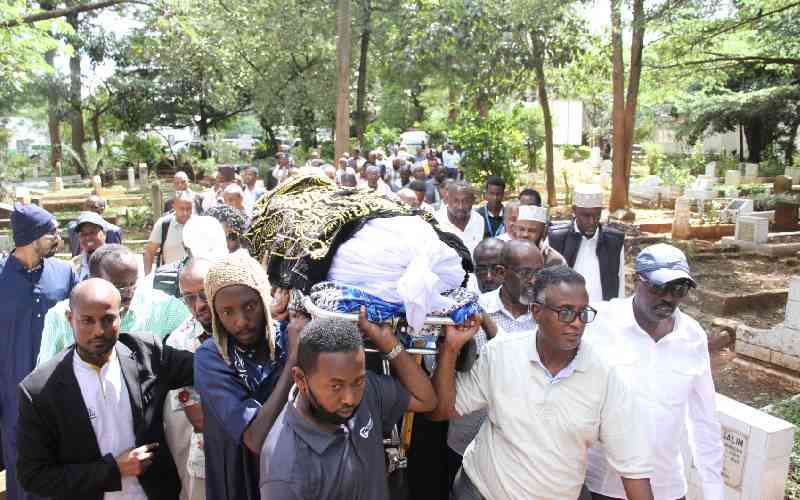
Justice Mohammed Ibrahim is laid to rest at Kariakor Muslim cemetery, Nairobi, on December 18, 2025. [Edward Kiplimo, Standard]

Former Chief Justice David Maraga on Thursday paid tribute to his former Supreme Court colleague Mohamed Ibrahim who died on December 17, marking the end of a distinguished life in law and public service.

The Supreme Court judge’s funeral prayers (Swalah) were held at Masjid Noor in South C, after which he was laid to rest at the Muslim Cemetery in Kariokor, as family, friends, and colleagues gathered to honour a jurist respected for his integrity and courage.

Maraga described Ibrahim as a judge of rare uprightness and discipline and had zero tolerance for corruption.


“Mohamed was a man who never tolerated corruption. He carried out his work diligently and without fear or favour. This country has lost one of its most brilliant legal minds,” he said.

Maraga recalled working with Ibrahim in private legal practice before they both joined the judiciary, sometimes appearing on opposing sides.

Ibrahim’s legal career spanned decades and was rooted in a strong commitment to constitutionalism, human rights, and the rule of law.

In private practice, he handled complex and politically sensitive cases at a time when defending constitutional freedoms often attracted hostility from the State.

Despite intimidation, Ibrahim remained resolute. Colleagues said those experiences only strengthened his resolve and sharpened his moral clarity.

His appointment to the judiciary marked a defining chapter in his public service. Ibrahim rose through the ranks to serve at the highest levels of the judicial system, earning a reputation for meticulous preparation and carefully reasoned judgments.

Former CJ David Maraga, former AG Justin Muturi, and former Nairobi Town Clerk Philip Kisia during the burial of Justice Mohammed Ibrahim at Kariakor Muslim cemetery, Nairobi, on December 18, 2025. [Edward Kiplimo, Standard]

He was widely viewed as a steady voice of reason during periods of institutional pressure, consistently guided by fairness and respect for human dignity.

Former Nairobi Town Clerk Philip Kisia described the Supreme Court judge as a man whose values never shifted.

“He was simple, hardworking, and his principles were permanent. If this country, especially the judiciary, had even ten people of Mohamed’s calibre, corruption would have no place,” Kisia said.

Kisia added that Ibrahim always placed the value of human life above all else and remained composed despite the many trials faced by the judiciary.

Former National Assembly Speaker Justin Muturi traced his friendship with the judge to 1978, when they were classmates.

“We have been friends for a very long time. Even when I went into active politics, that friendship never changed,” Muturi said.

He praised Ibrahim’s unwavering commitment to dignity, human rights, and constitutional governance, noting that detention and intimidation never deterred him from serving the country.

“He stood firm for what was right, regardless of the personal cost,” Muturi said.

Beyond the courtroom, Ibrahim was remembered as a loyal friend, mentor, and family man who quietly guided younger lawyers and judges. Those close to him described him as calm, thoughtful, and principled.

In mourning Mohamed Ibrahim, the nation reflects on a life defined not by titles alone, but by steadfast values.

“He served this country with commitment and dedication, and his legacy will endure,” Maraga said.