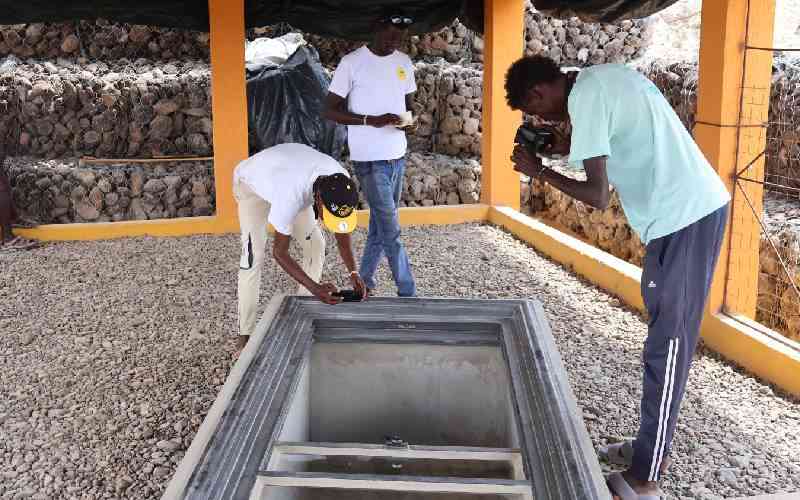
Youths view Homo erectus footprints in a glass structure in Ileret, Marsabit County. [Nanjinia Wamuswa, Standard]
For years, the Turkana Boy has placed Kenya on the world map as a key site in the story of human evolution.
Now, there is even more evidence supporting Kenya as a cradle of humankind.
The recent discovery of Homo erectus footprints in Ileret, Marsabit County, adds new depth to this already fascinating narrative—one that is poised to become an even greater tourist attraction.
During a recent visit, Grace Gude, a curatorial assistant at the National Museums of Kenya (NMK), welcomed visitors to the Ileret Footprint Interpretation Centre, guiding them through an orientation.
“This is the main entry point for guests, where we provide essential information before they begin their exploration of the site,” she explains.
The centre features an exhibition that highlights the history and significance of the footprint site and the rich culture of the local Daasanach people, their connection to the ecosystem, and their efforts to conserve the region’s prehistoric heritage. It is curated around three core themes: prehistory, climate change, and community.
The Ileret footprint site, dated to 1.5 million years ago, is located in an ecologically fragile zone of semi-arid and arid terrain, characterised by vast plains, rocky outcrops, and sparse desert vegetation, including resilient grasses and shrubs.
Dr. Purity Kiura, Principal Investigator at the NMK and Chief Research Scientist, says the site was discovered in 2004 by a team of researchers from the Koobi Fora Field School, a paleoanthropological training program run by the museum in partnership with Rutgers State University of New Jersey.
Some of the Homo erectus footprints in Ileret, in Marsabit County. [Nanjinia Wamuswa, Standard]
She explains that while exploring the geology of the area, the team came across a fossil bone, which later turned out to be a human fossil—specifically, a hardened bone.
“This discovery prompted further surveys to better understand the time period and environment in which this early human lived,” she says.
Geologists were brought in to study the stratigraphy and dating of the area when they noticed ground depressions that turned out to be footprints made by early humans as well as various animals.
At this point, she says, the research team resolved to conserve the footprints in 2014, with plans to make them accessible to the public in the future. Unfortunately, sediment erosion at the site continued to pose a threat.
In 2022, supported by the British Council and the Cultural Protection Fund, the museum launched the Ileret Footprint Project, a major conservation initiative to counter climate-related threats such as heavy rains and wind erosion that stripped away sediments.
Stay informed. Subscribe to our newsletter
“We also had to address threats from human activities. The local Daasanach community is largely pastoralist, and livestock movements, as well as the harvesting of vegetation and rocks from the site, posed significant risks,” Dr. Kiura says.
Dr Purity Kiura, Principal Investigator and Chief Research Scientist, the National Museums of Kenya, during the interview about Homo erectus footprints in Ileret, Marsabit County. [Nanjinia Wamuswa, Standard]
Today, several conservation structures are in place, including gabions built to slow sediment flow from the surrounding slopes and prevent runoff from damaging the site.
There are also soak pits and underground tanks that collect runoff water for community use. In addition, trees have been planted to help stabilize the soil and support long-term conservation efforts.
A selected section of the ancient footprints was carefully opened for public viewing using a specially designed, openable structure. Visitors slide the protective glass to view the prints, preserved in their original context.
Dr. Kiura explains, “This project is unique and the first of its kind globally, where an ancient footprint site has been opened up for public viewing. Researchers from other countries, including Tanzania, have visited to learn from the methods used here, hoping to apply similar techniques to sites such as the Laetoli footprints.”
Here, visitors can view human footprints, numerous bird prints, and prints from animals such as hippopotamuses, small antelopes, and gazelles.
Scientists have identified 83 different footprints belonging to approximately 22 individuals, mostly adult males and a few children. They say this site was likely a watering hole and a place where early humans and various animals, both terrestrial and aquatic, came to hunt or scavenge for food.
They also discovered animal bones bearing cut marks—evidence of stone-tool use.
Dr. Kiura says they have conserved and opened the site as a tourist attraction. It targets local residents, domestic and international tourists, and researchers. Students, teachers, and academic groups with an interest in archaeology, history, or science will benefit from the site's unique resources and its interpretive programs.
Since February, several visitors, both local and international, have toured the area.
Some of the fossils found by researchers, dating back 1.5 years ago in Ileret, Marsabit County. [Nanjinia Wamuswa, Standard]
She reveals they are finalizing the entry charges, likely to mirror those of other prehistoric sites in Kenya—about Sh400 for Kenyan citizens and around Sh1,200 for international visitors. Local residents will have a different, more affordable rate, to be determined in consultation with the county government.
Before the discovery, locals were unaware that anything of significance existed in the area.
Jane Jilo Katelo, Deputy Director of Tourism in Marsabit County, says they began by engaging the community in a participatory process.
“We explained the importance of the Ileret footprint site, and the community was receptive. They recognised the value of the site and agreed to provide the land where the footprints are located,” she says.
Iyayo Siroro, a local, reflects on the transformation brought by the discovery: “We didn’t know there was anything valuable here. After getting involved, we’ve learned that this is the origin of humanity. We value this place.”
Arweya Lotiele shares his excitement about the economic benefits. “It’s a miracle that we’re earning money from this place. I’ve been working here, building gabions and assisting with other tasks, and I get paid for it. It’s a great opportunity for us,” he says.
Joseph Mirgichan, Director of Culture for Marsabit County, says the Ileret footprints—alongside discoveries like the Turkana Boy—confirm that Kenya, and especially Marsabit, is truly the birthplace of humanity.
He is optimistic that the Ileret footprints are poised to become a major tourist attraction.
“Ileret contributes critically to our understanding of early human anatomy, adaptive strategies, and technological innovation. It strengthens Kenya’s role as a central cradle of human evolution and a landmark in the story of human origins,” he says.
Some of the community activities planned for visitors at the site include tree planting, sand volleyball, sand football, a camel derby, a boat race, and a medical camp.
The main challenge is the site’s remote location. Although road access has improved, the area remains quite distant, and there is no consistent transport service to ensure regular access to the Ileret footprint site.