×
App Icon
The Standard e-Paper
Smart Minds Choose Us
★★★★ - on Play Store
Download App

UN warns of irreversible global 'water bankruptcy'

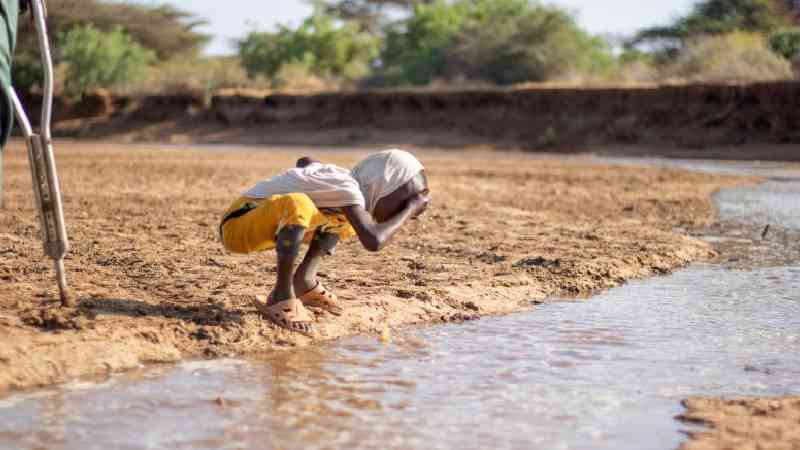
River Ewaso Ng'iro which had gone completely dry for six months flows back to life on the 2nd day of the 2023 Edition of the Camel Caravan [Jayne Rose Gacheri,  Standard]

The United Nations (UN) has warned of an unfolding and potentially irreversible global “water bankruptcy” with severe consequences.

In a report released last week at the UN headquarters in New York, the global body described the situation as severe to an extent that terms like “water crisis” or “water stressed” can not capture the magnitude of the situation and appealed to world leaders to take measures against the escalating consequences of climate change and other human activities that are degrading or destroying sources of water.

According to the report published by the United Nations University and based on a study in the Journal water Resources, several regions across the world are severely afflicted by the water problem citing the example of the Afghan capital, Kabul, likely to be the first modern city to run out of water while Mexico City is sinking at a rate of about 20 inches annually as the vast aquifer beneath its streets is over pumped.

In the US Southwest, States are locked in a continual battle over how to share the shrinking water of the drought-stricken Colorado River.


“If you keep calling this situation a crisis, you’re implying that it’s temporary. It’s a shock. We can mitigate it,” said Kaveh Madani, director of the UN University’s Institute for Water, Environment and Health, and the report’s lead author.

Global heating

Amid chronic groundwater depletion, water over-allocation, land and soil degradation, deforestation, and pollution, all compounded by global heating, the report entitled “Global Water Bankruptcy: Living Beyond Our Hydrological Means in post -Crisis Era”, declared a dawn of an era of global water bankruptcy, and asked world leaders to facilitate “honest, science-based adaptation to a new reality.”

“This report tells an uncomfortable truth: many regions are living beyond their hydrological means, and many critical water systems are already bankrupt,” stressed Madani.

The report explains that the concept of water bankruptcy is when nature provides income in the form of rain and snow, but the world is spending more than it receives, extracting from its rivers, lakes, wetlands, and underground aquifers at a much faster rate than they are replenished, putting us in debt.

Climate change-fuelled heat and drought are compounding the problem, reducing available water.

The consequences of the bankruptcy are declining aquifers, shrinking rivers and lakes, dried wetlands, crumbling land and sinkholes, the creeping of desertification, a dearth of snow, and melting glaciers. The report warns that “many regions are living beyond their hydrological means” with almost four billion people faced with severe water scarcity for at least one month each year.

In reference to cities such as Los Angeles, Las Vegas, and Tehran, where expansion and development have been encouraged, despite limited water supplies, Madani warns that “everything looks right until it’s not,” and then it’s too late. The lead author further explained that instead of recognizing the problem and adjusting consumption, water is taken for granted, and “credit lines keep increasing.”

Although details of the report are alarming, Madani, however, says that appreciating the existence of the crisis of water bankruptcy will trigger nations to adopt long-term strategies to reverse the damage instead of focusing on short-term emergency interventions.

He called on nations to transform agriculture, so far the biggest global consumer of water, through shifting crops and more efficient irrigation; better water monitoring using AI and remote sensing; reducing pollution; and increasing protection for wetlands and groundwater.

“Millions of farmers are trying to grow more food from shrinking, polluted, or disappearing water sources. Without rapid transitions toward water-smart agriculture, water bankruptcy will spread rapidly,” notes the report.

“Farmers and food systems sit at the very heart of Global Water Bankruptcy. Roughly 70 per cent of global freshwater withdrawals are used for agriculture, much of it in the Global South,” adds the report.

Groundwater provides about 50 per cent of domestic water use and over 40 per cent of irrigation water worldwide. Both drinking water and food production now depend heavily on aquifers that are being depleted faster than they can realistically recharge.

Worldwide failure

Madani emphasised that the findings do not suggest worldwide failure, but there are enough bankrupt or near-bankrupt systems, interconnected through trade, migration, and geopolitical dependencies, that the global risk landscape has been fundamentally altered.

The burdens fall disproportionally on smallholder farmers, indigenous peoples, low-income urban residents, and women and youth, while the benefits of overuse often accrue to more powerful actors.

Depletion limits.

The report introduces water bankruptcy as a condition defined by both insolvency and irreversibility.

Insolvency refers to withdrawing and polluting water beyond renewable inflows and safe depletion limits.

Irreversibility refers to the damage to key parts of water-related natural capital, such as wetlands and lakes, that makes restoration of the system to its initial conditions infeasible.

But all is not lost: comparing water action to finance, Madani said that bankruptcy is not the end of action. 

“It is the start of a structured recovery plan: you stop the bleeding, protect essential services, restructure unsustainable claims, and invest in rebuilding,” he noted.

The world is rapidly depleting its natural “water savings accounts”, according to the study: more than half the world’s large lakes have declined since the early 1990’s, while around 35 per cent of natural wetlands have been lost since 1970, added Madani.

The human toll is already significant. Nearly three-quarters of the world’s population lives in countries classified as water-insecure or critically water-insecure.