×

The Standard e-Paper
Kenya’s Boldest Voice
 The Standard Group Plc is a
multi-media organization with investments in media platforms spanning newspaper
print operations, television, radio broadcasting, digital and online services. The
Standard Group is recognized as a leading multi-media house in Kenya with a key
influence in matters of national and international interest.
The Standard Group Plc is a
multi-media organization with investments in media platforms spanning newspaper
print operations, television, radio broadcasting, digital and online services. The
Standard Group is recognized as a leading multi-media house in Kenya with a key
influence in matters of national and international interest.

Audio By Vocalize
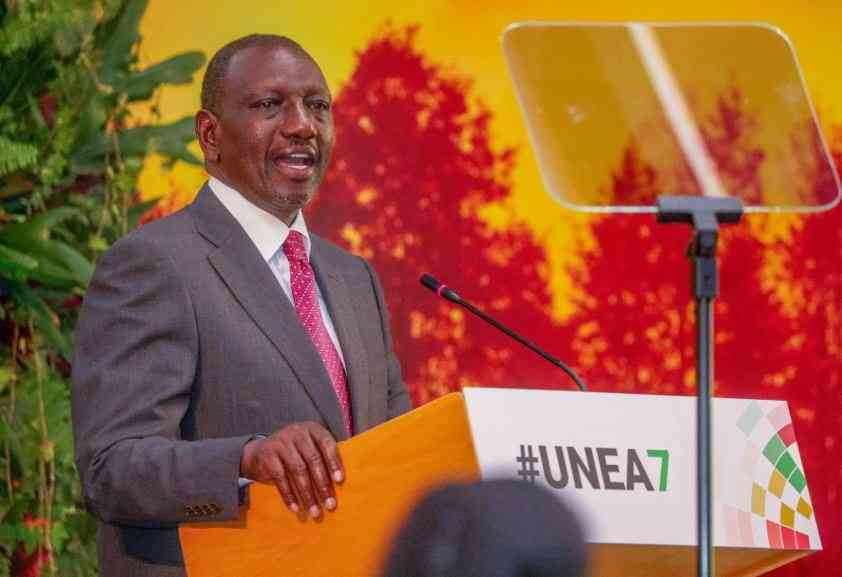
President William Ruto told the United Nations Environment Assembly (UNEA) that countries must treat climate action as core to their economies, not as an optional pledge.
Ruto used the UNEA-7 high-level opening segment to tell governments that climate action must now sit at the centre of national economic planning, not on the sidelines of policy debates.
He said the assembly must define "the environmental guardrails for this new era of economic transition" and warned that fast-rising technologies such as artificial intelligence and electrification will deepen inequality if they grow on foundations of pollution and extraction.
He described a global economy shifting under the weight of climate shocks, adding that states cannot ignore the numbers.
Kenya has already declared a national drought emergency across 20 counties. The crisis has placed 2.5 million people at risk of hunger and water shortages. Hurricane Melissa hit Jamaica with a force equal to the country's entire annual GDP. A station in Vietnam recorded 1.7 metres of rainfall in a single day.
Multi-country cyclones in Indonesia, Sri Lanka and Thailand killed thousands and displaced millions. Ruto said these extremes are "the new global normal," and they expose economies whose institutions cannot match the speed of the crisis.
UNEP Executive Director Inger Andersen strengthened that argument. She said the environment is "the very foundational bridge for peace, prosperity, economic growth and stability."
She warned that any economy degrading nature is "eroding its own balance sheet," because natural capital loss now translates directly into lost income, higher health costs, weaker financial markets, and lower productivity.
She cited the latest Global Environment Outlook, which shows environmental damage claiming millions of lives and costing trillions of dollars each year.
She said societies relying on fossil fuels and destructive extraction are "burning through the resources that keep them developed."
Scale solutions
United Nations Secretary-General Antonio Guterres framed the economic crisis within a political one. He said temperatures continue to rise, biodiversity continues to collapse, and societies are becoming "more unsafe."
He reminded member states that sustainability underpins "peace, prosperity, equality." He urged governments to scale solutions rapidly across water systems, mining, metals, and resilience, and said delay only shrinks the space for solutions.
He called on leaders to invest in justice and resilience and to "remember what we are fighting for." The tension running through the morning speeches at the event was clear: multilateralism stands on shaky ground.
Ruto said COP30 "kept multilateralism alive but did not meet expectations." He told delegates that the world now expects "determination and solidarity" and expects words to align with action.
Stay informed. Subscribe to our newsletter
He insisted that member states must back UNEP with real money and political support because countries safeguarding global public goods cannot do so while "struggling with poverty and limited fiscal space."
He said environmental action and economic transformation must move together because growth that deepens pollution will only push people into deeper hardship.
Andersen emphasised that UNEA remains indispensable because no country can face the crisis alone. She pointed to progress on minerals governance, coral reefs, and plastics negotiations as proof that cooperation still works.

Subscribe to our newsletter and stay updated on the latest developments and special offers!







 join
join