×

The Standard e-Paper
Smart Minds Choose Us
 The Standard Group Plc is a
multi-media organization with investments in media platforms spanning newspaper
print operations, television, radio broadcasting, digital and online services. The
Standard Group is recognized as a leading multi-media house in Kenya with a key
influence in matters of national and international interest.
The Standard Group Plc is a
multi-media organization with investments in media platforms spanning newspaper
print operations, television, radio broadcasting, digital and online services. The
Standard Group is recognized as a leading multi-media house in Kenya with a key
influence in matters of national and international interest.

Audio By Vocalize
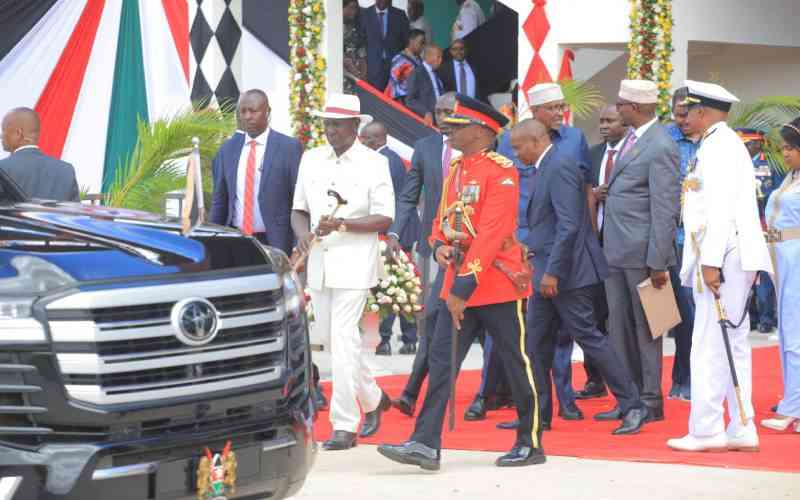
President William Ruto has announced education reforms targeting Northern Kenya and other marginalised regions.
President Ruto directed the formal integration of Madrassa, Duksi, and the Programme for Pastoral Instruction into the national education framework to ensure all learners have recognised pathways into education and future opportunities.
Speaking during this year’s Madaraka Day celebrations held in Wajir County for the first time, President Ruto said education remains the government’s most important investment in transforming historically marginalised areas and unlocking national development.
President Ruto said some children in Northern Kenya and other underserved communities continue to remain outside formal education systems because alternative learning pathways had not been fully recognised within national frameworks.
“Some children in Northern Kenya and other marginalized regions remain outside the formal education system because certain alternative learning pathways have not been adequately recognised or accommodated within our education framework,” he said.
He added that the absence of a clear policy framework had created barriers for learners seeking progression into formal education, skills development, and future opportunities.
“This challenge is particularly evident in the absence of a clear framework to recognise and integrate Duksi, Madrassa, and the Programme for Pastoral Instruction into the national education system,” President Ruto said.
The announcement marked one of the major policy declarations during the national celebrations held under the theme “Education, Skills and the Future,” reinforcing the government’s message that access to learning must extend beyond traditional classroom settings.
To address the challenge, the Head of State directed the Cabinet Secretary for Education to engage stakeholders and initiate measures under the Basic Education Act to formalise the integration process.
“This will ensure that every child, regardless of background or circumstance, has a recognised pathway into learning, skills, and opportunity. Every child deserves a door into learning. It is our duty to open every door,” he declared.
The move signals a broader government effort to expand education access while recognising the realities of communities that have historically relied on non-formal and community-based learning systems alongside conventional schooling.
President Ruto further emphasised that geographical location should no longer determine access to quality education opportunities.
“No child will be denied the opportunity to learn because of geography or historical neglect,” he said.
He pointed to ongoing investments including school feeding programmes that are supporting learners in arid regions, alongside teacher deployment, infrastructure expansion, and digital connectivity efforts across Northern Kenya.
Stay informed. Subscribe to our newsletter
“School feeding programmes are already supporting 2.4 million learners in arid regions, while we continue to deploy teachers, build infrastructure and expand digital connectivity across the region,” he said.
Ruto framed the integration agenda within broader education reforms anchored on the Competency-Based Education and Training (CBET) system, which he said is shifting Kenya from examination-focused learning toward developing learners’ talents, innovation, and problem-solving capabilities.
“The Competency-Based Education and Training system is transforming what learning means in Kenya,” he said, noting that the approach is designed to help children discover and develop their individual strengths.
In a move aimed at addressing long-standing teacher shortages in Northern Kenya, Ruto announced that 1,800 teachers from Wajir, Mandera, and Garissa had been employed and would be deployed across the region under an affirmative action programme.
He added that thousands of young people from the region were now enrolled in teacher training institutions, describing local teacher development as a sustainable solution to education challenges.
President Ruto also announced plans to fund the establishment of Wajir County’s first university, saying expanding higher education access remained critical to accelerating development and creating opportunities for future generations.
Subscribe to our newsletter and stay updated on the latest developments and special offers!


 Prefer the Standard on Google






 join
join