×

The Standard e-Paper
Kenya’s Boldest Voice
 The Standard Group Plc is a
multi-media organization with investments in media platforms spanning newspaper
print operations, television, radio broadcasting, digital and online services. The
Standard Group is recognized as a leading multi-media house in Kenya with a key
influence in matters of national and international interest.
The Standard Group Plc is a
multi-media organization with investments in media platforms spanning newspaper
print operations, television, radio broadcasting, digital and online services. The
Standard Group is recognized as a leading multi-media house in Kenya with a key
influence in matters of national and international interest.

Audio By Vocalize
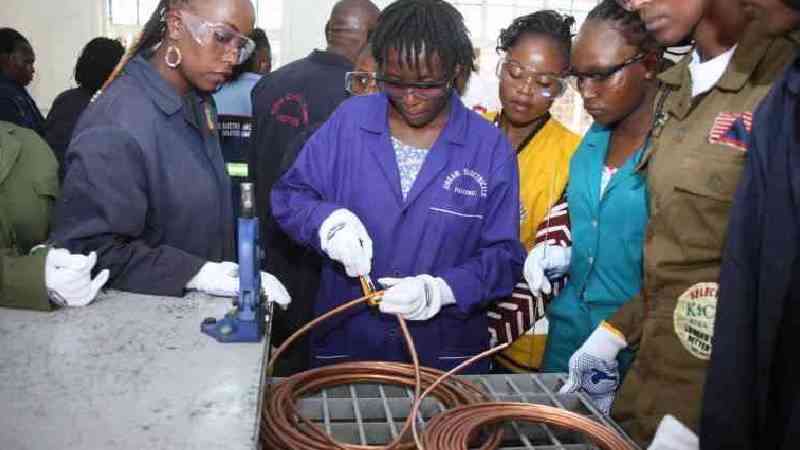
It has now emerged that fees at public Technical and Vocational Education and Training (TVET) institutions have nearly doubled over the last year, triggering low enrolment and rising dropout rates as technical colleges have become more expensive than public universities.
Trainers of the Technical colleges have raised an alarm over the sharp increase in costs, which they say is undermining completion and locking out learners from poor and middle-income households.
The Kenya Union of Technical and Vocational Education Trainers (KUTVET), tuition fees under the modular curriculum introduced in May 2025 have risen from about Sh56,000 to Sh105,000 per year.
The funds exclude accommodation, examination charges, tools, materials and subsistence costs.
“It has now become extremely difficult for the ordinary parent to sustain a child in a technical institution. Fees have risen from Sh56,000 to Sh105,000 per year for tuition alone.” KUTVET Secretary General Kepher Ogwui said.
Under the current system, learners pay about Sh35,000 per term, with trainers warning that once all additional costs are factored in, the total annual expense can climb to as high as Sh400,000.
“This programme was well thought out and meant to make learners more practical-oriented and self-reliant, but the way it is being implemented has created serious challenges that are now driving students away,” Ogwui said.
This is compared to universities, where, effective September 2025, university fees for public institutions have been significantly reduced, with students now paying between approximately Sh 5,800 and Sh 75,000 per year
Humanities and Social Sciences: These are the most affordable, with fees ranging from Ksh 5,814 to Ksh 23,256 per semester.
Business and Economics: Fees range from Ksh 7,525 to Ksh 30,101 per semester.
Medicine, Dentistry, and Pharmacy: These clinical courses have been reduced to a range of Ksh 22,371 to Ksh 75,000 per semester.
Engineering and Surveying: Fees for these programs now fall between Ksh 12,960 and Ksh 51,840 per semester.
Ogwui said the rising costs have led to declining enrolment and high dropout rates in public technical institutions across the country.
“We don’t have students in colleges now. Enrolment is very low because children cannot afford the fees. Even those who manage to join are dropping out before they complete their courses,” he said.
The union warned that the trend is already affecting the supply of skilled labour.
Stay informed. Subscribe to our newsletter
“This means the number of trainees completing their training is not sufficient for the market,” he added.
The crisis has been worsened by delays and gaps in government capitation, which is meant to subsidise learner costs. According to KUTVET, only trainees who enrolled in September 2023 are currently benefiting from government support.
“Any student who enrolled in 2024 or later is not receiving capitation. They are left in college with a lot of challenges because there is no funding,” Ogwui said.
As a result, institutions are increasingly relying on Constituency Development Fund (CDF) bursaries and private support, which trainers say is insufficient to cushion learners from rising fees.
Trainers also raised concerns over the administration of exams by the Curriculum Development, Assessment and Certification Council (CDACC), saying the current system compromises exam integrity.
“Sometimes the examination is sent to institutions just 30 minutes before the exam starts. Colleges are expected to print, photocopy and issue papers to thousands of candidates within that time,” he said.
He warned that this exposes exams to leakage, citing cases where candidates had access to question papers before sitting the exam.
KUTVET said some institutions lack basic facilities such as printers, power supply and packaging materials, yet are still expected to administer high-stakes national exams.
KUTVET warned that the challenges in public TVETs are pushing parents to private institutions, some of which lack qualified trainers.
“Some parents insist on taking their children to private institutions simply because they want a certain exam. But many of these institutions do not have qualified manpower.” Ogwui said.
He added that some private colleges rely on trainers from public institutions to teach their students.
The union has called on the government to convene a national stakeholders’ forum to review the modular curriculum and address funding and examination challenges.

Subscribe to our newsletter and stay updated on the latest developments and special offers!









 join
join