×

The Standard e-Paper
Smart Minds Choose Us
 The Standard Group Plc is a
multi-media organization with investments in media platforms spanning newspaper
print operations, television, radio broadcasting, digital and online services. The
Standard Group is recognized as a leading multi-media house in Kenya with a key
influence in matters of national and international interest.
The Standard Group Plc is a
multi-media organization with investments in media platforms spanning newspaper
print operations, television, radio broadcasting, digital and online services. The
Standard Group is recognized as a leading multi-media house in Kenya with a key
influence in matters of national and international interest.

Audio By Vocalize
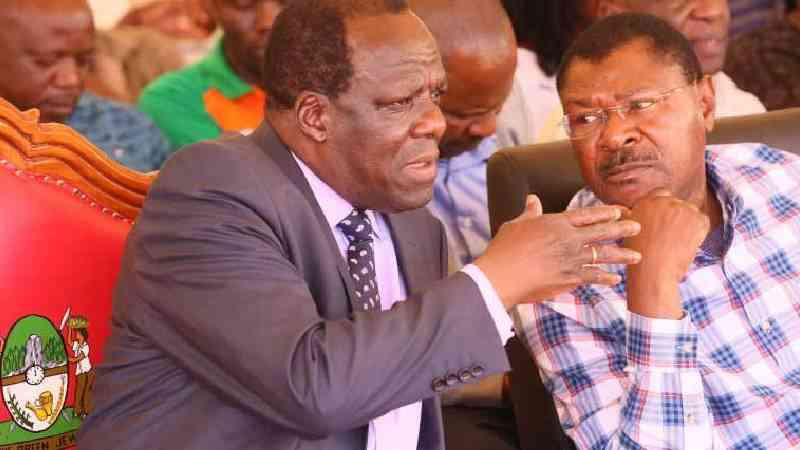
The excitable nature of our leadership, in part, arises from an allergy to truth. When Cabinet Secretary Wycliffe Oparanya admitted that canvassing votes for President William Ruto in Western Kenya had become a herculean task, local loyalists bridled.
The Luhya community is Kenya's second-largest ethnic bloc, with close to three million registered voters spread across Kakamega, Bungoma, Busia, Vihiga, Trans Nzoia, and Nairobi. Any serious presidential candidate must salivate after such numbers. Yet, going into 2027, the Luhya community presents a fractured political house. Its most prominent leaders are pulling in different directions, making the idea of a united Luhya vote more of a theoretical construct than a political reality.
On the one side are Prime Cabinet Secretary Musalia Mudavadi and National Assembly Speaker Moses Wetang'ula, regarded as the region's kingpins, backing Ruto's re-election bid. Their position is to support Ruto now, consolidate gains, and present their own candidate in 2032. Mudavadi has warned the community against being swayed by Governor George Natembeya and other leaders drifting in a different direction, insisting that Dr Ruto is going to win in 2027 and that the community should not be distracted by leaders whose agenda is ‘insults’.
This position is backed by COTU Secretary General Francis Atwoli, who has reaffirmed his support for Mudavadi and Wetang'ula. But Trans Nzoia Governor George Natembeya chose to run against the grain, and launched the ‘Tawe’ Movement, which, he avers, is prepared to challenge Ruto in 2027, not sit back and wait for 2032.
Natembeya says the erroneous belief that a president must either be a Kikuyu or Kalenjin will be broken in 2027. Nairobi Senator Edwin Sifuna has aligned with this insurgent energy, with indications that his net has attracted leaders from Wiper, DAP-K and Ford Kenya.
An Infotrak survey released in January 2026 found that 50 per cent of Luhya respondents identified Natembeya as the most influential politician in the community, ahead of Mudavadi at 32 per cent, Sifuna at 31 per cent and Wetang'ula at 29 per cent. More telling, 36 per cent said Natembeya champions the Western region's interests better, placing him ahead of Mudavadi at 18 per cent and Wetang'ula at 14 per cent. The poll findings suggest a region transitioning from status quo politics to performance-based leadership, where visibility, assertiveness and advocacy matter more than legacy alone.
This is the maze Ruto must navigate, but it isn't going to be easy. Mudavadi and Wetang'ula are his most valuable Luhya assets, yet their influence within the community is eroding. The Sifuna-Natembeya axis is being viewed as a break from the old script of elder-driven negotiated democracy, with their growing popularity suggesting a hunger for ideological clarity and issue-based politics rather than ethnic arithmetic and transactional alliances.
The Kenya Kwanza administration has been laying down plans to contain Natembeya ahead of 2027, with former CS Susan Nakhumicha and former Kiminini MP Chris Wamalwa having announced bids to unseat him. Meanwhile, a unity summit convened by grassroots Luhya leaders in Nairobi in May last year was snubbed by Mudavadi, Wetang'ula and Oparanya, attracting open anger from community members. The irony is that a meeting called to forge unity became a demonstration of division.
A group of lawmakers under the Western Region MP Caucus are rooting for a united front, with some vowing to support Ruto's re-election on one condition: that the post of deputy president be reserved for a Luhya. This transactional calculus is problematic. Luhya leaders have historically exchanged community votes for positions rather than policy concessions, and the electorate is becoming impatient with that arrangement.
A community split three ways between Ruto supporters, Natembeya's Tawe Movement and Sifuna's opposition alliance is a community whose vote is already dispersed. That dispersion benefits Ruto more than it hurts him, because it neutralises what could otherwise be a decisive bloc.
Subscribe to our newsletter and stay updated on the latest developments and special offers!


 Prefer the Standard on Google






 join
join