×

The Standard e-Paper
Stay Informed, Even Offline
 The Standard Group Plc is a
multi-media organization with investments in media platforms spanning newspaper
print operations, television, radio broadcasting, digital and online services. The
Standard Group is recognized as a leading multi-media house in Kenya with a key
influence in matters of national and international interest.
The Standard Group Plc is a
multi-media organization with investments in media platforms spanning newspaper
print operations, television, radio broadcasting, digital and online services. The
Standard Group is recognized as a leading multi-media house in Kenya with a key
influence in matters of national and international interest.

Audio By Vocalize
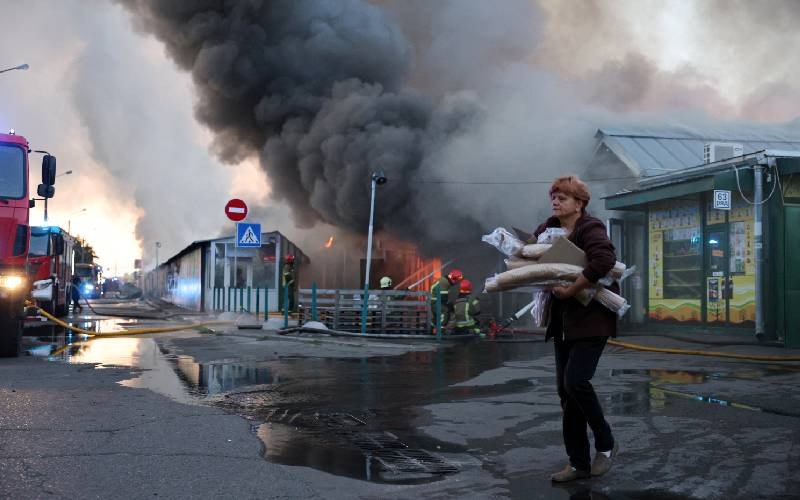
A woman salvages items from the burned-out book market as Ukrainian rescuers work to extinguish a fire following a Russian strike in Kyiv on August 16, 2026. [AFP]
The chances of a missile attack on Kyiv that night were around 50 percent, according to the administrator of a social media channel monitoring Russian air raids.
His channel, Aeris Rimor -- roughly derived from the Latin for Searcher of the Skies -- is one of dozens sending real-time messages about incoming drones and missiles.
Ukrainians consult them to track potential Russian attacks, like people check weather applications for storms but with less certainty, shorter warning, and deadly stakes.
During one recent overnight attack, AFP journalists were granted rare access to shadow "Esko", the channel's administrator, on condition that his identity and some details of the operation remained undisclosed.
The 19-year-old, sporting a budding beard, usually operates from home, filling lulls by watching the TV show Criminal Minds or honing his drone-flying skills on a simulator.
Twenty-six minutes after midnight, the air raid alert rang, soon followed by a red dot glitching across the map on a screen in front of him.
"Oh, a missile on Kyiv," he said.
Switching to Telegram, he sent a message to 150,000 followers: "KYIV TARGET!"
"It's going to hit Kyiv in about a minute," he said.
He then sent out the names of the districts being targeted, quietly lamenting a few typos.
Seconds later, explosions echoed over the capital.
The red dot disappeared from the map, only for another to pop up shorty after.
"You have to literally stay on duty and stare at the screen the whole time, because you can easily miss it," said Esko, who did not appear to struggle, even late into the night.
Esko was looking at a live map used by Ukraine's air defence units.
Stay informed. Subscribe to our newsletter
Red icons -- depicting Russian drones -- were dotted across the map and disappeared as they were downed by Ukraine's air force.
The channels are tolerated by authorities but operate in a legal grey area as they use information from air force contacts.
Esko would not reveal publicly how he accessed the map.
In its nightly attacks, Moscow increasingly fires ballistic missiles, flying up to thousands of kilometres (miles) per hour and reaching Kyiv within three minutes of an air raid warning.
This poses a haunting dilemma for those in the capital.
Either go to a shelter -- the metro or a basement -- in advance, accepting a disrupted and uncomfortable night of half-sleep.
Or stay home and face the risk of a hit, particularly dangerous for those in high-rise buildings in heavily targeted districts.
Sometimes authorities warn hours before a likely attack.
Telegram channels -- sifting through intelligence data -- close the information gap, putting out daily forecasts on the probability of different types of attacks.
Esko said people often reach out asking for advice.
"You can only say: something might happen... but decide for yourselves."
On a recent night in Kyiv when there were mixed signals about a Russian strike, Kateryna Reshetnyk had gone down to the subway.
She based her decision on "a parallel analysis of several channels that have been posting truthful information for a long time."
She had set up folding chair next to the turnstiles with her mother and grandmother -- their beds for the next hours.
"But no one knows for sure what will happen or not. You just rely on your intuition and survival instinct," the 34-year-old said.
Hundreds of others, armed with mats, tents and pillows, had done the same.
Dogs snored next to their owners, who were glued to their phones, screens lighting up weary faces.
"We track what's happening and where, because our relatives, friends and colleagues are all over Kyiv and the region, so at least we understand what is happening and where," Reshetnyk said.
The night passed without a major strike.
Ukraine's air force grudgingly tolerates the monitoring channels.
"We can't ban them. They exist, they inform the public, for some people that's convenient," spokesman Yuri Ignat told AFP.
But he warned those running them not to post "excess information ... that the enemy can use against us."
With people making potentially life-or-death decisions based on his posts, Esko said he felt the weight of responsibility.
Much of his life now is spent at the screen, tracking hundreds of drones on only a few hours sleep.
But he prefers busy nights, rather than uneasy periods of calm when Russia is stockpiling for future attacks.
"You keep waiting, waiting, waiting, and then you start posting warnings because the tension is rising. And still, nothing happens. You post again, and nothing happens..."
"And then they hit."








Subscribe to our newsletter and stay updated on the latest developments and special offers!








 join
join