×

The Standard e-Paper
Fearless, Trusted News
 The Standard Group Plc is a
multi-media organization with investments in media platforms spanning newspaper
print operations, television, radio broadcasting, digital and online services. The
Standard Group is recognized as a leading multi-media house in Kenya with a key
influence in matters of national and international interest.
The Standard Group Plc is a
multi-media organization with investments in media platforms spanning newspaper
print operations, television, radio broadcasting, digital and online services. The
Standard Group is recognized as a leading multi-media house in Kenya with a key
influence in matters of national and international interest.

Audio By Vocalize
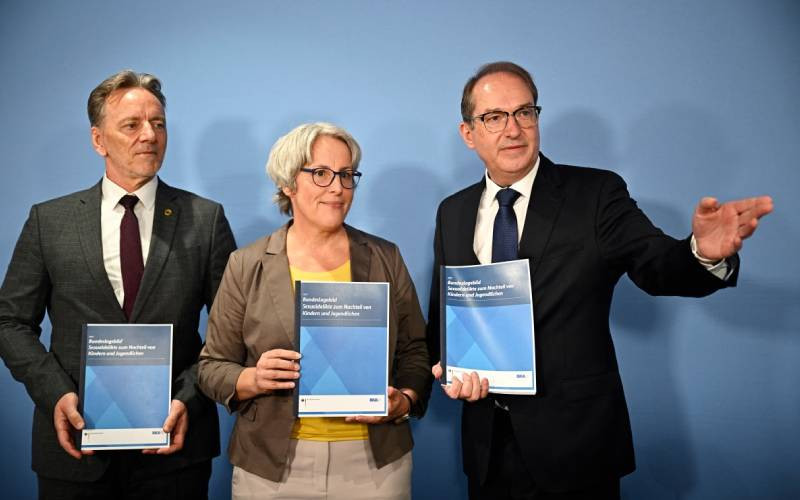
(L-R) President of the Federal Criminal Police Office Holger Muench, Independent Commissioner for Child and Adolescent Sexual Abuse (UBSKM) Kerstin Claus and German Interior Minister Alexander Dobrindt present the 2025 report on sex crimes against minors in Germany on July 21, 2026. [AFP]
German authorities warned Tuesday of the "growing influence" of AI and digital technology on the sexual abuse of children, saying in a report that criminal abusers are increasingly using those tools.
Sexual abuse of minors is "increasingly shifting to the digital realm," driving overall statistics "upward", said Holger Muench, the head of Germany's Federal Criminal Police Office (BKA).
A total of 20,051 minors were victims of sexual abuse in Germany in 2025, compared to 19,344 in 2024, according to the BKA report released Tuesday.
Interior Minister Alexander Dobrindt called it an "alarmingly high" number, which still does not take into account "a high volume of unreported cases" that "could significantly exceed what we see in the reported statistics".
Muench said that two worrying trends are emerging, including a rise in cyber-grooming "where minors are targeted and a relationship of trust is deliberately cultivated to facilitate sexual abuse".
Germany has also seen an increase in reports of people watching the abuse of children in real time through online livestreaming, Muench said, with cases skyrocketing from just 25 such cases in 2024 to "more than 250" in 2026.
Much of the livestreamed abuse appears to take place abroad, Muench said, with the Philippines an apparent "hotspot" for the crimes.
"We have evidence that around 40 per cent of offenders who access these livestreams actually travel to these locations to commit abuse," Muench added.
Widely available AI has helped facilitate cyber-grooming by allowing abusers to more easily create fake identities and "simulate friendship and closeness in chats," according to Kerstin Claus, the German government's commissioner for combating child abuse.
Muench said the proliferation of AI-generated child pornography has had "no impact" on the number of real children being subject to abuse.
But it does pose a problem for police and others investigating child abuse, who must "deal with much higher volumes" of material and quickly determine "what is real and what is not".
AI manipulation also allows for the creation of sexually abusive material from "seemingly innocuous images", Muench said.
That victimises children, and may also be contributing to a rise in the "sextortion" of children, where intimate photos or videos are used as blackmail.
Claus, the commissioner, said global surveys have estimated that "11 per cent of all children and adolescents" worldwide have been victims of "sextortion".
Stay informed. Subscribe to our newsletter
German lawmakers are expected to mandate that internet service providers retain IP addresses for three months to better combat online child abuse and other forms of cybercrime, Dobrindt said.
A vote in parliament is expected "in the autumn", the minister said.








Subscribe to our newsletter and stay updated on the latest developments and special offers!