×

The Standard e-Paper
Smart Minds Choose Us
 The Standard Group Plc is a
multi-media organization with investments in media platforms spanning newspaper
print operations, television, radio broadcasting, digital and online services. The
Standard Group is recognized as a leading multi-media house in Kenya with a key
influence in matters of national and international interest.
The Standard Group Plc is a
multi-media organization with investments in media platforms spanning newspaper
print operations, television, radio broadcasting, digital and online services. The
Standard Group is recognized as a leading multi-media house in Kenya with a key
influence in matters of national and international interest.

Audio By Vocalize
As climate change intensifies droughts, floods and unpredictable weather across Africa, stronger institutions, better-trained professionals and accessible climate information are increasingly important for helping governments and communities prepare for future risks.
Reliable climate information is becoming one of the most important tools for building resilient food systems and cushioning communities against the impacts of climate change.
Whether guiding farmers on when to plant, helping county governments prepare for floods and droughts, or informing national policies, effective climate services are increasingly shaping decisions that safeguard livelihoods and strengthen resilience.
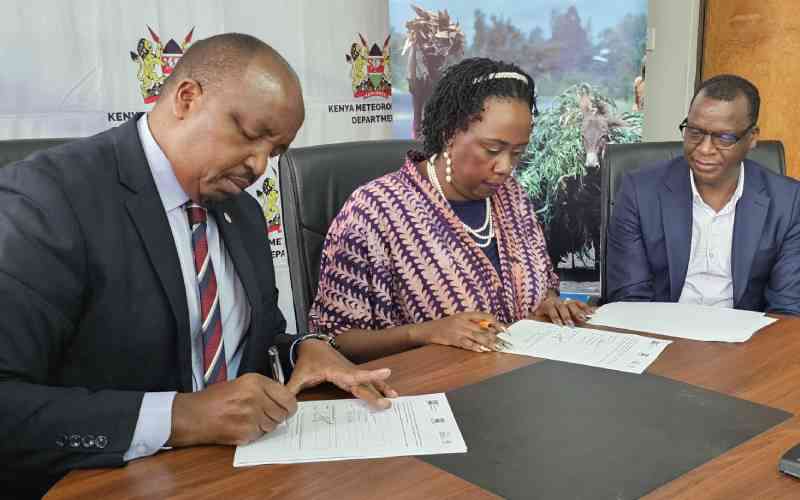
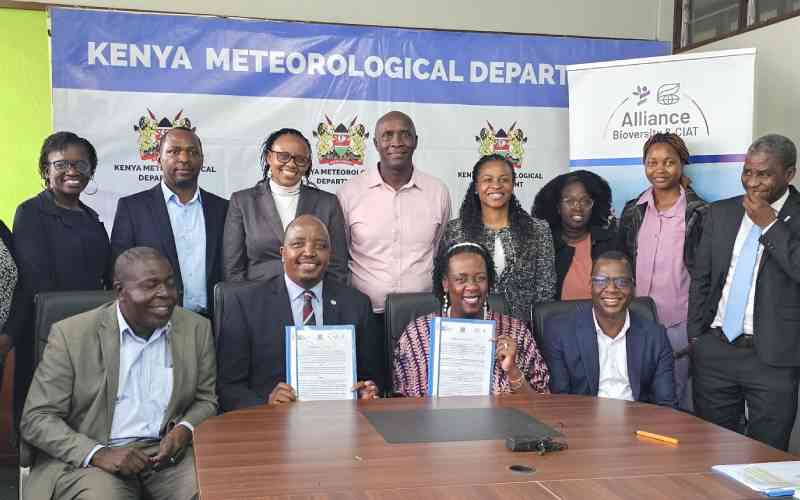
It is against this backdrop that the Alliance of Bioversity International and CIAT (The Alliance), the Kenya Meteorological Service Authority (KMSA) and the Institute for Meteorological Training and Research (IMTR) have signed a Memorandum of Understanding (MoU) to deepen collaboration in climate science, research, capacity building and the delivery of climate services.
The agreement, signed at IMTR in Nairobi on Tuesday, marks a renewed commitment to transforming climate science into practical solutions that support farmers, policymakers and communities in making informed decisions while strengthening resilience across Kenya and the wider African continent.
The partnership brings together the Alliance's expertise in agricultural research and sustainable food systems, KMSA's mandate to provide weather and climate information and early warning services, and IMTR's role as a regional centre of excellence in meteorological training.
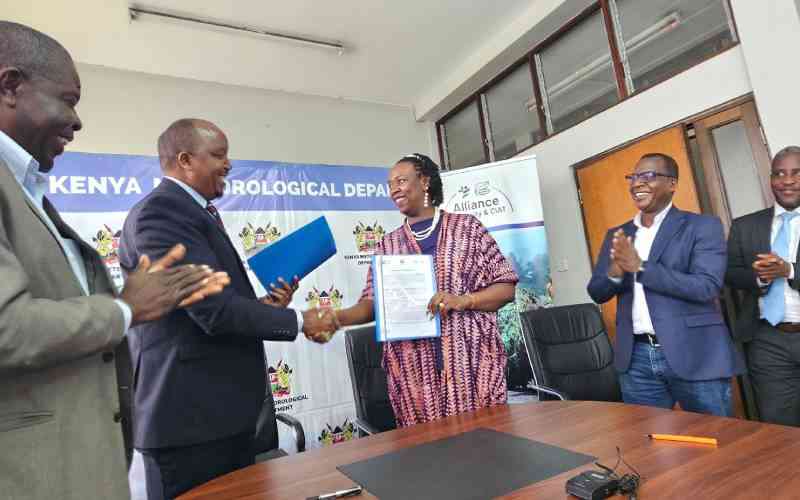
Jointly, the institutions will work to improve climate services, strengthen institutional capacity, advance research and innovation, and ensure reliable climate information reaches those who need it most.
The Alliance delivers research-based solutions that harness agricultural biodiversity to sustainably transform food systems while addressing the interconnected challenges of climate change, biodiversity loss, environmental degradation and malnutrition.
KMSA, operating under the Ministry of Environment, Climate Change and Forestry, provides timely weather forecasts, climate information and early warning services that protect lives, livelihoods and the environment.
IMTR, a branch of KMSA and a World Meteorological Organisation Regional Training Centre for Anglophone Africa, trains meteorologists, hydrologists and other geoscience professionals from Kenya and across the region.
Over the years, these institutions have jointly developed eight professional training curricula, strengthened Participatory Scenario Planning, produced a gender-responsive Cost-Benefit Analysis Toolkit for climate services, tested artificial intelligence-powered advisories for farmers and collaborated on innovative climate communication initiatives.
The new agreement expands this cooperation into climate research and modelling, artificial intelligence applications, curriculum development, digitisation of climate records, data stewardship, early warning systems, policy support, resource mobilisation and institutional capacity strengthening.
Speaking during the signing ceremony, the Alliance of Bioversity International and CIAT's Managing Director for Africa, Dr Wanjiru Kamau-Rutenberg, said the partnership is about ensuring scientific knowledge translates into practical action that improves lives.
"This MoU is about a question for Africa's future: how do we make climate science useful, trusted and powerful in people's lives?" She paused.
Dr Rutenberg noted that the success of climate services depends on answering the everyday questions facing farmers.
Stay informed. Subscribe to our newsletter
"A farmer does not wake up asking for climate information services but rather asks: Will the rains come? What should I plant? Can I trust this advice? That is the human question, one this partnership answers with institutions, trust and tools," she added.
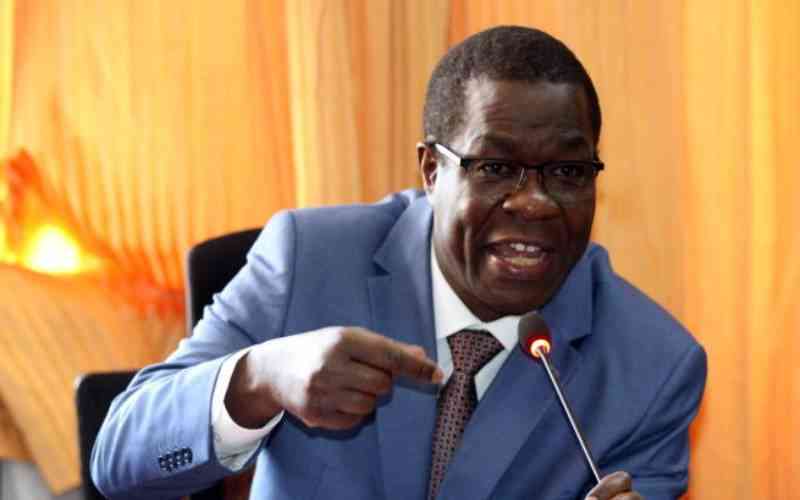
According to the Director of the Kenya Meteorological Service Authority, Edward Muriuki, the increasing frequency of extreme weather events makes collaboration more important than ever.
He said, "We may not do much about climate hazards, but we can do something about vulnerability."
Muriuki emphasised that the true value of climate science lies in ensuring information reaches communities in time to support decisions. "No matter how good the science or the department's capabilities are, they are of little use if they do not reach communities. We must leverage technology to ensure climate information reaches the last mile," he said
IMTR Principal Bernard Chanzu described the agreement as the formalisation of a partnership that has already demonstrated meaningful results.
"It is a sign of strengthening and working together to improve livelihoods. If we build the capacity of IMTR through this relationship, we are strengthening the entire institution and its contribution to the region," he said.
Implementation of the partnership will begin with a strong focus on training. “Already, plans are underway to train agricultural extension officers and county climate directors, equipping frontline practitioners with the knowledge and tools needed to translate scientific information into practical advice for farmers,” said Project Lead, Enhancing Climate Change Adaptation in East Africa (ECREA) Dr Desire Kagabo.
The initiative is expected to strengthen the link between climate research and agricultural extension services, enabling farming communities to better adapt to changing weather patterns while improving food security and resilience.
Additionally, the MoU also supports Kenya's Vision 2030 and the National Framework for Weather, Water and Climate Services by promoting wider access to timely, accurate and actionable climate information.
The partners believe the collaboration will strengthen climate resilience not only in Kenya but also across Africa through research, innovation, knowledge sharing and the development of skilled professionals capable of responding to an increasingly uncertain climate.





Subscribe to our newsletter and stay updated on the latest developments and special offers!







 join
join