×

The Standard e-Paper
Join Thousands Daily
 The Standard Group Plc is a
multi-media organization with investments in media platforms spanning newspaper
print operations, television, radio broadcasting, digital and online services. The
Standard Group is recognized as a leading multi-media house in Kenya with a key
influence in matters of national and international interest.
The Standard Group Plc is a
multi-media organization with investments in media platforms spanning newspaper
print operations, television, radio broadcasting, digital and online services. The
Standard Group is recognized as a leading multi-media house in Kenya with a key
influence in matters of national and international interest.

Audio By Vocalize
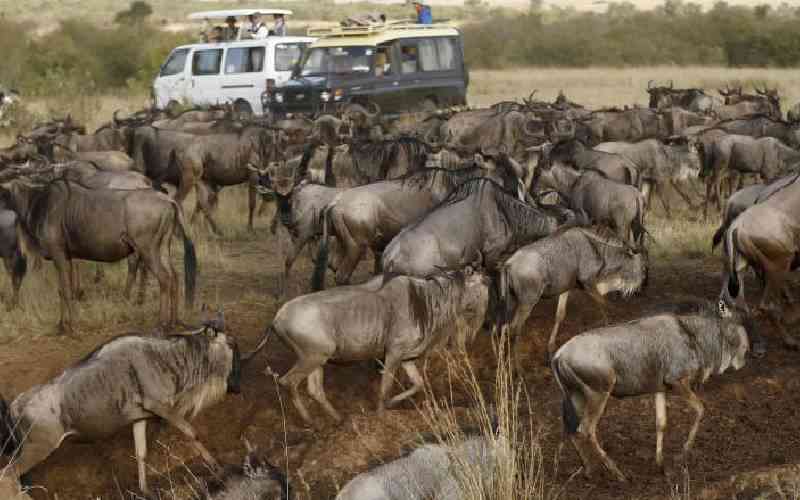
The annual wildebeest migration has officially begun at the Maasai Mara National Reserve.
The first herds crossed the Sand River from Tanzania's Serengeti National Park, marking the start of one of the world's most spectacular wildlife events.
The first crossing drew large crowds of tourists, international photographers, tour drivers, and safari guides eager to witness the iconic spectacle, widely regarded as the "Eighth Wonder of the Natural World."
Before the migration arrived, the reserve was in its traditional low-tourism season, as wildebeest and other grazers remained in the Serengeti for the calving period.
During this time, dramatic confrontations between lions and Cape buffaloes dominate the Mara's wildlife scene.
These high-stakes encounters represent one of the African savannah's most intense predator-prey relationships.
Lions target buffalo calves, the injured, isolated, or ageing adults, while buffalo herds aggressively defend their own, often rescuing members from lion prides and occasionally inflicting fatal injuries on the predators.
Buffaloes become a key food source for lions when the migration leaves the Mara, although hunts can last for hours or even days, with either side capable of emerging victorious.
With the migration's arrival, however, the focus shifts. For the next two months, lions, cheetahs, leopards, hyenas, and the Mara River's crocodiles will have an abundance of prey as thousands of wildebeest cross the reserve in search for fresh grazing.
The migration is also expected to provide a major economic boost to Narok County through increased tourism revenue.
This comes as Narok County's Executive Committee Member for Finance, David Ole Muntet, unveiled a budget projecting sh5.31 billion in Own Source Revenue (OSR) for the 2026/27 financial year, including tourism proceeds from the Maasai Mara.
Muntet said the revenue projections were based on detailed analysis of previous financial years, noting that the 2025/26 financial year experienced a decline in collections.
"This was primarily due to the Gen Z-led protests experienced in June 2025, followed by political campaigns and rallies related to the Narok Town Ward by-election. The resulting uncertainty disrupted tourism activities and led to a decline in visitor bookings to the Maasai Mara during the peak season, consequently affecting revenue collection," said Muntet.
Maasai Mara tour driver and guide Alex Ole Nkumum said he witnessed one of the first crossings involving mixed herds of zebras and wildebeest near the Ritz-Carlton Safari Lodge.
Stay informed. Subscribe to our newsletter
"I was among the first to witness the crossing. We expect millions more wildebeest to arrive throughout the week as the migration intensifies," said Nkumum
He said the herds are now moving towards the Mara River, where the migration reaches its dramatic climax as thousands of wildebeest brave crocodile-infested waters.
"The crossings will become more frequent, placing the Mara in both local and international focus. Tourists from across the world have been arriving since last week to witness the annual spectacle, meaning business will be booming here," he added.
Over the next two months, the wildebeest will roam the Mara's vast savannah before repeatedly crossing the Mara River between the western Mara Triangle and the eastern sections of the reserve, including the CIS Mara area, offering visitors multiple opportunities to witness dramatic river crossings.
The migration also attracts predators, including lions, cheetahs, leopards, and hyenas, creating spectacular wildlife encounters as the tall grass provides ideal cover for hunting.
Meanwhile, the Maasai Mara National Reserve management has warned tourists, tour drivers, and safari guides to strictly adhere to park regulations throughout the migration season.
Chief Park Warden Stephen Minis said more than 300 police reservists have been deployed across the reserve to enforce compliance, particularly at Major River crossing points.
Drivers found driving off designated roads or harassing wildlife will face an instant fine of Sh20,000 and a one-year suspension of their vehicles' access to the reserve.
"The county government, under Governor Patrick Ole Ntutu, has fully implemented the Maasai Mara Management Plan. This is the third migration season under the new regulations, and all drivers must comply with the established rules," Minis said.
The management plan introduced a zonation system comprising high-use zones, low-use zones, the Mara River Ecological Zone, and a buffer zone to better regulate tourism activities while reducing environmental pressure.
According to Minis, the Mara River Ecological Zone, which contains the main wildebeest crossing points and critical rhino breeding habitats, will receive enhanced protection, with tour guides required to strictly observe conservation regulations.
The reserve will continue operating seven entry gates: Sekenani, Talek, Musiara, Ololaimutiek, Sand River, Enoompuai, and Oloololo.
Visitors can also access the reserve by air through Keekorok, Olkiombo, Musiara, Mara Serena, and Kichwa Tembo airstrips. All visitors must obtain valid entry receipts before entering the reserve.
The county government has also capped hot-air balloon operations at six balloons per concession. Operators must obtain annual approvals from the Narok County Government, the Kenya Civil Aviation Authority, and the National Environment Management Authority before operating within the reserve.





Subscribe to our newsletter and stay updated on the latest developments and special offers!







 join
join