×

The Standard e-Paper
Join Thousands Daily
 The Standard Group Plc is a
multi-media organization with investments in media platforms spanning newspaper
print operations, television, radio broadcasting, digital and online services. The
Standard Group is recognized as a leading multi-media house in Kenya with a key
influence in matters of national and international interest.

Audio By Vocalize
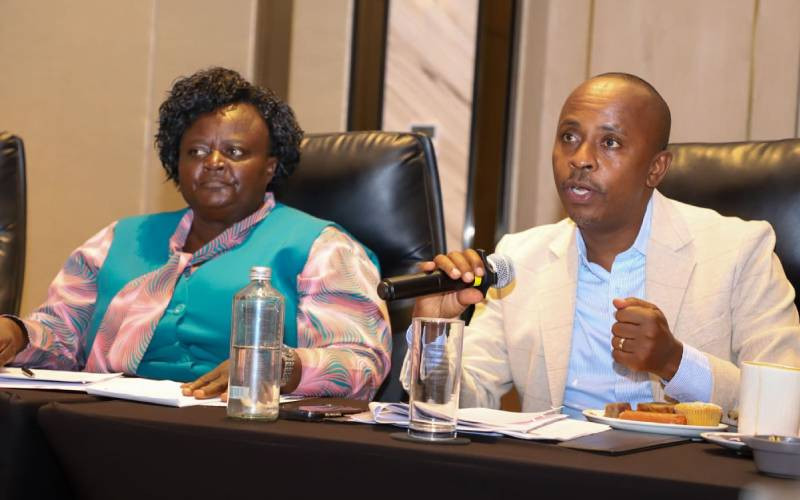
National Assembly Committee on Communication, chair John Kiarie Joyce Atieno Bensouda during a committee meeting examining Kenya's preparedness to regulate AI on November 27, 2026. [Elvis Ogina, Standard]
The Government has no dedicated budgetary allocation for Artificial Intelligence (AI), raising questions about the country's preparedness to regulate emerging technologies even as concerns mount over their potential misuse ahead of the 2027 General Election.
The Ministry of Information, Communications and the Digital Economy has admitted that the 2026/2027 national budget contains no specific funding for AI development, regulation and implementation, despite the Government's ambition of positioning Kenya as a regional technology powerhouse.
The funding gap could undermine the implementation of the Kenya National Artificial Intelligence Strategy 2025–2030, with the Ministry saying it will engage the National Treasury and development partners to mobilise resources.
The admission came as MPs raised concerns over the growing threat of AI-generated deepfakes, misinformation, data breaches, cybercrime, job losses and the possible extinction of indigenous languages.
Appearing before the National Assembly Committee on Communication, Information and Innovation, Principal Secretary John Tanui said the Government was developing a regulatory framework to address the emerging challenges.
He told the committee that the Draft Kenya AI and Other Emerging Technologies Policy would be submitted to Cabinet by December 2026, with work on an AI Bill expected to begin in January 2027 in collaboration with the Office of the Attorney-General.
The proposed law will address accountability, transparency, discrimination in automated decisions, human oversight and protection of personal information.
However, MPs questioned whether the Government had practical mechanisms to contain AI-generated misinformation, particularly during the 2027 election campaigns when fabricated videos, images and audio recordings could be used to damage reputations, intimidate political opponents and mislead voters.
Isiolo South MP Mohamed Tubi told the committee that politicians were already being targeted through fabricated images, warning that manipulated content could cause irreparable reputational damage before victims had an opportunity to respond.
The committee challenged the Ministry to move beyond policy formulation and establish effective monitoring and reporting systems across all 47 counties.
Members also called for closer coordination between ICT agencies, the Office of the Data Protection Commissioner and media organisations to enable citizens to report online abuses and have harmful content addressed.
Tanui warned that AI could be exploited to impersonate political leaders, spread misleading information and undermine public confidence in electoral processes.
He said the Government was working with the Independent Electoral and Boundaries Commission, Communications Authority of Kenya, National Cohesion and Integration Commission and law enforcement agencies to strengthen detection and investigation of manipulated digital content.
The Government is also seeking cooperation with technology platforms to improve reporting and removal of harmful material.
Stay informed. Subscribe to our newsletter
Committee chairman John Kiarie raised concerns about the dominance of English in AI development, questioning whether indigenous African languages could be marginalised as technology advances.
"What is the realistic possibility of the death of traditional languages and tongues in Kenya specifically, and in Africa, from your observation?" he asked.
Kiarie also demanded details of local AI innovations, ongoing research, public awareness campaigns and training programmes for government officers, questioning whether Kenya was adequately preparing its citizens for the technological transformation.
Data protection emerged as another major concern, with the chairman citing the reported breach involving the Business Registration Service and questioning how Kenya would handle investigations and lawsuits involving foreign technology companies.
"How are these lawsuits going to be managed, and what are your international dependencies in cooperation on such investigations when they arise?" he asked.
The Ministry maintained that foreign companies processing personal information belonging to Kenyans remained subject to the Data Protection Act, 2019.
Officials said the proposed regulatory framework would strengthen safeguards around sensitive biometric, financial and health information while requiring privacy protections to be incorporated into AI systems from the design stage.
Despite the regulatory and funding gaps, the Government disclosed that AI applications were already being deployed in public institutions.
The Kenya Revenue Authority uses its Shuru AI chatbot to support taxpayers through its WhatsApp filing service, while the Ministry of Health has deployed AI-assisted chest X-rays to improve tuberculosis detection.
The Kenya Meteorological Department is also piloting AI-assisted rainfall forecasting to support farmers, while Konza Technopolis hosts the SecureKE/Konza Sovereign Security Operations Centre, which uses AI-enabled analytics for round-the-clock cybersecurity monitoring and threat detection.
The Ministry said AI could further improve revenue collection, immigration processing, public procurement monitoring and law enforcement, while insisting that public institutions must remain accountable for decisions made through automated systems.
MPs also raised concerns about children's exposure to AI-generated sexual abuse material, cyberbullying, impersonation and online exploitation.
On employment, the Ministry proposed a sector-by-sector assessment involving the Labour Ministry, Kenya National Bureau of Statistics, employers and workers to establish how automation could affect jobs, earnings, working hours and recruitment, particularly at entry level.
It said digital skills programmes, including Jitume facilities and digital hubs, were being expanded to equip young people with skills needed to participate in the digital economy.







Subscribe to our newsletter and stay updated on the latest developments and special offers!