×

The Standard e-Paper
Kenya’s Boldest Voice
 The Standard Group Plc is a
multi-media organization with investments in media platforms spanning newspaper
print operations, television, radio broadcasting, digital and online services. The
Standard Group is recognized as a leading multi-media house in Kenya with a key
influence in matters of national and international interest.
The Standard Group Plc is a
multi-media organization with investments in media platforms spanning newspaper
print operations, television, radio broadcasting, digital and online services. The
Standard Group is recognized as a leading multi-media house in Kenya with a key
influence in matters of national and international interest.

Audio By Vocalize
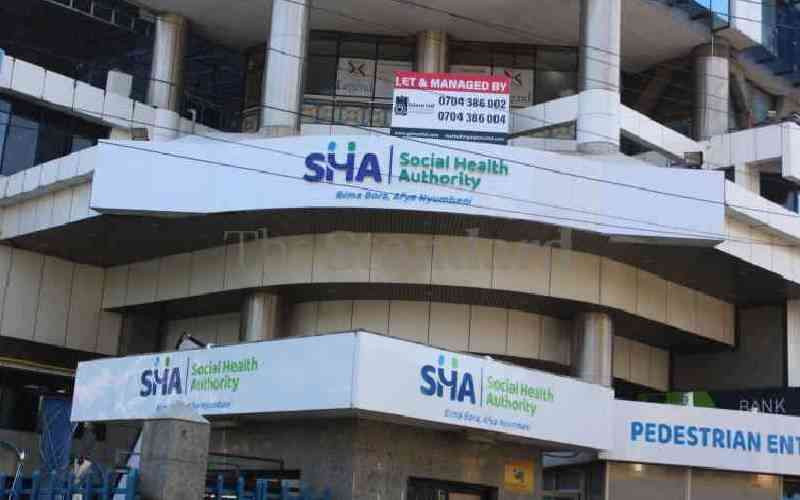
The Social Health Authority (SHA) is set to meet with private and faith-based hospitals to reach a consensus on a disputed new contract.
The meeting is set for tomorrow
SHA leadership will meet associations of hospitals, namely Christin Health Association (CHAK), SUPKEM, Kenya Association of Private Hospital (KAPH) and Rural Urban Private Hospitals Association of Kenya (RUPHA).
Insiders hinted to The Standard that the meeting will focus on the 2026/27 contract cycle, christened known as HAKIKA.
“Our meeting is purely aimed at focusing on the contract. We are meeting SHA leadership to submit our concerns,” said an insider representing the association consortium leadership.
The consortium has listed about 40 items in the submission set to be presented to SHA leadership during the engagement.
“We have listed around 40 items for them to internalise, and feedback is still being collected. As a consortium of healthcare associations, we are presenting them our submissions; they have it,” added the insider.
Among contentious issues in the submission are forcing hospitals to carry financial burden when SHA delays payment of claims.
In the contract, expected to be actualised on October 1, SHA makes the obligation subject to the availability of resources in the relevant Fund and appropriation of Funds by the National Assembly.
Even with the obligation, hospitals are warned against charging patients.
Hospitals question why SHA dictates payment, yet the majority of patients treated are required to register and pay 2.75 percent for salaried one to enjoy Social Health Insurance Fund (SHIF) services.
“In the contract, SHA states clearly that payment shall be made within 90 days of claims submission. Remember, most patients are SHA members, so if they do pay, why then should we be subjected to having reimbursement done at availability of funds?” posed the source.
“We shall not be forced to get into contracts whereby SHA decides when to pay or when to. We expect payment to be issued within set timelines. Why should we be subjected to availability of funds,” added the insider.
In the submission, the consortium want SHA to allow them to charge patients for services issued when money is not available, or have SHA services suspended, to prevent them from running into losses that have been experienced in the past.
Stay informed. Subscribe to our newsletter
The hospitals have also strongly challenged claims auditing provision, which they say could result in deductions being applied beyond individual claims found to have errors.
The hospitals' concern is that where a sample of claims shows errors, SHA can extrapolate the error rate to a wider batch and deduct the corresponding amount.
“That is illegal, definitely. You can't approximate accounting. Accounting is exact. You cannot say you are going to estimate a penalty, or a surcharge; it is not proper. No one does that ever,” said sources.
According to hospitals, if SHA is set to surcharge a facility, they need to have evidence with a basis, and not an approximation.
With the clause in the contract, SHA assumes that hospitals will always have errors in their operations, therefore imposing deductions.
But hospitals have maintained that the deductions are illegal, and are not listed in the Social Health Insurance Act 2023, nor in SHA General Regulation tied to SHA hospital contracting.
On Thursday, hospitals held a meeting with SHA leadership ahead of the official launch of the contract cycle, they did not arrive at a consensus.
According to the sources, hospitals participated in the launch of the contract cycle, “but it was just for the launch, nothing much”.
“We attended the launch, just as invited because we are SHA service providers. We did not attend because we agree with SHA on the contracts,” added the source.
But on Friday, Health CS Aden Duale directed hospitals to sign the contract by October 1, 2026.
The CS welcomed negotiations, saying the new e-contracting system is aimed at transitioning hospitals from transactional towards partnership.
Duale gave hospitals at least 12 days to sign the contracts.
However, while engaging hospitals, Duale warned that such a move should not lower set standards in the contract.
The SHA contract as it is according to the consortium, will render hospitals bankrupt, saying they are required to procure commodities for treating patients, and pay employees providing service.
Previously, hospitals have been at loggerheads with SHA over unpaid claims, with some being forced to close because of mounting debts.
Public hospitals also had unpaid SHA claims running into billions of money, among the Kenyatta National Hospital (KNH) and Moi Teaching and Referral Hospital (MTRH).
The Standard visited a number of public and private hospitals which had been forced to limit services following accumulated SHA claims.
Previously, there has been disputes over payment of claims, processing of claims with hospitals accusing SHA of taking too long for approval, while rejecting most running into millions, without explanation.
The authority has also reported cases of fraud, with some hospitals accused of cheating the system to steal taxpayers' money.
According to SHA, delay payment is linked to incomplete and inaccurate claims submitted by hospitals.
On her part, SHA CEO Dr Mercy Mwangangi has maintained that the contract shall ensure patients get quality care, in actualisation of Universal Health Coverage (UHC).
SHA is the vehcile to realisation of UHC, an initiative aimed at ensuring all Kenyans receive quality care, regardless of their financial power.






Subscribe to our newsletter and stay updated on the latest developments and special offers!








 join
join