×
App Icon
The Standard e-Paper
Home To Bold Columnists
★★★★ - on Play Store
Read on the App

Resounding success: How new surgery at KNH is restoring children's hearing

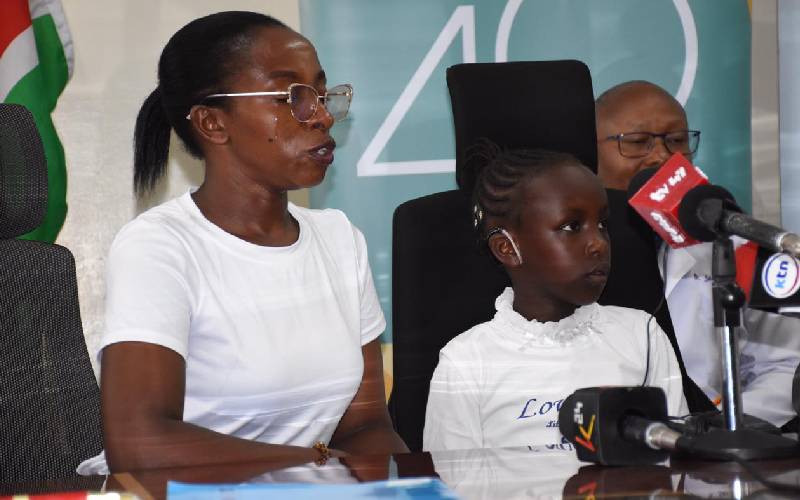
Winket Wambui and her daughter, Goretti at KNH for cochlear implant switch-on, on January 14, 2026. [Maryann Muganda, Standard]

At Kenyatta National Hospital (KNH), Winket Wambui, aka Mama Goretti, sits quietly in a boardroom, surrounded by doctors from the Ear, Nose and Throat (ENT) department.

Beside her, holding her hand tightly, is her seven-year-old daughter, Goretti. The child’s face is calm, almost expressionless, but her mother’s eyes are wet with tears, tears she admits are not of pain, but of overwhelming joy.
For years, Mama Goretti has had to be strong. Too strong, she says. On this day, however, she allows herself to cry in public for the first time.


Goretti has a hearing impairment and is among 50 children whose lives have been transformed through cochlear implant surgeries conducted at KNH between November 3 and 7, 2025. Earlier, in June 2023, Goretti received her first cochlear implant.

In January 2026, she returned to the hospital to receive her second implant and to have the devices “switched on” the moment when sound enters a child’s world for the first time.

“Before, I had to go with her everywhere,” Mama Goretti recalls. “If I left her behind, she couldn’t communicate. I had to tell my other two children to always watch where she was going.”

The journey has been long and emotionally draining. It began in 2022 when Goretti was diagnosed with profound hearing loss. The family first tried hearing aids, at a cost of about Sh100,000, but they offered little improvement.

Doctors then advised cochlear implantation a highly specialised intervention costing up to Sh2.7 million in Kenya.

“It was a dark time for our family,” Mama Goretti says. “I could not believe the cost. I kept asking myself where such money would come from.”

Today, Goretti can now call out her mother’s name. She can recognise her siblings’ voices. She is enrolled in a regular school, in PP2, and has learned to write her own name a milestone that once seemed impossible.

“She is now going to a normal school,” Mama Goretti says. “If you take such a child to a special school when they can hear and speak, they may not develop speech fully. She needs to interact with other children.”

Her advice to parents starting the cochlear implant journey is simple: ignore the negativity.

“People will tell you it will not work. They will say it takes too long,” she says. “Do not listen. Progress comes slowly, but it comes.”

According to Dr Samuel Nyagah, Head of the ENT Department at KNH, the recent cochlear implant programme marks a historic moment not just for the hospital, but for Kenya’s public health system.

“A cochlear implant is a highly specialised device for people with severe to profound hearing loss, especially those who cannot benefit from conventional hearing aids,” Dr Nyagah explains.

“What we have done here has never been achieved before in a public hospital in Kenya.”

The programme involved implanting cochlear devices in 50 children, followed by weeks of healing before the critical “switch-on” phase.

During switch-on, audiologists activate and programme the device to begin stimulating the auditory nerve.

“When we switch on the device, it is like day one of life,” Dr Nyagah says. “It is as if the child is being born again. The children we are switching on today are being born into sound.”

He emphasises that surgery is only the beginning. Long-term success depends on audiologists, speech therapists, and, critically, the cooperation and commitment of parents.

Explaining what happens after surgery, Mina Abdo, a Cochlear Clinical Technologist, said the implant operation is only the beginning of a long and carefully managed journey.

“We are very grateful for the opportunity and the strong support that has enabled these milestones at Kenyatta National Hospital,” Abdo said. “The surgery has been done, but now a new journey begins the journey of switch-on.”

According to Abdo, the switch-on involves fitting the child with an external sound processor that converts sound into electrical signals that stimulate the auditory nerve.

“The processor is attached externally, and that is what we activate during switch-on,” he explained.

“Once it is connected to the internal implant, we begin creating what we call a map a customised programme that introduces sound to the child gradually over the next few months.”

The process is deliberately slow and cautious. “At the beginning, we introduce sound at the most comfortable level,” Abdo said. “Our first priority is to confirm that the implant placed during surgery is functioning properly and that the internal and external components are communicating well.”

Once that is confirmed, audiologists programme the processor with four sound levels Programme 1 through Programme 4 which are adjusted weekly.

“The volume increases gradually because the brain needs time to adapt,” she said. “Some of these children have never heard before. For them, this is their very first experience with sound.”

The reactions, he noted, vary widely.

“Some children cry because the sound is unfamiliar. Others smile or laugh. Some appear shocked. All of this is normal,” Abdo said.

“By the time they reach Programme Four, many are able to hear at near-normal levels.”

Speech therapy begins immediately after switch-on to help children learn how to interpret sound, develop listening skills, and eventually acquire speech.

“This is not an instant process,” he emphasised. “It takes time, patience, and commitment from parents and caregivers. But it is how we give these children the opportunity to develop speech and language.”

Demonstrating the technology, Abdo explained that the processor works much like a miniature computer.

“This device converts sound into electrical signals, which are then transmitted to the implant inside the body,” she said. “It is worn behind the ear, similar to a hearing aid, and uses a battery to function.”

A coil connected to the processor rests on the scalp, held in place by a magnet over the implanted device.

“This external part is what people see when they look at a cochlear implant recipient,” she said. “It is small, but it does all the work that allows the child to hear and engage with the world.”

On Wednesday, 12 children had returned to KNH for their switch-on sessions each one beginning a new chapter of sound and communication.

Dr Nancy Kemunto, an audiologist at KNH, explains that the switch-on process is gradual and carefully monitored.

“For children receiving a cochlear implant for the second time, the process is easier because they are already familiar with the device,” she says. “For first-timers, it takes longer, as each component is delicate. If any part is not connected correctly, the device may not work or could be damaged.”

During the session, the audiologist carefully arranges and explains all the components to the child and parent.

The processor the external part of the cochlear implant uses two types of batteries: a rechargeable battery and a disposable cell battery.

For demonstration purposes, the cell battery is often used because rechargeable batteries may not be fully charged.

“At first, the child does not hear sound as we do; they may only feel vibrations,” Dr Kemunto says. “We start with very soft volumes and increase them gradually over several weeks.”

Each child is assigned several sound programmes, adjusted progressively to allow the brain to adapt to new auditory input. Parents are also trained on proper device care, including battery management and using a drying kit to protect the processor from humidity and prevent damage.

 “The brain is amazing,” Dr Kemunto says. “It takes time, but it learns to interpret these electrical signals as sound.”

Speech therapists then take over, helping children develop listening skills, speech and language abilities that were delayed due to hearing loss.

“Hearing and listening are not the same,” KNH Speech Therapist Nicholas Samora explains. “We teach the child how to listen. From there, language and speech begin to grow.”

KNH Chief Executive Officer Dr Richard Lesiyampe describes the programme as a powerful example of what collaboration can achieve.

“This was made possible through partnerships with the Office of the First Lady, Mama Rachel Ruto, and the Her Highness Princess Lalla Asmaa Foundation of the Kingdom of Morocco.”

The surgeries were covered by the Social Health Authority (SHA), while the cochlear devices were donated.

“This is not a one-off achievement,” Dr Lesiyampe says. “It is proof that our public health system can deliver complex, specialised care when supported.”

He acknowledges, however, that the high cost of cochlear devices remains a barrier for many families and calls for continued support from donors and partners.