×

The Standard e-Paper
Stay Informed, Even Offline
 The Standard Group Plc is a
multi-media organization with investments in media platforms spanning newspaper
print operations, television, radio broadcasting, digital and online services. The
Standard Group is recognized as a leading multi-media house in Kenya with a key
influence in matters of national and international interest.

Audio By Vocalize
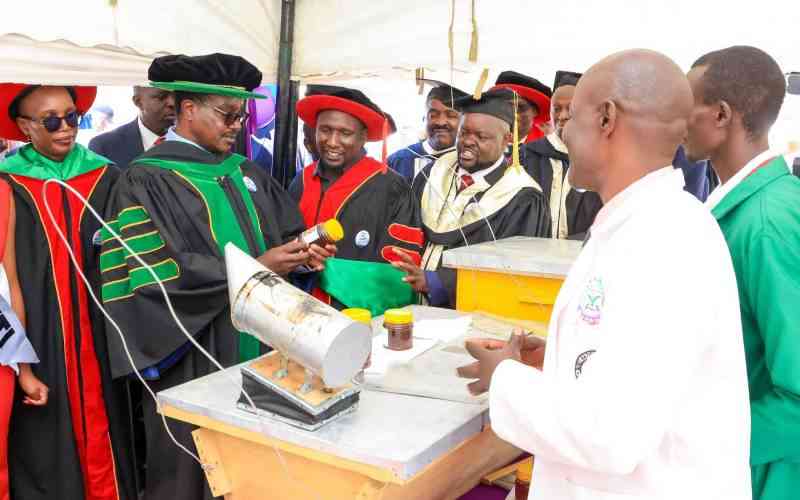
Education Cabinet Secretary Julius Ogamba admire products by Bureti National Polytechnic graduands during 2nd Graduation ceremony November 20, 2026. [Courtesy].
African education systems have been urged to equip learners with lifelong skills, including technical, digital and entrepreneurial competencies, to prepare them for diverse employment opportunities beyond university education and formal jobs.
The call is contained in a new Mastercard Foundation report titled ‘Secondary Education in Africa: Expanding Pathways to Work, Livelihoods, and Lifelong Learning,’ which advocates for secondary education that responds to the changing demands of the labour market.
Institutions’ Chief Executive Officer Sewit Ahderom said secondary education represented a critical opportunity to prepare young people for economic participation, particularly because many learners do not proceed to higher education.
“Education for today's young people, especially at the secondary level, must lead somewhere. For most young Africans, secondary school is the last time a system reaches them at scale,” Ahderom said.
The report comes as Kenya's pioneer Competency-Based Education (CBE) senior school cohort, comprising approximately 1.13 million learners, prepares to enter its second year after transitioning to Grade 10 in January 2026.
The learners were placed in three pathway-based approach aligns with the need to prepare young people for multiple job opportunities of Science, Technology, Engineering and Mathematics (STEM), Social Sciences, and Arts and Sports Science.
More than half selected STEM, with a March baseline study by CEMASTEA showing that over 95 per cent of those who chose the pathway intend to pursue it beyond senior school.
Launched in Accra, Ghana, on November 24 attended by education ministers from Ghana, Liberia, Rwanda and Sierra Leone, the report highlights the changing nature of employment and the need for African countries to rethink the relationship between education and work.
The report estimates that more than 10 million young Africans enter the labour market annually, yet only approximately three million formal jobs are created, leaving millions to pursue alternative sources of income.
It notes that employment opportunities are increasingly shifting from agriculture towards services, while artificial intelligence, digital platforms and climate change are transforming traditional occupations and creating new areas of economic activity.
The report urges governments to expand education to include self-employment, entrepreneurship, technical trades, digital work, green jobs, care services and creative industries.
Daniel Hailu, Interim Chief Programme Officer at the Mastercard Foundation, said education systems must acknowledge that young people would follow different routes into adulthood and employment.
“Secondary education can no longer be organized around one assumed destination or a single, predictable transition from school to work. Instead, it must help young people to navigate multiple pathways,” Hailu said.
He added that secondary education remained Africa's main platform for preparing young people for employment but required significant reforms to respond to changing economic realities.
Stay informed. Subscribe to our newsletter
Kenya is among the countries highlighted for taking steps towards aligning its education system with emerging labour market demands, recognizing the curriculum reforms, including the removal of the primary school leaving examination in 2023 and the introduction of a new Grade 9 assessment in 2025 as part of the competency-based reforms.
It also identifies computer programming in secondary education and the integration of green skills as important developments in preparing learners for future opportunities.
However, the transition to specialised senior school pathways presents significant implementation challenges.
Uneven distribution of infrastructure, inadequate specialised equipment, teacher preparedness and capitation funding remain concerns, particularly as schools seek to provide practical learning experiences across the three pathways.
The report places teachers at the centre of successful education reforms, warning that curriculum changes alone cannot deliver the desired outcomes without investment in teacher preparation, professional development and school leadership.
“Teachers turn ideas on paper into something a young person experiences in real life, and we need to back them,” Ahderom said.
Ghana's Free Senior High School policy was cited as an example of expanding access to secondary education.
Ghana's Education Minister, Haruna Iddrisu, said the next priority was ensuring that increased enrolment translated into meaningful learning outcomes.
“Through Free Senior High School, we have opened the doors of secondary education to hundreds of thousands more young people. But this report reminds us that access is the beginning, not the end. Whether access translates into learning depends largely on one of our greatest assets – teachers,” Iddrisu said.
Ghana's National Entrepreneurship and Innovation Programme was hailed for providing young entrepreneurs with training, mentorship and access to financing, demonstrating the importance of connecting education with practical economic opportunities.
The report also identifies progress across the continent since the first edition was published in 2020 with secondary school enrolment increasing from approximately 95 million to more than 110 million learners in 2024, while lower-secondary completion rates rose from 40.5 per cent in 2015 to 47.7 per cent in 2024. Gender disparities in access to education have also narrowed considerably.
However, the continent faces mounting pressure to expand opportunities as more than 330 million young people in Sub-Saharan Africa are expected to reach working age by 2035, a figure exceeding the combined number in the rest of the world.
The African Union's Continental Education Strategy for Africa (CESA 2026–2035) similarly emphasises foundational, socio-emotional and labour-market-ready skills, lifelong learning, teacher development and stronger school leadership.
African Union Commissioner for Education, Science, Technology and Innovation Professor Mohamed Belhocine said the strategy recognises education's wider responsibility in responding to digitalisation, artificial intelligence, climate change and emergencies.
He described CESA 2026–2035 as a framework for transforming African education systems into vehicles for equity, innovation and sustainable development.



Subscribe to our newsletter and stay updated on the latest developments and special offers!