×

The Standard e-Paper
Fearless, Trusted News
 The Standard Group Plc is a
multi-media organization with investments in media platforms spanning newspaper
print operations, television, radio broadcasting, digital and online services. The
Standard Group is recognized as a leading multi-media house in Kenya with a key
influence in matters of national and international interest.
The Standard Group Plc is a
multi-media organization with investments in media platforms spanning newspaper
print operations, television, radio broadcasting, digital and online services. The
Standard Group is recognized as a leading multi-media house in Kenya with a key
influence in matters of national and international interest.

Audio By Vocalize

Universities across the region have been challenged to strengthen partnerships with industry and transform academic research into practical solutions that drive economic growth, innovation and regional development.
Speaking during the opening of the 17th Inter-University Council for East Africa (IUCEA) Annual Conference in Nairobi, Cabinet Secretary for Education Julius Ogamba said higher education institutions must move beyond their traditional role of producing graduates to becoming engines of innovation and enterprise.
Addressing delegates from universities, governments, development partners and the private sector, Ogamba emphasized that the future of East Africa depends on universities that connect knowledge with industry, research with commercial opportunities and innovation with societal needs.
"The challenge before us is therefore not a lack of talent. It is the need to build stronger bridges between knowledge and enterprise, between discovery and deployment, between research and revenue, and between universities and the industries they are meant to serve," he said in a speech read on his behalf by Higher Education PS Dr Beatrice Inyangala.
The three-day conference is being held under the theme, "Powering the Future of Higher Education in East Africa through Strategic Partnerships and Collaborations," bringing together stakeholders to discuss the future of higher education in the region and launch a new IUCEA Strategic Plan that will guide the bloc through 2031.
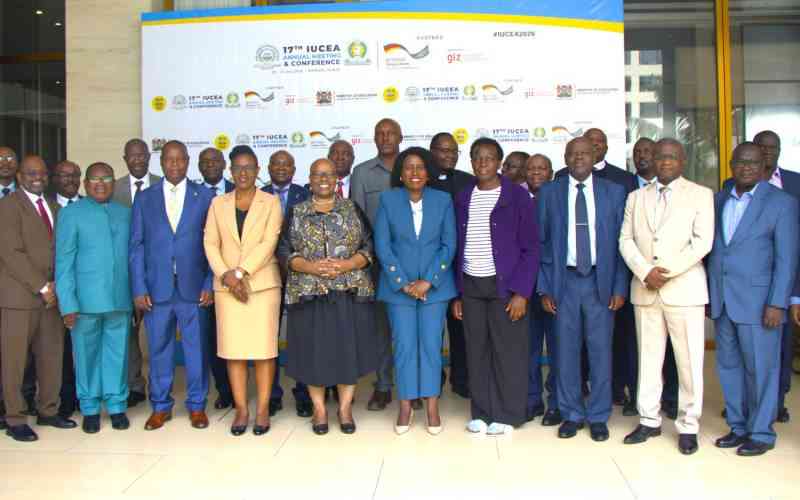
From 5th Right, PS Higher Education Dr Beatrice Inyangala, Prof. Rose Clarke Nanyonga, Chairperson executive committee of the IUCEA, Annette Ssemuwemba, Deputy Secretary General, East African Community joins other delegates in the conference on July 29, 2026. [Mike Kihaki, Standard].
Ogamba said universities should no longer operate as isolated academic institutions but as active partners in solving pressing regional challenges.
He called for closer collaboration between academia, governments and industry, arguing that such partnerships are essential for creating jobs, improving competitiveness and accelerating industrial transformation.
"Universities cannot remain ivory towers disconnected from the realities of the marketplace, nor can industry continue to view universities merely as suppliers of graduates. The future belongs to ecosystems where academia, government and industry innovate together," he said.
He noted that leading universities around the world have succeeded by commercializing research, supporting innovation and creating industries, rather than limiting themselves to teaching and publishing academic papers.
The Cabinet Secretary urged universities to provide students with practical opportunities to work alongside industry in developing solutions to real-world challenges. He cited engineering, agriculture, healthcare and artificial intelligence as sectors where collaboration could produce significant benefits for the region.
According to Ogamba, engineering students should contribute to smarter manufacturing systems, agricultural researchers should develop climate-smart technologies to improve food security, while medical researchers should work closely with hospitals to enhance healthcare delivery.
He also encouraged universities to establish partnerships that harness artificial intelligence to develop African solutions for African challenges.
He acknowledged encouraging progress across the region, including the establishment of innovation hubs, incubation centres and technology transfer offices in several universities. Students, he noted, are increasingly developing digital platforms, health technologies, fintech products and climate-smart agricultural innovations.
However, he stressed that these initiatives require stronger support from governments, private investors, venture capital firms and development partners to achieve meaningful impact.
Stay informed. Subscribe to our newsletter
Beyond innovation, Ogamba highlighted the importance of regional integration in higher education.
He said the vision of an East African Common Higher Education Area extends beyond harmonizing academic qualifications to creating an integrated ecosystem where students, researchers and ideas move freely across borders.
"Our aspiration is not simply to harmonise qualifications or facilitate student mobility. It is to create a genuinely integrated higher education ecosystem where knowledge, innovation, research and talent move seamlessly across our borders," he said.
He observed that while university enrolment and research collaboration have expanded significantly over the past two decades, progress remains uneven.
Some institutions are embracing digital learning, artificial intelligence and innovation ecosystems, while others continue to struggle with inadequate infrastructure, limited research funding, quality assurance challenges and graduate employability.
Ogamba warned that such disparities risk creating "islands of excellence surrounded by oceans of disparity," underscoring the need for stronger regional cooperation.
He reminded participants that no single institution or government can transform higher education alone.
"No university, however prestigious; no government, however committed; no industry, however innovative, can transform higher education alone. The universities that will define the twenty-first century will not be those that work in isolation. They will be those that build partnerships, create solutions and transform economies. ," he said.






Subscribe to our newsletter and stay updated on the latest developments and special offers!





 join
join