×

The Standard e-Paper
Kenya’s Boldest Voice
 The Standard Group Plc is a
multi-media organization with investments in media platforms spanning newspaper
print operations, television, radio broadcasting, digital and online services. The
Standard Group is recognized as a leading multi-media house in Kenya with a key
influence in matters of national and international interest.
The Standard Group Plc is a
multi-media organization with investments in media platforms spanning newspaper
print operations, television, radio broadcasting, digital and online services. The
Standard Group is recognized as a leading multi-media house in Kenya with a key
influence in matters of national and international interest.

Audio By Vocalize
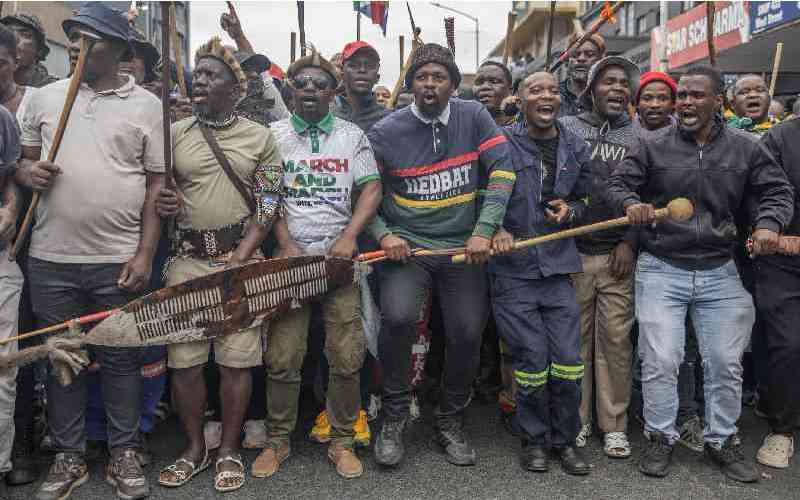
Members of the Zulu regiment known as the ‘Amabutho’ during a demonstration by the "March and March" movement marking an unofficial deadline for undocumented foreign nationals to leave South Africa in Durban, on June 30, 2026. [AFP]
I wake up daily, older and sadder, but also wiser. The poet Samuel Taylor Coleridge (1772-1834) taught me that the burden of experience compels us to tell our story, so that others may learn from it.
The one profound question is about solidarity. What happens to solidarity after victory? You see, in the 1980s, as I have recalled before, we were strident youth at the University of Nairobi, bearing revolutionary placards in the streets of the city. “Down with Apartheid,” they proclaimed, “Release Mandela!”, “Azania is our commitment!”
We braved police tear gas, believing with the confidence of youth that history can tilt towards justice. We skipped meals, to contribute a few shillings towards the ANC. South Africa’s freedom was not just their affair. It was a collective African business. But we graduated before Mandela could walk free from the dungeons of Apartheid.
Life happened, sometimes rather fast. Some comrades became big shorts in government. Others found comfortable offices in the corporate world we had denounced as imperial capitalism, friends of Apartheid. My own “revolutionary radicalism” received a wakeup call from practical encounters with Eric Honecker’s East Germany and Tanzania’s Ujamaa, soon after graduation.
Certainties surrendered to questions. I moved into the middle house, where realism resides. I was now neither a revolutionary nor a cynic. Just a moderate protester; a realist who is nonetheless persuaded that justice matters. Yet, as I see African visitors clobbered in South Africa today, with apparent support – if not the prompting – of Cyril Ramaphosa’s government, I cannot help asking, did we go hungry for nothing? Was Azania a fatter illusion than I have come to accept?
South Africans are angry at African foreigners. They accuse them of taking up their jobs. Their President says they have a just cause. The Mandela Foundation is silent. The Sisulu Foundation, too. Only Thabo Mbeki has spoken out, but Mbeki sits in the fringes of things South African. Yes, each state has the right to regulate migration. But must it subcontract immigration policy to mobs and goons?
I ask well aware that Africa is fast morphing into a continent running on the gas of goons. In my own country, the police and goons take turns to escort and protect each other during public events. Yet, I must still ask, where did we go wrong? We regarded the anti-Apartheid struggle as a continental duty. We refused to watch from afar. We marched, organised, raised money, and dared the police. All this was because we believed that South Africa’s freedom was Africa’s own. It was my own freedom. The struggle was a shared investment that created shared expectations. Future moral institutions and heirs to leadership would defend African solidarity, we thought. Hence, when these voices are silent during xenophobia, and others say, “They have a just cause,” we must wonder whether the silence is not a loud complicit voice.
Are the Mandela and Sisulu foundations complicit in the Africa against Africa hate and violence in South Africa?
Has Ramaphosa commissioned immigration policy management to mobs? Is he conscious of the fact that South African capital has lodged itself in every village in Africa? Its manufacturers and retailers fill South African shopping malls, from Dar to Dakar; and from Accra to Harare and Nairobi. Its banks are everywhere in Africa. Africa has created millions of jobs for South Africans back at home.
Yes, Africa is keeping South African manufacturing and agricultural sectors alive, healthy and well. We have welcomed South African farm produce and factory goods with the same generosity that enlisted us in the struggle against Apartheid.
Yet, if South African capital finds Africa, South Africans are less welcoming to Africa. Their goods arrive in Emanyulia with applause. But the Emanyulian enters Johannesburg on suspicion.
Another poet, William Butler Yeats (1865-1939), warned, “Too long a sacrifice can make a stone of the heart.” I wake up daily to the reality that people are not ennobled by their finest moments. The story of freedom must be told to every new generation. Ramaphosa and South Africa’s iconic foundations have their duty to their new generations. Witnessing what I witness today, would I march again? I suspect I would. Not because South Africa has become the country we imagined. Apartheid was evil. Wicked. It had to go, and we all had a duty to make it go; like all bad and wicked regimes must go. Conscience has no finishing line. Azania must remain a vision we aspire towards, at home and away. I may be older, sadder, and wiser. But, I am not defeated. We must continue to hope.
- Dr Muluka is a strategic communications adviser. www.barrackmuluka.co.ke
Stay informed. Subscribe to our newsletter


Subscribe to our newsletter and stay updated on the latest developments and special offers!







 join
join