×
App Icon
The Standard e-Paper
Kenya’s Boldest Voice
★★★★ - on Play Store
Download App

Why drought response and peace efforts should go hand in hand

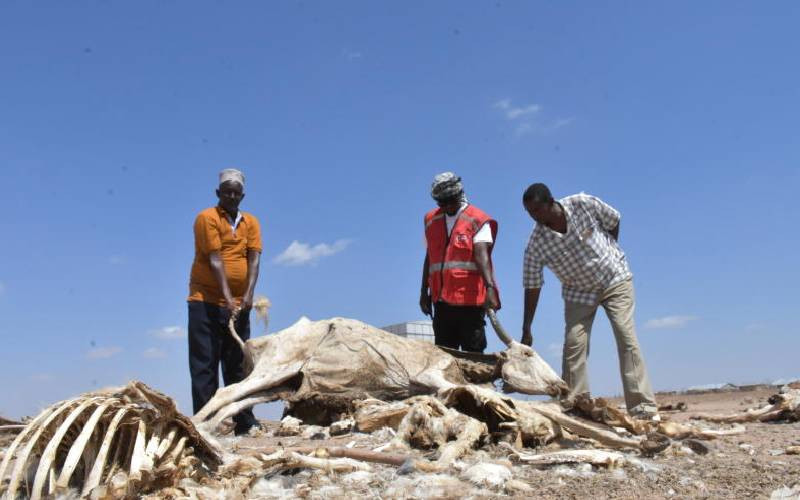
Mzee Abdulahi Tadicha and Kenya Red Cross staff lift the carcass of livestock in Korbesa Village, Isiolo North Sub-County, on February 20, 2023. [File, Standard]

The arid and semi-arid lands (ASALs) are once again confronting the familiar pressures of drought. Rainfall variability, rising temperatures, and recurrent dry spells are constraining access to water and pasture across vast landscapes that sustain millions of livelihoods. What is often under-acknowledged is that drought in the ASALs is not only a humanitarian or environmental challenge, but also a peace and stability concern.

Across the region, drought consistently shapes movement patterns, resource use, and social interaction. As pasture and water decline, communities move farther and more frequently in search of survival. Livestock cross administrative boundaries, grazing systems overlap, and pressure on shared resources intensifies. When these stresses are not managed early, they can escalate into conflict, displacement, and insecurity.

Climate change is intensifying both the frequency and severity of droughts, with many ASAL counties now experiencing droughts at intervals shorter than five years. As dry periods become longer and recovery windows shorter, competition over scarce rangeland resources becomes more frequent, more prolonged, and more volatile. In this context, effective drought response is inseparable from peacebuilding.


Peace is therefore a critical anticipatory and early action in minimising the impacts of drought. It underpins investment, development, and the sustainability of pastoral livelihoods, including mobility for trade and access to shared resources. Without dialogue, negotiated access, and cooperation, even well-resourced drought responses struggle to deliver lasting impact. Insecurity restricts mobility, damages productive assets, and erodes trust at precisely the moment when cooperation is most needed. This is why the government prioritises peace not as a secondary outcome of stability, but as a core drought coping strategy.

Across many ASAL counties, community-based peace dialogue mechanisms play a quiet but decisive role in managing drought stress. Peace committees, grazing committees, elders, women, and youth leaders negotiate grazing arrangements, agree on migration routes and convergence zones, manage access to water points, and resolve disputes before they escalate.

The dividends are even higher when these structures are supported and linked to county and national coordination systems. When peacebuilding is approached as a proactive resilience investment, informed by risk analysis and early warning signals, the results are tangible. There are fewer clashes, safer livestock movements, and more predictable use of shared resources, particularly along major pastoral corridors where multiple counties and communities converge on shared ecosystems.

The Garissa-Isiolo-Meru corridor is one such landscape. It is a vital livestock movement route and drought fallback area, as well as an economic artery supporting pastoral livelihoods. It is also a corridor where drought-related pressures, if poorly managed, can quickly spill into conflict. Historically, declining pasture and water availability in this area have led to heightened tensions during prolonged dry seasons. Yet it is also a landscape with strong traditions of negotiated access and locally rooted peace agreements. When dialogue is prioritised and agreements are respected, communities are able to share rangeland resources, protect livestock, and maintain social cohesion even under severe stress.

The Peace Caravan that kicks off today from Modogashe, traversing Barquqe, Eldere, and Benane before concluding with a public baraza in Garbatulla on February 5, is part of the integrated approach. Led by the Ministry of East African Community, ASALs and Regional Development through the National Drought Management Authority, and implemented in partnership with county governments, community institutions, and civil society, the caravan builds on recent NDMA-supported peace initiatives that are already bearing results.

By taking dialogue directly to the pastoral routes where drought pressure is most acute, the caravan seeks to reinforce trust, peaceful coexistence, community legitimacy, and locally agreed guidelines for sharing water and pasture. It also aims to help contain tensions before they escalate, demonstrating how drought response and conflict prevention work together in practice.

Walking together, sharing meals, and reaffirming shared rules of engagement demonstrate that drought does not have to lead to conflict. Cooperation remains possible, even in the most difficult conditions.

Lt. Col (Rtd) Hared is the Chief Executive Officer of the National Drought Management Authority