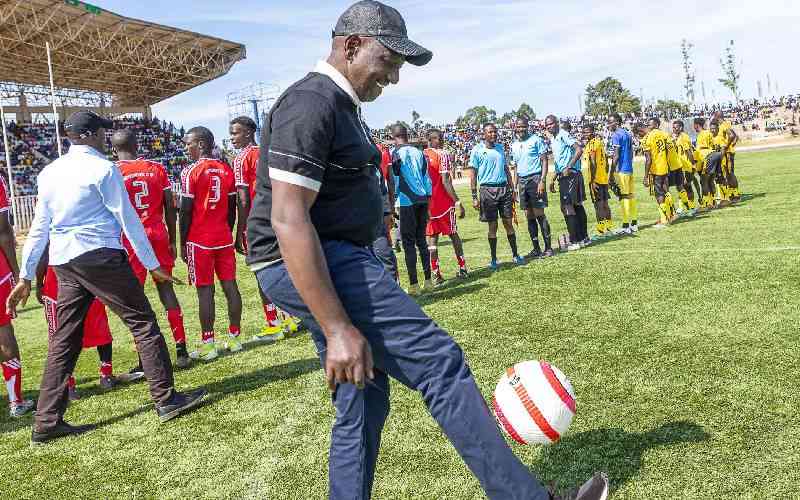
President William Ruto during the FCPA Barasa Governor’s Cup at Bukhungu Stadium, Kakamega County, on January 1, 2026. [PCS]
President William Ruto has framed 2026 as the decisive year of implementation. The moment when promises mature into visible outcomes and when Kenyans are finally meant to “see the full picture”. Politically, this framing is neither accidental nor naive. It reflects a classic incumbency strategy: Delay judgment, buy time, and concentrate delivery narratives in the final stretch before the re-election campaign fully takes hold.
Yet history and political economy offer a sobering warning. Governments are not ultimately judged by their intentions or timelines but by lived experience. And by that standard, 2026 may prove to be less a year of consolidation and more a year of political reckoning.
The core challenge facing Dr Ruto is not communication. It is credibility. Implementation is not a switch that can be flipped in the fourth year of a term. Development outcomes are cumulative and path-dependent. When early policy choices generate economic pain, institutional stress, or social fatigue, later promises of delivery struggle to reverse hardened public sentiment.
Take infrastructure, for example. The administration has continued to announce ambitious road, housing, and energy projects. But Kenya’s fiscal reality has tightened dramatically. Debt servicing now competes directly with development spending, social protection, and basic public services. In such an environment, infrastructure delivery becomes slower, more selective, and politically exposed. Every new project raises uncomfortable questions: Who pays, who benefits, and what is being sacrificed?
On the economy, the President faces an even steeper uphill climb. Macroeconomic stabilisation, inflation control, currency management, and fiscal consolidation are necessary, but they are politically insufficient. Kenyans experience the economy at the micro level: The cost of food, rent, transport, school fees, and healthcare. Here, the bottom-up promise that powered the 2022 campaign has been steadily eroded.
High taxation, shrinking disposable incomes, and rising household pressure have produced a legitimacy gap. When citizens feel poorer despite official assurances of recovery, economic narratives collapse. No amount of statistical improvement can override the daily arithmetic of survival.
Health and education present even greater political risk. These are sectors with what political scientists call high negative salience: Failures are immediate, visible, and emotionally charged. Disruptions in healthcare financing, shortages in public facilities, and confusion around education reforms do not remain abstract policy debates. They land directly in homes and communities. They produce anger, anxiety, and a sense of betrayal.
Education transitions, in particular, affect children, and nothing mobilises political resentment faster than the perception that a government is experimenting with the future of families. Health crises, similarly, turn policy missteps into moral indictments. These are not arenas where governments can afford prolonged uncertainty.
Perhaps the most ambitious and perilous promise is the “Singapore dream.” Singapore is not merely a destination of wealth; it is a product of disciplined institutions, ruthless anti-corruption enforcement, industrial strategy, and a social compact that balanced growth with social order. Invoking Singapore without first securing governance credibility is risky. Aspirations without institutional trust quickly sound like slogans. Singapore was not built on speeches or symbolic launches. It was built on predictability, meritocracy, and an unforgiving stance against elite impunity. When citizens observe procurement scandals, policy reversals, and selective accountability, comparisons to Singapore invite scepticism rather than inspiration.
Ultimately, 2026 will not be decided by press conferences, road launches, or carefully staged development tours. It will be decided in kitchens where food budgets no longer stretch, in hospitals where care is uncertain, in classrooms where reforms feel rushed, and in small businesses struggling to stay afloat. That is the President’s true battlefield. It is intimate, unforgiving, and immune to spin. If the lived reality of Kenyans does not improve meaningfully, 2026 may become less a year of implementation and more a year when political patience finally runs out. In politics, once patience is exhausted, no promise arrives in time.
Gitile is a professor of management and leadership