

Prime Cabinet Secretary Musalia Mudavadi during a one on one interview with The Standard group. [Wilberforce Okwiri, Standard]
×

The Standard e-Paper
Smart Minds Choose Us
 The Standard Group Plc is a
multi-media organization with investments in media platforms spanning newspaper
print operations, television, radio broadcasting, digital and online services. The
Standard Group is recognized as a leading multi-media house in Kenya with a key
influence in matters of national and international interest.
The Standard Group Plc is a
multi-media organization with investments in media platforms spanning newspaper
print operations, television, radio broadcasting, digital and online services. The
Standard Group is recognized as a leading multi-media house in Kenya with a key
influence in matters of national and international interest.

Audio By Vocalize
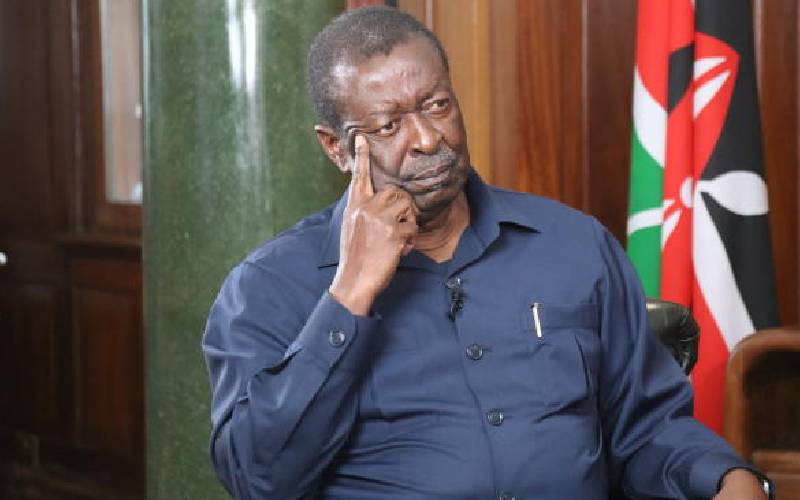 Prime Cabinet Secretary Musalia Mudavadi during a one on one interview with The Standard group. [Wilberforce Okwiri, Standard]
On December 26, 2025, Prime Cabinet Secretary (PCS) Musalia Mudavadi proposed that Kenya hold a referendum alongside the 2027 general election, alleging that Kenya was in a referendum moment. The reasons that he gave to support he proposes that it is meant to solve the crisis of boundary delimitation, the census deadlock, relook at counties (names, number, wards), resolve NADCO issues (such as entrenching the NCDF, introduce a Senate Oversight Fund and Ward Fund), and bolstering theunified face of Kenya in government by formalsing the office of the Prime Minister and the Official Leader of the Opposition. This proposal sounds valid and genuine until you interrogate them individually.
First, the need for a referendum to solve the boundary delimitation crisis does not require a constitutional amendment. The failure to conduct a review of electoral boundaries since 2012 is in breach of Article 89 of the Constitution, which requires electoral boundaries to be reviewed every eight to 12 years. The reason the country has not had a delimitation of electoral boundaries is based on the well-known fact that the primary driver of this exercise, the IEBC, had not been properly constituted until recently. The New IEBC Chairperson, Mr Erastus Ethekon, has stated that completing the electoral boundary delimitation exercise before the 2027 general election is impossible due to time constraints.
The commission has instead sought an advisory opinion from the Supreme Court on how to proceed, given that constitutional deadlines have been missed. Interim measures can focus on conducting a review of electoral boundaries immediately after the 2027 elections. The second issue relates to the census deadlock, which primarily refers to a significant legal and political crisis in Kenya that may affect the 2027 elections. The deadlock is a constitutional crisis that stems from the nullification of the 2019 census results in three counties (Mandera, Wajir, and Garissa) by the High Court in January 2025, due to data integrity issues. A valid national census is a prerequisite for a proper electoral boundaries review as mandated by the Constitution, which requires boundaries review every eight to 12 years, a deadline which expires in March 2024.
Without valid population data, a lawful boundary review cannot take place. A cure for this crisis may require conducting a fresh census. I doubt whether a referendum is necessary to unlock this crisis; just set aside resources for a fresh census based on the court decision. The third point that the PCS raises as necessitating a referendum is the re-examination of counties, more specifically, their numbers, names, and number of electoral wards. I am not sure which research Mudavadi bases his newfound thinking on. However, one reality is that the government and more so a member of its executive cannot drive such a constitutional review agenda. We have been on this road before, when the Supreme Court’s decision on March 31, 2022, in the case related to the Building Bridges Initiative (BBI) determined that a sitting President cannot initiate a constitutional review process through a “popular initiative.” Why does Mudavadi want to drive a constitution review initiative? Let other Kenyans, as witnessed during the ‘Punguza Mizigo’ initiative, drive a citizen-based initiative. My friend Omwami, do not cry louder than the bereaved. The third and final issue that Mudavadi raises in his clamour for a referendum revolves around resolving NADCO issues, namely entrenching the NCDF, introducing a Senate Oversight Fund and Ward Fund, and bolstering the unified face of Kenya in government by formalising the office of the Prime Minister and the Official Leader of the Opposition. These three issues jointly alter the basic structure of the 2010 Constitution.
The Basic Structure Doctrine is a principle in constitutional law with origins in India. This doctrine states that a constitution has fundamental, unamendable features (such as democracy, the rule of law, and separation of powers) that cannot be abolished or altered by Parliament through ordinary amendment processes, requiring a higher “constituent power” (the people’s sovereign will, often via referendum) instead. Do we want a parliamentary democracy, a presidential democracy, or a mongrel (hybrid democracy that combines both)? On this one, I agree with you, Mudavadi. It’s only Kenyans who can alter the basic doctrine of the Constitution through a referendum. However, your timing seems suspect. Why the sudden urgency to merge it with the general election? This can be done as early as 2026; we need to separate a referendum from the general election. Some of the reasons you give for conducting a referendum jointly with the 2027 elections are that it will save taxpayers’ money, in your own words, it would be cost-effective. Allow me to remind you that you currently occupy an unconstitutional office, the PCS docket.
I humbly submit that you are the least competent individual to advise Kenyans on cost-cutting measures. Since 2022, you have continued to draw a budget and salary from the National Treasury in your capacity as the PCS, which is an unconstitutional and illegal office. I submit you are not genuine in your clamour for a referendum in 2027, and you are only trying to legitimise holding a new office of Prime Minister after the 2027 elections for your own selfish ends. In my mind, I can almost hear the closed-door conversation that culminated in your presser, it goes something like this, “wewe Musalia Sukuma hii agenda, inakuguza wewe zaidi! (Musalia, lead this agenda, it affects you more!).” These are well-orchestrated schemes and tactics used by governments to divert the public’s attention from pertinent issues. Is the Singapore dream still on course?
In conclusion, as we usher in a new year, it would be good manners for me to disclose that Mudavadi is my great friend. But it’s only friends who can genuinely call each other to order. My good friend MM, the worst decision you made this year was to allow your party, ANC, to be acquired by UDA. The earlier you come to terms with this reality, the better. This action exposes you to the vulgarities of the 2027 political weather. Your political capital has been decimated, and it does not take a prophet to foretell your political existence post-2027. As a seasoned political operator, I find it hard to believe that you cannot see the hole you are digging. This leads me to my conclusion: Political survival is the only card you have up your sleeve.
The writer is a Nakuru County Politician and a 2027 Gubernatorial Aspirant
Subscribe to our newsletter and stay updated on the latest developments and special offers!








 join
join