×
App Icon
The Standard e-Paper
Home To Bold Columnists
★★★★ - on Play Store
Download Now

Equip women with guns, shift GBV discourse from begging to offending

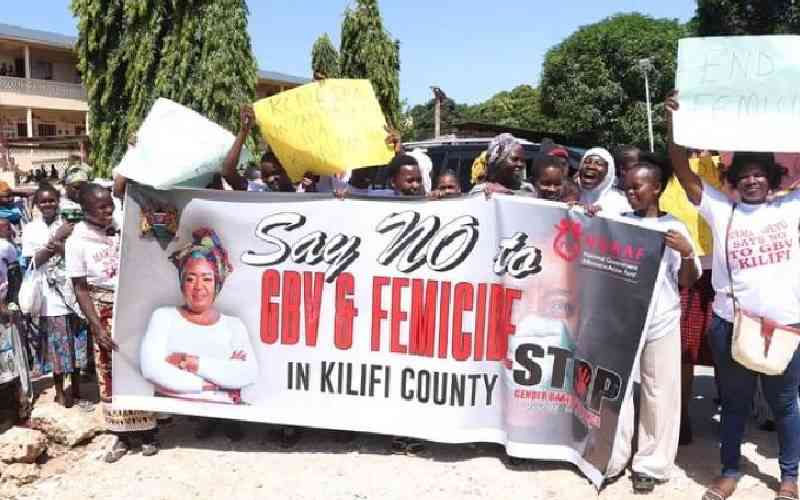
Kilifi residents march during a community sensitisation campaign against GBV and femicide at Bofa youths' grounds. [File, Standard]

One of the ways I marked the recently ended 16 Days Against Violence was by drawing out a strategy outlining five routes to bring about the vision of a Kenya that works for women, for a local women’s rights organisation.

Ruminating on it after, I realised that despite fleshing out the five key pathways towards this (in summary, harnessing the realms of politics, business, culture, security, and community) one crucial feature was missing.

This feature was the question of how to enable safety for women at a time of global femicide. UN Women statistics indicate that globally, 6 women are killed every hour, 137 women lose their lives every day to gender based violence (GBV). We have been doing the same thing (begging), expecting the violence to stop. It is time to change strategy and shift intervention on GBV from begging to outrightly offending.


Having gone through my own lived experience of GBV, I have been seeking to understand it, by understanding why human society in the 21st century views and treats women the way it does.

Some of the texts helpful to this end include Merlin Stone’s When God Was a Woman, which reminds us that women were the key deities for 35,000 years, that Judaeo Christian religion only came on the scene 3,000 years ago, after systematically destroying these Goddess religions.

The Chalice and the Blade Riane Eisler has been a reminder that the violent, corrupt, extraction-oriented politics is not sustainable and is not only model that can be used to the society and communities around.

The Creation of Patriarchy has been eye opening in revealing the methods patriarchy uses to systematically silence, erase, destroy and devalue women’s power and presence in the public space. Safa Hussain’s Disobedient Under Patriarchy on the other hand, has been inspiring with its zero tolerance spirit to the normalization of victimhood and suffering and women, and it’s willingness to end it, as Malcolm X put it, by any means necessary.

The bulk of these are from the global North, I am yet to delve into texts from the global south, and much closer to home, Africa and Kenya (book recommendations are welcome).

What all these works do is show us that the current crisis of womanhood can be traced to an abject failure of imagination. The society of women are in a comfort zone, in a prison. It has been normalised that a woman will be killed for all sorts of frivolous reason, and nothing will be done about it. To the level that it is now culture.

These works open our eyes to the fact that the insults and denigration levelled against women are completely misplaced.

Ancient societies where fathers were of absolutely no importance existed, meaning to be a single mother today is neither shameful nor aberrant.

The women writing these books remind us of the relationship between the nuclear family, capitalism and patriarchy, and how women’s free labor is extracted on the home front, at large cost to their wellbeing.

These books help us see that the vile and violent male dominated leadership is not an immovable feature in nature. In ancient Egypt, women were the chief traders, economic and political leaders, while men stayed at home weaving and taking care of children.

My suspicion in the current fatigue in fighting for a better world comes from a fatalism that no better visions and possibilities exist. But the evidence from research shows otherwise.

Back to the crisis of the – femicide – and how women’s lives have become easily discardable. Living comfortable in the city, the victimised reality of women’s lives for many is theoretical.

My head reeled to come across Gloria Steinem’s Woman with Gloria Steinem documentary series (available on YouTube on the Vice News channel), capturing the experiences of women across the world. Raped women forced to set up villages for themselves and their children in the DRC following societal rejection. Teen marriage as a continuing practice, to individuals old enough to be their grandparents.

Women’s bodies used as sites for vengeance and retribution amidst spiralling drug and gang wars in El Salvador. Girl schools in Afghanistan bombed and attacked for having the temerity to set themselves up to educate women. The violence will only get worse and worse as patriarchy wages its final fight to remain alive.

The Kenyan women’s rights collective has the opportunity to take leadership on the front of facing GBV, and putting a decisive end to it. If able to succeed in this, other countries will get the opportunity to learn how it can be done.

Previous efforts at begging, pleading, being diplomatic, inoffensive, and politically correct have proven futile. Women human rights organisations, women human rights defenders and the collective of womanity need a new strategy. This strategy would be moving from begging for violence to stop, to being willing to wield violence unequivocally, against perpetrators.

I’ll spell out a possible outline of what this could look like, to prove that this is not a utopian goal. If working with a 10-year framework to completely eradicate GBV in Kenya in mind, the strategy could be rolled out in three phases.

The first phase would be teaching self-defence to begin with. Girls, from the moment of birth, should be taught self-defence. Self-defence, whether using martial arts from the orient such as karate, taekwondo, judo and jujitsu should be taught at all education stages, from nursery to university, and even at the home front. All institutions should be brought on board towards this goal. From schools, to religious institutions, to security forces, to the media, to corporate organisations, to NGOs, to SMEs, to county administration, to the family. County administration and NGOs will play a key role in this, inspecting, overseeing, monitoring and evaluating the problems set up.

The second phase would be an escalation from this and would involve the equipping with weaponry, tools and arms that women can use in their defence. Rolling this out in the fourth year is very timely as by then, the government will have been able to amass the funds needed to equip all women with guns.

It’s important to note that while these recommendations are structured in this way for the collective, those that are able to afford access to them beforehand should go ahead towards implementing them.

Parents who have the financial wherewithal can buy their daughters guns as wedding presents, so that if at any point their husbands become a menace, they can deal with them early.

The third phase which will roll out in the eight year, will be going on the offensive. Here, regular perpetrators will have been identified and isolated, and women will be encouraged to go after them with their weaponry and arms.

The state will also play a key role in this to ensure women do not devolve into mindless marauding gangs, but where it has proven to have failed, women that stamp out any last embers of GBV will neither be apprehended nor prosecuted in the criminal justice system as they were carrying out civilian policing work.

In summary, the first year will be dedicated to planning, year two and three toward self-defence, year four monitoring and evaluation, year five and six equipping, year seven monitoring and evaluation, year eight and nine going on the offensive, year ten monitoring and evaluation.

One thing that would be sure is that at the end of ten years, the situation of GBV will be vastly different than at the beginning. Kenya is the cradle of mankind; humanity emerged from its womb. Kenyan women rights leaders have a historical opportunity to lead from the front.