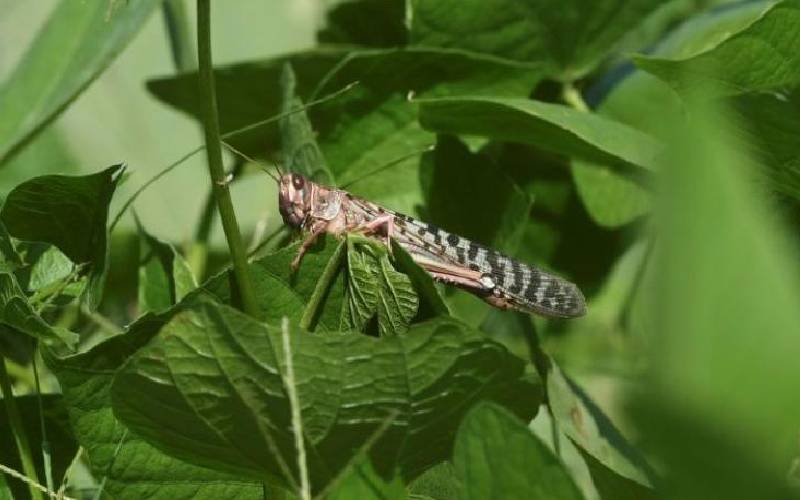
Lorugum village in northwest Kenya is under siege. Hundreds of thousands of young desert locusts perch on trees, shrubs, and grass.
In the coming days or weeks, their bodies will turn from pink to yellow, their wings will harden and, if nothing is done to stop them, they will begin to swarm, with disastrous consequences for agricultural production and the environment.
Using his smartphone camera, Christopher Achilo takes photos and videos of a tree trunk in the village that is crawling with the pink insects, and uploads the https://cdn.standardmedia.co.ke/images onto an app.
“One locust eats food equal to its weight (every day), so imagine having millions of locusts, if you cannot even see over the trees,” he said.
“Within some time, all the trees are just naked. They even go inside the farms, they strip the farms, so it is a very big impact on the food security.”
Achilo is part of a team of locust scouts trained by local aid group ACTED, with the help of the United Nations Food and Agriculture Organisation (FAO) and Turkana County, to spot and report sightings using a new application, E-Locust.
The information he and the others collect is sent in real-time to a database in Lodwar, Turkana’s main town, which is then used by another team deployed to spray the insects with pesticides to prevent swarm formation.
Locust numbers, the worst in three generations, surged in East Africa and the Red Sea region in late 2019 and early this year, encouraged by unseasonably wet weather and dispersed by a record number of cyclones.
The pests could cost East Africa and Yemen $8.5 billion this year, the World Bank has said.
Swarms can fly up to 150km (93 miles) a day, with the wind, and a single square kilometre swarm can eat as much food in a day as 35,000 people can. Desert locusts feed on nearly all green vegetation and crops, including leaves, flowers, fruit, millet and rice.
Meanwhile, Somalia has set up a disaster warning centre to battle floods and locusts.
At a government building in a former United Nations compound in Mogadishu, Khadar Sheikh Mohamed stares at a bank of giant screens displaying weather conditions across the country.
Mohamed is the director of the new national disaster early warning centre designed to help Somalia predict disasters. This year it has already suffered from flooding and a locust invasion.
“Finding the accurate data which may save lives is ... important for us,” he told Reuters at the centre.
The centre opened in June, and is funded by Saudi Arabia through the United Nations’ World Food Programme. It was conceived after cycles of floods and drought caused widespread food shortages, including a famine in 2011 that killed more than a quarter of a million people.
Out of Somalia’s 15 million people, 5.2 million currently need aid, the United Nations says, and more than 2.6 million are displaced due to fighting and natural disasters.
Civil war
Somalia has suffered civil war since 1991, and a fragile, federalist government is battling al Qaeda-linked al Shabaab insurgents.
The violence has destroyed almost all the country’s infrastructure and driven many educated Somalis abroad, but in recent years the internationally backed administration has been trying to rebuild government institutions.
At the centre, dozens of Somali analysts use the latest satellite data, from temperatures to wind pressure, to provide early warnings for flooding, drought, and locust movements.
Government officials said they had initially struggled to recruit skilled workers locally.
“Somalis don’t really have the expertise,” said Muqtar Sheikh Hassan, the director general at the ministry of humanitarian and disaster management. So they hired foreign experts to train local analysts.
Now the centre is fully staffed by Somalis, said Mohamed. “Sometimes you have only 24 or 72 hours to evacuate people. If the information is in another language, it takes more time to translate and disseminate. Now we are able to release warnings quickly.”
Want to get latest farming tips and videos?
Join Us
 The Standard Group Plc is a multi-media organization
with investments in media platforms spanning newspaper print operations,
television, radio broadcasting, digital and online services. The Standard Group
is recognized as a leading multi-media house in Kenya with a key influence in
matters of national and international interest.
The Standard Group Plc is a multi-media organization
with investments in media platforms spanning newspaper print operations,
television, radio broadcasting, digital and online services. The Standard Group
is recognized as a leading multi-media house in Kenya with a key influence in
matters of national and international interest.

 Kenya spearheads Apple farming revolution in region




 join
join 