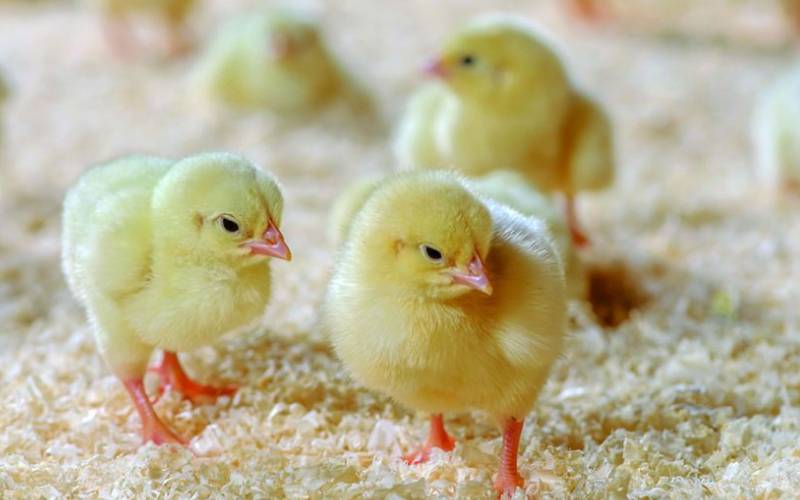
The livestock subsector contributes over 10% GDP to the Kenyan economy. Poultry are the most abundant livestock species, and domestic chicken (98%) are the most important, with other poultry species constituting 2% of the current total estimated population of 32 million birds.

What are the basic requirements for brood houses?

Brooding houses should be isolated from other houses containing older birds. The producer should follow an all-in-all-out program, never mixing birds of different ages.

All facilities must thoroughly be cleaned, and disinfected.

Before the arrival of chicks, the brooder ring and heaters must be checked and disinfected.

On arrival chicks should be offered fresh feed and water containing glucose where chicks are stressed.

How to prepare a brooder?

Cut an 8 by 4 hardboard sheet or the equivalent into 2 equal parts lengthwise and join the pieces to form a circle.

How about chick placement?

Feeders and drinkers should be cleaned and disinfected two days before use.

All the equipment should be arranged and litter spread.

The brooder ring should be prepared and curtains fixed on the open side for the insulation of the brooder house. Spray with good quality disinfectant 2 days before the chicks arrive.

Provide foot bath at the entrance with lime powder or any other disinfectant.


How to Manage the Temperature?

Ideal brooding temperatures are measured 5 cm above the litter surface.

Evening is the best time to observe chicks and make temperature adjustment.

Thermometers may not always be available. Therefore, use the behaviour of chicks as a guide.

Adequate floor, feeder and drinking spaces are also important.

Relative humility, light and ventilation should be provided for optimum comfort of the chicks.

On Source of Heating

You can use domestic heaters (jiko) 1 for 10 chicks or Infrared lamps (250 watts) 1 for 250 chicks or even Pancake heater 1 for 1000 chicks.

Feed Management During Brooding

The use of supplemental feeder is recommended to help chicks get off the best start possible.

Trays should be provided at the rate of 1 per 100 chicks and should be placed between the main feed and drinker lines and adjacent to the brooders.

Supplemental feeders should be provided for the first 7-10 days.

The feed trough height should be adjusted so that they rest on the litter for the first 14 days to ensure all birds can easily access feed without having to climb into the feeder.

Thereafter, feeders should be raised incrementally throughout the growing period so that the lip of the trough or pan is level with the birds back at all times.


Light Management

Continuous lighting should be provided for the first 48-72 hours

It is highly recommended that all flocks are grown under natural light.

What causes Chick mortality?

The main reasons for chick mortality are: Poor brooding conditions- high and low brooding temperature, Feed poisoning – fungal toxins, litter poisoning (ingestion of sawdust), Injuries – rough handling and prolonged transportation stress, Starvation, Humidity, Nutrition deficiency, Genetic disorders and of course predators.


Want to get latest farming tips and videos?
Join Us


Poultry brooding