The Standard Group Plc is a multi-media organization
with investments in media platforms spanning newspaper print operations,
television, radio broadcasting, digital and online services. The Standard Group
is recognized as a leading multi-media house in Kenya with a key influence in
matters of national and international interest.
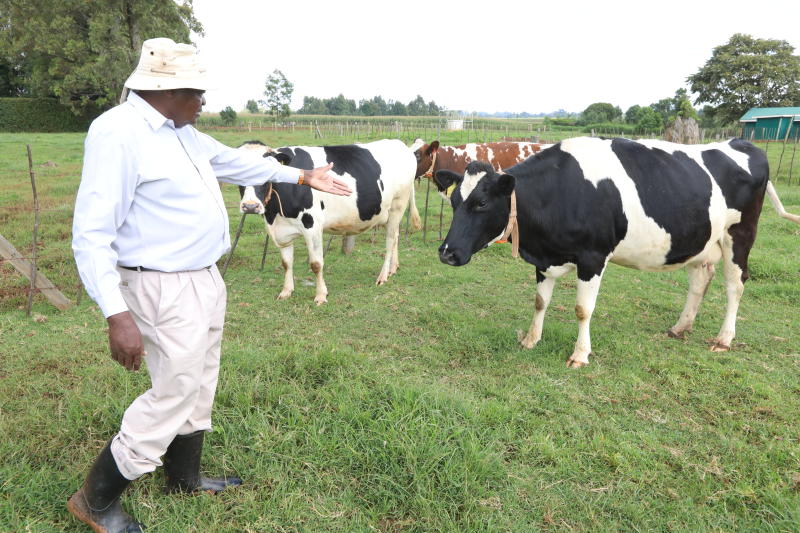
Transport PS Esther Koimet’s Ilula Farm manager John Magut at the farm in Uasin Gishu. (Kevin Tunoi, Standard)
When some 70 dairy farmers from Uasin Gishu visited Ilula Farm recently, they were struck by how the venture had used modern technology to enhance milk production.
Located on the outskirts of Eldoret town, Ilula has embraced latest dairy farming technologies that have seen it increase production from 30 litres to 700 in five years.
Ilula farm, owned by Transport Principal Secretary Esther Koimett, has distinguished itself as an ideal agricultural model farm.
The farmers drawn from various cooperative societies, got lessons on good livestock husbandry. The event targeting dairy farmers in the region was organised by the Standard Group in partnership with Uasin Gishu County government.
Five years ago, the farm had only 39 animals but the number has gone up to 100.
To beat the high cost of running a dairy farm, Koimett said they make their own feeds which but supplement with commercially produced ones.
According to Koimett, marketing milk has been the farm’s biggest challenge.
“Marketing our milk is still a challenge and this is why we want to venture into value addition. We sell most of our milk to dairy processors, schools, hotels, hospitals among others,” said Koimett.
She also challenged more women to venture into dairy farming. “Women are the bedrock of our economy through their engagements from as little as keeping chicken on small scale and we are proud of them, I am calling on more women to consider venturing into dairy farming,” she added.
Mr John Magut, the farm manager, said the venture started with 39 dairy cows – 19 adult cows and 20 heifers.
“We currently have 100 cows consisting of about 40 adult cows and 60 heifers. We have two major breeds - Friesian and Ayrshire but we have also tried to have natives from Europe and we already have one red Frisian on trial,” said Magut.
He said the cows produce 700 litres of milk daily. The average productivity per cow from is 37 litres.
“We produce our own feeds which has been the main drive for the rising milk production. We give them a balanced diet which is key in milk production,” said Magut.
Magut who took the farmers round the dairy farm said hygiene is paramount as the animals produce more when they are comfortable.
He said concentrates are always kept safe to ensure they are free of aflatoxin.
The feeds – hay and silage are well mixed manually with concentrates – Maclik Plus, Super, lime, wheat bran, maize bran are well mixed to achieve a good dairy meal.
There are also feeds for various needs of the dairy cows depending on their age and stages, noted Magut.
“Through our record keeping, we understand our dairy cows well. A good farmer first understands the needs of the cows before focusing on money,” he added.
During the tour, Josphat Kipkogei, the farm livestock manager enlightened the farmers on dairy meal formulation.
Kipkogei also showed farmers how Ilula Farm groups and stages the dairy cows depending on their age and sex.
“Ilula farm uses Worldwide sires, Corporation Resource International (CRI) sires and America Breed Society (ABS) sires in breeding its dairy cows,” said Kipkogei.
Trainee farmers Marry Chebii from Megun ward, Joel Serem from Kapseret sub-county and Phillemon Boit from Sosiani Cooperative in Turbo described Ilula Farm visit as an eye-opener.
“It was a great opportunity because I have always yearned to visit a functional dairy farm. It was a great learning opportunity and I will put what I learnt into practice,” said Chebii.
Boit said feed formulation and care of breeds from birth to production stages was his greatest lesson.
Serem said he looked forward to upgrading his breeds from indigenous to hybrid having seen the difference in terms of production.
Contrary to what most Kenyan dairy farmers believe, dairy cows can feed and give milk on forage alone. If properly managed and harvested at the right time, grass for example contain up to 16 per cent protein. Dairy meal in most cases has 17 per cent protein. Feeding your dairy cow on well-managed grass can therefore give between 15 – 20 liters of milk. This makes forage is the cheapest way to produce milk.
However, several factors make it difficult for farmers to produce their own forage. Its now common to see farmers buy hay form large-scale farmers in Nanyuki, Timau, Nakuru and other areas. Farmers that supply hay also face challenge in managing the grass well, often harvesting them too late. By the time this hay reaches the farmer, nutrients from the hay have been used up and cow is left only with fibre.
This is why most farmers complain of no increase in milk despite feeding their cows with commercial hay.
 The Standard Group Plc is a multi-media organization
with investments in media platforms spanning newspaper print operations,
television, radio broadcasting, digital and online services. The Standard Group
is recognized as a leading multi-media house in Kenya with a key influence in
matters of national and international interest.
The Standard Group Plc is a multi-media organization
with investments in media platforms spanning newspaper print operations,
television, radio broadcasting, digital and online services. The Standard Group
is recognized as a leading multi-media house in Kenya with a key influence in
matters of national and international interest.





 join
join 