The Standard Group Plc is a multi-media organization
with investments in media platforms spanning newspaper print operations,
television, radio broadcasting, digital and online services. The Standard Group
is recognized as a leading multi-media house in Kenya with a key influence in
matters of national and international interest.
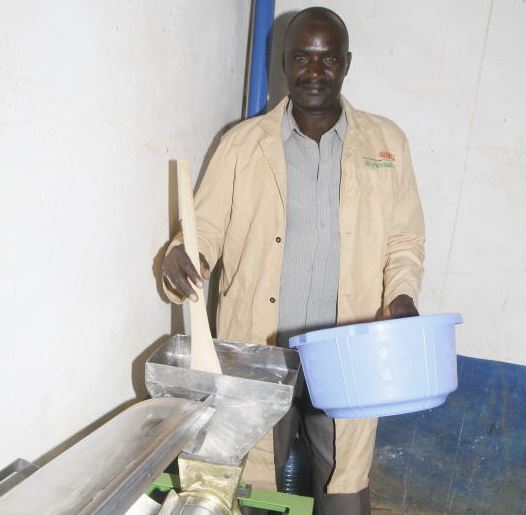
Joseph Kimathi, Kithoni Women Group member explains how the mango squeezing machine has helped prevent mango wastage. [Jenipher Wachie, Standard]
For years, Jackson Musyoka from Makueni knew what to expect every season when he harvested his mangoes. It would start with a bumper harvest of succulent mangoes that would fill him with joy. The joy would slowly fade as he desperately sought market and carried sacks to local hotels only to be turned away because they already had a supplier. By the time the season was peaking, his joy would turn into frustration whenever he had to throw sacks of rotting mangoes.
“Everyone had mangoes, but there was nowhere to take them. We would throw a huge portion, give some to children who would get fed up of eating mangoes, then we would try giving them to animals. It was a big waste,” he says.
In 2012, he decided to come together with other farmers struggling with the same issues. They formed Kithoni Farmers Self Help group whose mandate was to improve their bargaining power when they got to the market.
Their first agenda was to look beyond producing local varieties of mangoes. They wanted to have export quality so that they can expand their market base. After thorough consultations, the members felt they would develop faster if they started growing hybrid mangoes. As they were setting up their nursery, they were hit by the first challenge.
“Makueni being dry made it a challenge for us to water the nursery regularly. We had to find options to ensure our crops do not dry up,” he says.
They partnered with local NGOs and built a water table to provide them with water. In no time, their trees were growing, and then came their first massive harvest three years later.
They started reaching out to different partners, including government and researchers. It is through their inquiries that they came across a programme by JKUAT that awarded farmers with a mango processing plant.
Prof Daniel Sila, the lead project manager and a lecturer in the department of Food Science and Technology at JKUAT, says the project aimed at reducing post-harvest loss. They had read many heartbreaking stories of farmers who had worked hard only to face annual disappointments because they had highly perishable commodities.
“One of the requirements was for the group to have a recognisable number of women and for them to show commitment,” says Sila. Kithoni group was a perfect fit, with 35 out of their 70 members being women.
Value Addition
Anastacia Mwikali, a group member, says as soon as they got the processing plant, they embarked on value addition.
“We started making juice and selling it to hotels and schools. We were surprised that we would run out of mangoes and even buy from other farmers. We never imagined there will be a time when we did not have mangoes rotting in our stores,” she says.
She says the processing plant has shaken them off the shackles of depending on seasons, and they now have a bargaining power when brokers who used to take advantage of their situation come. “It is a good feeling to be able to say No when middlemen approach you with low pricing. We send them away with their lorries because we can use our mangoes for something else,” she says.
The mother of eight, says she no longer worries about her children going without food since they get orders for their juices from different parts of the country.
JKUAT trained them on the process involved, from caring for the mangoes while at the farm, to extracting the juice from the pulp.
“When we first got the machine, we had moments when we wondered if as villagers, we will be able to work it. It took a short time before we grasped how the processing machine works,” says Musyoka.
Even though they are excited about the technology, they say they still have challenges. Being away from a major town makes it difficult to access electricity to run the mango processor. They have to use a generator and they say it can get expensive especially when they have a lot of fruits to extract.
The process of getting accreditation from the Kenya Bureau of Standards has hindered them from going large scale with their production.
Even with the challenges, they say they are optimistic that in a few years, their mango juice and jam will be a common food in many households.
 The Standard Group Plc is a multi-media organization
with investments in media platforms spanning newspaper print operations,
television, radio broadcasting, digital and online services. The Standard Group
is recognized as a leading multi-media house in Kenya with a key influence in
matters of national and international interest.
The Standard Group Plc is a multi-media organization
with investments in media platforms spanning newspaper print operations,
television, radio broadcasting, digital and online services. The Standard Group
is recognized as a leading multi-media house in Kenya with a key influence in
matters of national and international interest.

 Kenya spearheads Apple farming revolution in region




 join
join 