×

The Standard e-Paper
Home To Bold Columnists
 The Standard Group Plc is a
multi-media organization with investments in media platforms spanning newspaper
print operations, television, radio broadcasting, digital and online services. The
Standard Group is recognized as a leading multi-media house in Kenya with a key
influence in matters of national and international interest.
The Standard Group Plc is a
multi-media organization with investments in media platforms spanning newspaper
print operations, television, radio broadcasting, digital and online services. The
Standard Group is recognized as a leading multi-media house in Kenya with a key
influence in matters of national and international interest.

Audio By Vocalize
Kenya has made notable progress in reforming its basic education system.
This persistent teacher shortages, declining boy-child enrollment, and deep inequalities threaten to derail the gains unless urgent action is taken, civil society leaders have warned.
Speaking during a national education review forum, Joseph Wasikhongo, National Coordinator of the Elimu Yetu Coalition, said the country's education reforms, while promising, remain vulnerable.
"Kenya has taken important steps forward in basic education, but progress remains fragile unless teacher shortages, inclusion gaps, and financing delays are urgently addressed," he said.
Wasikhongo noted that government initiatives such as the Kenya Primary Education Equity in Learning Programme (KPEELP) and the Secondary Education Quality Improvement Programme (SEQIP) have strengthened access, infrastructure, and learning systems.
However, he cautioned that unresolved structural challenges could undermine these gains.
"Without decisive action on teacher deployment and welfare, the promise of the Competency-Based Education system may not be fully realized, particularly for learners in marginalized regions," he said.
As Kenya prepares for the transition to Grade 10 under the Competency-Based Education (CBE) system, more than 100,000 teachers have been retrained, learning materials developed up to Grade 11, and over 14,600 junior secondary classrooms constructed nationwide.
Despite this progress, Wasikhongo said the transition faces serious risks.
"The transition to Grade 10 is a critical moment for the education system, but it is under serious threat from a national teacher deficit, subject mismatches, and uneven parental awareness," Wasikhongo said.
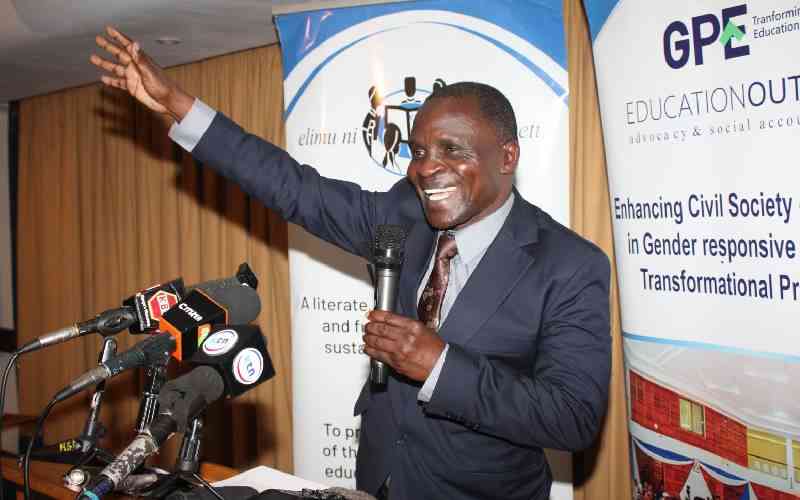
 Joseph Wasikhongo, National Coordinator of the Elimu Yetu Coalition during a press briefing on the state of Education in Kenya. [Juliet Omelo, Standard]
Although more than 46,000 junior secondary teachers were recruited in January 2025 and an additional 20,000 are expected in 2026, the national teacher deficit still exceeds 100,000.
Shortages are most severe in arid and semi-arid lands (ASAL), hard-to-staff schools, and STEM subjects.
He stressed that recruitment must remain under the Teachers Service Commission and free from political interference, while teacher welfare should be strengthened through decentralized mental health and wellness services.
The coalition also raised concern over a sharp decline in boy-child participation in secondary education. Net enrollment for boys has dropped from 51.2 per cent in 2020 to 45.4 per cent in 2024, even as girls continue to post higher transition and retention rates.
"The sharp decline in boy-child enrollment at secondary school level is an emerging crisis that demands urgent, targeted policy intervention," Wasikhongo said.
Despite improvements in Special Needs Education, learners with disabilities remain significantly underrepresented, accounting for less than two per cent of total enrollment.
Stay informed. Subscribe to our newsletter
According to Elimu Yetu, weak governance, delayed financing, and inadequate inclusive infrastructure continue to lock out many children.
"Despite policy commitments, learners with disabilities remain largely excluded from the education system, pointing to weak governance, delayed financing, and inadequate inclusive infrastructure," Wasikhongo said.
Digital learning and data-driven planning have expanded, particularly through the use of the National Education Management Information System (NEMIS).
However, many rural, ASAL, and refugee-hosting schools still lack electricity, digital devices, and internet connectivity.
The coalition urged greater investment in renewable energy, connectivity, and full integration of early childhood and special needs data to ensure equitable planning.
While welcoming the government's SHIRIKA Plan aimed at integrating refugees into host communities, Elimu Yetu expressed concern over the continued exclusion of refugee teachers from the formal education system.
"Refugee teachers play a vital role in learning continuity, yet they remain unrecognized and unsupported within the formal education system," Wasikhongo said, urging the government to align practice with its international obligations.
Education financing also emerged as a major concern, with persistent delays in capitation disbursement straining schools, particularly those serving learners with special needs
"Education financing must be timely and predictable; delays in capitation, especially for special needs education, continue to undermine service delivery in schools," Wasikhongo said, calling for stronger accountability and investigations into ghost schools.
The coalition further warned that climate-related shocks such as droughts and floods are increasingly disrupting learning across the country.
"Climate-related shocks are no longer isolated events but a recurring disruption to learning, requiring resilient school infrastructure and community-based preparedness," he noted.
Elimu Yetu further called on the Ministry of Education to urgently use findings from the Kenya Junior School Education Assessment (KJSEA) to guide learner placement, teacher deployment, and targeted support as the system transitions to senior school.
"The Kenya Junior School Education Assessment provides critical evidence that must be used to guide fair learner placement, teacher deployment, and targeted interventions," Wasikhongo said.
As the country reflects on education reforms in 2025, Wasikhongo said civil society would continue to play a watchdog and partnership role.
"Civil society will continue to partner with government, hold duty bearers accountable, and amplify the voices of marginalized learners to ensure no child is left behind," he said.

Subscribe to our newsletter and stay updated on the latest developments and special offers!










 join
join