×
App Icon
The Standard e-Paper
Read Offline Anywhere
★★★★ - on Play Store
Download Now

Inside new CBE grading system: How KJSEA results will shape senior school placement

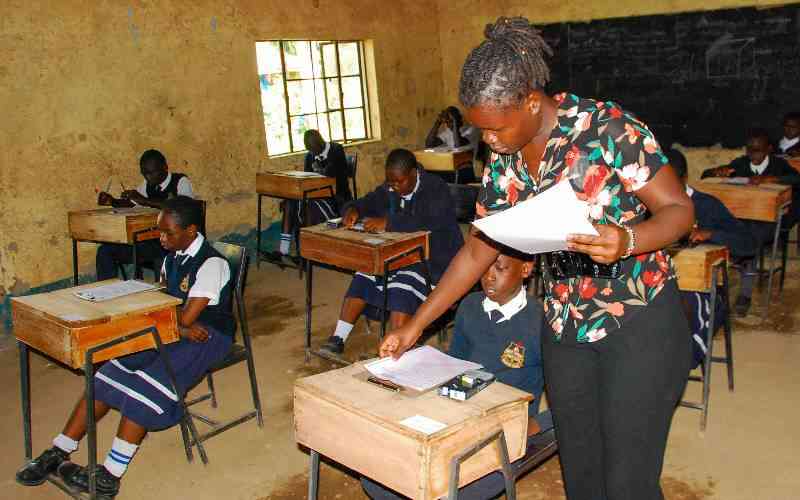
Kakamega Hill school  Junior School Education Assessment candidates during rehersal on October 24,2025. [Benjamin Sakwa, Standard]

The new grading structure under the Competency-Based Education (CBE)  system is going to reshape how learners transitioning to Senior School will be assessed and placed.

The system, built on cumulative evaluations, brings together national continuous assessments, classroom-based evaluations, and the earlier KPSEA scores to produce a final score out of 100 percent.

According to the government, this recognises diverse skills, and by reducing exam pressure, the system seeks to create more well-rounded, capable learners.


Under the new model, the Kenya Junior Secondary Education Assessment (KJSEA) for 1.1 million learners will contribute 60 percent of the final score.

These results, being released today, form the largest single portion of a learner’s placement marks as the pioneer Junior Secondary cohort prepares to transition to Grade 9.

Learners’ final marks will also include 20 percent from School-Based Assessments (SBA) conducted in Grades 7 and 8.

Another 20 percent will come from the Kenya Primary School Education Assessment (KPSEA), administered nationally in Grade 6 in 2022.

The final score will be determined as follows: Final Score = KJSEA (60 percent) + SBA (20 percent) + KPSEA (20 percent), totalling 100 percent.

This approach marks a significant shift from the previous high-stakes, one-off examination system, which was marked out of 100 percent per subject.

It aligns with CBE’s idea of evaluating a learner progressively, across multiple years, using varied tasks that reflect academic growth, skills acquisition, and holistic development.

A concern had emerged over learners who missed the KPSEA in 2022 but later transitioned to Junior Secondary in 2023.

Kenya National Examinations Council (KNEC) Chief Executive Officer David Njengere addressed the issue, explaining that an alternative assessment was provided.

“We have an assessment called the Qualifying Test (QT), which is administered to children who may have come from other countries or missed the KPSEA,” said Njengere.

He noted that the QT represents a major innovation within the CBE rollout.

“All the candidates who sat this assessment did so on an e-platform, which attests to the digital skills the learners in CBE are acquiring,” he added.

This ensures no learner is disadvantaged in the final computation for Senior School placement.

The eight-level achievement grading system

Beyond raw scores, the new KJSEA grading model introduces eight Achievement Levels (AL), each tied to points that will be used during Senior School placement.

The system evaluates how well a learner meets or exceeds expectations, rather than ranking them competitively.

The levels include: Exceeding Expectations (EE), EE1 (AL 8) will constitute learners with 90–100 percent, which will account for eight (8) points, translating to (Exceptional), while EE2 (AL 7) will have scores between 75–89 percent, adding up to 7 points (Very Good).

Meeting Expectations, learners will be graded in ME1 (AL 6): 58–74 percent will give candidates 6 points (Good), and ME2 (AL 5): 41–57 percent will earn 5 points (Fair) Approaching Expectations (AE), AE1 (AL 4) covers learners with 31–40 percent score, accounting for 4 points, where learners will be advised on (Needs Improvement), while AE2 (AL 3) of: 21–30 percent will earn learners 3 points, which is (Below Average).

Below Expectations, BE1 (AL 2): 11–20 percent will gain two points and be graded (Well Below Average), while BE2 (AL 1): 1–10 percent will be awarded one point (Minimal) Unlike the traditional grading system, this new structure places emphasis on the learner’s competency level rather than relative performance against peers.

Under CBE’s design, Senior School placement is not only about academic scores but also about aligning learners with their talents and strengths.

The new model groups learners into pathways such as STEM (Science, Technology, Engineering, and Mathematics), Performing Arts, and Sports and Social Sciences pathways.

Placement will therefore draw from both achievement levels and accumulated marks from KPSEA, SBA, and KJSEA.

Education officials say this approach ensures that learners pursue pathways where they are most likely to excel, rather than being pushed into schools purely based on cut-off marks.