×
App Icon
The Standard e-Paper
Home To Bold Columnists
★★★★ - on Play Store
Download App

How a Bungoma officer Is rewriting the future of prisoners' children by keeping them in school

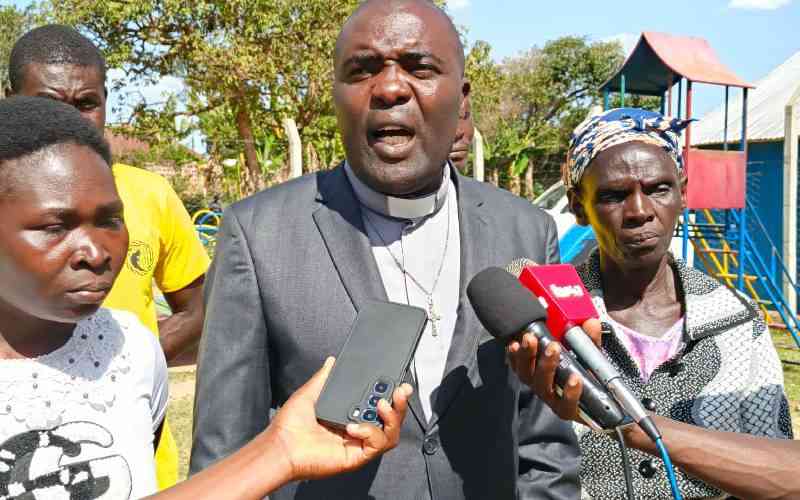
Chrispinus Wafula a Kenya Prisons Service cop and founder Prisons Christian Ministries addressing the media in Bungoma on Saturday after handing over the stationeries [Juliet Omelo, Standard]

Every morning, as the heavy prison gates clang shut behind inmates, another, quieter sentence is passed beyond the walls on the children left behind.

For many, a parent’s incarceration marks the beginning of stigma, hunger, and an abrupt end to schooling.

But in Western Kenya, one prison officer is determined to ensure those children are not forgotten.

Chrispinus Wafula, a Kenya Prisons Service officer and chaplain stationed at Kakamega GK Prison, has turned compassion into action, quietly transforming the lives of children whose parents are serving jail terms.


Hailing from Mabusi village in Kanduyi Constituency, Bungoma County, Wafula has made it his mission to keep such children in school and shield them from the cycle of neglect and hopelessness that often follows incarceration.

“I kept meeting inmates who were more worried about their children than their own freedom. They would ask, 'Are my children still in school? Are they safe?' That pain stayed with me,” Wafula said.

Moved by those encounters, Wafula rallied like-minded people to form Prison Christian Ministries (PCM), an initiative dedicated to advocating for the rights and welfare of prisoners’ children.

What began as a small act of charity has grown into a structured programme offering education sponsorship, mentorship, and psychosocial support.

On Saturday at Tabithan 2 Children's Safe House in Bungoma, the impact of that vision was on full display as children received stationery and learning materials as they resumed the new school term.

Naomi Wanjala, a beneficiary whose husband was jailed for 20 years [Juliet Omelo, Standard]

Laughter and excitement filled the room, a sharp contrast to the hardship many of them have known.

“When parents are jailed, their children suffer silently. They are stigmatized, neglected, and many drop out of school. Education became our priority because it is the one thing that can change their future,” Wafula explained.

Today, PCM supports 34 children enrolled in primary and secondary schools across the region, providing full sponsorship that covers school fees, uniforms, learning materials, and basic upkeep.

Some of the beneficiaries are transitioning to Grade 10, aligning the programme with the government’s 100 per cent transition policy.

Beyond financial support, the initiative runs a centre in Bungoma where children receive mentorship and counselling, helping them rebuild confidence and self-worth in communities where they are often judged for crimes they did not commit.

“Most conversations around prisons focus on security and punishment. Very few people talk about the innocent children affected when a parent is incarcerated,’ Wafula noted.

The consequences of that silence are stark. Many children of prisoners remain out of school, exposed to child labour, abuse, and early dropout due to a lack of resources.

Wafula warns that without intervention, these children risk being trapped in the same cycles of poverty and crime that society seeks to end.

He further argued that supporting prisoners’ families plays a crucial role in rehabilitation.

According to Wafula, inmates burdened by anxiety over their children’s welfare struggle to reform.

“True rehabilitation is impossible when a prisoner is mentally tortured by fear for their family. When you take care of their children, you restore peace of mind, and that helps them change,” he said.

For beneficiaries like Judith Nasambu, the programme has been life-changing. After her son was sentenced to 10 years in prison, she struggled to care for his children, whose education quickly collapsed under financial strain.

“My grandchildren were suffering and had stopped schooling. When they were accepted into this programme, they went back to school. Today, they are doing well, and we have hope again,” Nasambu recalls.

Another beneficiary, Naomi Wanjala, whose husband is serving a 20-year sentence, said PCM rescued her children from an uncertain future.

“They are now learning well, and their lives have changed,” she says.

Wafula believes the responsibility should not rest on individuals alone. He is urging the government to develop a clear policy framework to support children of incarcerated parents, many of whom are not captured in official databases and are excluded from bursaries and social protection programmes.

He is also keen to challenge public perceptions about uniformed officers.

“People think prison officers only punish. But we are also parents, mentors, and community members. We are here to heal, not just to guard,” he said.

Looking ahead, PCM plans to expand its reach to 10 counties by 2027, targeting 1,000 children nationwide.

Wafula said that centres are already operational in Murang’a, Kisumu, Kakamega, Mombasa, and Homa Bay.

As the children at the Bungoma center clutched their new stationery and looked towards the future once thought out of reach, the impact of the initiative is already evident.

By keeping vulnerable children in school, Wafula is quietly breaking a cycle of stigma and neglect that often shadows incarceration.

“Punish the crime,” he says quietly, “but protect the child.”