×

The Standard e-Paper
Kenya’s Boldest Voice
 The Standard Group Plc is a
multi-media organization with investments in media platforms spanning newspaper
print operations, television, radio broadcasting, digital and online services. The
Standard Group is recognized as a leading multi-media house in Kenya with a key
influence in matters of national and international interest.

Audio By Vocalize
Julia Kendi listens keenly as an Israeli bee expert explains the structure of a bee colony during a training session at Loreto Mary Ward Centre, in Karen, Nairobi.
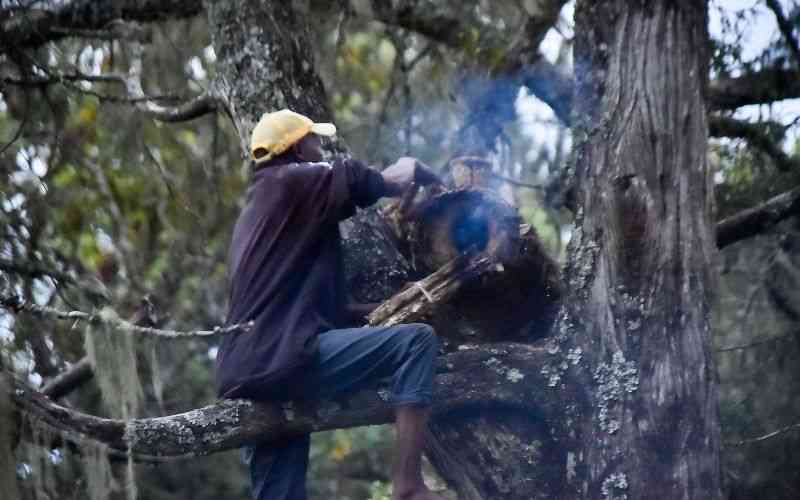
Kendi is an agronomist who works with about 300 small-scale beekeepers, most of whom keep one or two traditional beehives in Kirinyaga County.
Like tens of other beekeepers attending the training, Kendi says she wants to acquire knowledge of modern technologies and professional beekeeping skills that she can share with the farmers she works with.
Kendi says most of the farmers have limited land, knowledge and financial resources, making it difficult for them to invest in modern beekeeping equipment.
“Beekeeping is already part of many farmers’ homesteads. Unfortunately, they lack the skills and modern beehives that can help them maximise honey production. My goal is to help farmers make beekeeping an additional source of income,” she says.
She says that most of the farmers practise purely organic farming. Organic farming and beekeeping complement each other because bees play an important role in pollinating crops, thereby improving agricultural productivity.
Kendi was speaking during a beekeeping and pollination seminar organised by the Embassy of Israel through MASHAV-Israel’s Agency for International Development Cooperation in partnership with Kenya’s State Department for Livestock Development.
The four-day training brought together Kenyan beekeepers and Israeli experts to explore innovative beekeeping methods, modern technologies, honey production, improved pollination and climate-resilient practices.
Beyond honey production, the seminar highlights the critical role bees play in Kenya’s food security, agricultural productivity and farmers' livelihoods, particularly in high-value crops such as avocados and coffee.
Although Kenya has enormous untapped potential in beekeeping, the country currently produces only a fraction of what it could achieve. That’s why, through such partnerships, it hopes to boost honey production by equipping beekeepers with modern technologies, skills and knowledge.
Statistics from the State Department for Livestock indicate Kenya currently produces approximately 20,604 metric tonnes of honey annually against a domestic demand of about 43,500 metric tonnes.
This means local production meets only about 48 per cent of the country's honey demand, leaving a deficit of more than 52 per cent, which is largely bridged through imports, mainly from neighbouring countries, particularly Tanzania.
Kenya has approximately 1.8 million beehives. Of these, about 60 per cent are traditional log hives, while the remaining 40 per cent comprise modern beehives, almost equally divided between Kenya Top Bar Hives (KTBH) and Langstroth hives.
Principal Secretary, State Department for Livestock Jonathan Mueke described beekeeping as an important enterprise within Kenya's livestock sector, with significant potential to contribute to food security, employment creation, household incomes and environmental conservation.
He said the sector offers opportunities for youth and women, particularly in arid and semi-arid areas, where it diversifies livelihoods and strengthens household resilience.
Stay informed. Subscribe to our newsletter
Beyond honey and other beehive products, bees play a critical role in pollination, supporting agricultural productivity, biodiversity and sustainable food systems.
Mueke said Kenya and Israel have a longstanding partnership in agriculture, technology, innovation and capacity development. Kenya has much to learn from Israel's experience in agricultural technology, innovation and modern production systems.
“Our ambition is to transform apiculture from largely traditional production into a commercially competitive industry through improved production practices, quality assurance, value addition and access to markets. This includes strengthening linkages between beekeepers and crop farmers to maximise the benefits of pollination,” he said.
Mueke added that the government remains committed to strengthening the beekeeping value chain as part of the broader livestock transformation agenda.
He acknowledged the importance of Embassy of Israel and MASHAV partnerships in unlocking the sector's full potential.
Israel’s Deputy Ambassador Ariel Arviv said the two countries had a longstanding partnership through MASHAV, Israel’s Agency for International Development Cooperation, which has trained thousands of Kenyan professionals in agriculture, water management, healthcare and other sectors.
She noted that bees are important and essential for pollination, helping farmers produce many of the fruits, vegetables and crops being enjoyed today. Without bees and other pollinators, food systems would face serious challenges.
Arviv explains that beekeeping is therefore not only about producing honey. It is also about agricultural productivity, protecting biodiversity, creating income opportunities and strengthening food security.
“For Kenya, where agriculture supports millions of livelihoods, there is great potential to expand modern beekeeping practices and improve pollination, particularly for important crops such as avocados,” Arviv said.
However, the beekeeping sector also faces challenges. Arviv cites climate change, saying it presents new challenges to bee populations.
To her, this makes it even more important to share knowledge and adopt innovative practices that help farmers protect their bees and improve production.
Mueke also adds that climate change, habitat degradation and unsafe pesticide use increasingly threaten bee populations and their productivity.
“There is a need to promote climate-smart beekeeping, protect pollinators and recognise pollination as an essential agricultural productivity service,” he said.
Mueke reveals that the government plans to host the Nyuki Marathon 2027 in Nairobi. He explains that the event will use sport as a platform to raise awareness of the critical role bees play in pollination, biodiversity conservation, food security and sustainable livelihoods.







Subscribe to our newsletter and stay updated on the latest developments and special offers!