×

The Standard e-Paper
Join Thousands Daily
 The Standard Group Plc is a
multi-media organization with investments in media platforms spanning newspaper
print operations, television, radio broadcasting, digital and online services. The
Standard Group is recognized as a leading multi-media house in Kenya with a key
influence in matters of national and international interest.
The Standard Group Plc is a
multi-media organization with investments in media platforms spanning newspaper
print operations, television, radio broadcasting, digital and online services. The
Standard Group is recognized as a leading multi-media house in Kenya with a key
influence in matters of national and international interest.

Audio By Vocalize
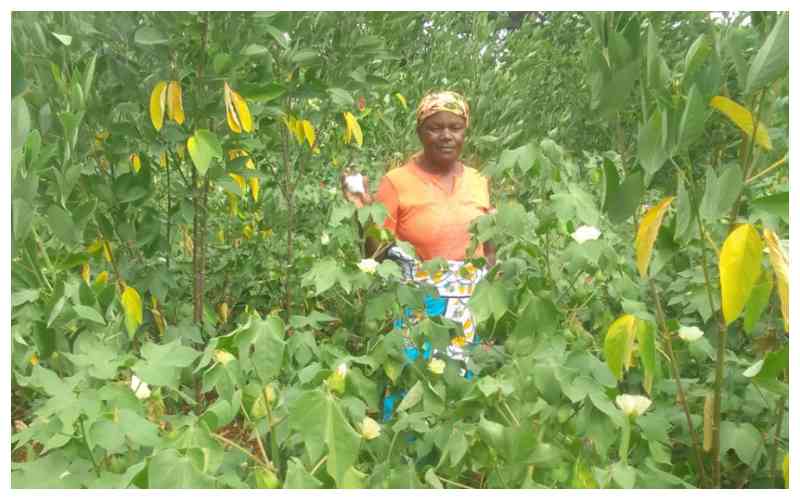
For nearly a decade, Winfrida Kasambu Muvea fought a losing battle with her cotton. Bollworms chewed through her crop. Pesticides ate into her already thin margins. In a good season, her three-acre farm in Chuluni village, Kitui County, produced about 500 kilograms of cotton, earning her about Sh26,000 a year. The work was demanding, but the returns barely justified the effort.
Today, the same farm tells a different story. Kasambu harvests more than 1,400 kilos of cotton per season, twice a year. She has become one of Kitui's best-known farmer advocates, advising fellow farmers, speaking at agricultural forums across Kenya and leading a farmer group of 82 members.
The transformation did not happen by chance. It came from combining modern agricultural science with a centuries old farming practice that had almost been forgotten.
The turning point came in 2020, when Kasambu was selected to join a group of Kitui farmers on a learning visit to Busia County, organised by the International Service for the Acquisition of Agri-biotech Applications (ISAAA), an organisation that promotes agricultural biotechnology, under the leadership of Dr Margaret Karembu.
There, she came across Bt cotton, a genetically modified variety developed to resist the destructive bollworm that had plagued her fields for years. The difference was immediately visible. The cotton plants were healthier, fuller and showed far less pest damage than the conventional varieties she had been growing. “Through the Busia visit, I became a Bt cotton champion,” she says with a laugh. “Now I even advise farmers struggling with their fields.”
Since then, Kasambu has become one of Kitui's most vocal farmer champions for Bt cotton, sharing her experiences across the country. Her story has also been documented as an example of how biotechnology can improve smallholder livelihoods.
Bt cotton remains one of Kenya's most debated agricultural technologies. Supporters argue that it reduces pest losses and increases yields, but critics question long-term dependence on certified seed and continue to challenge aspects of the country's biotechnology policy. For Kasambu however, the debate is measured in harvests.
What makes her farm remarkable is not simply the cotton she grows but how she grows it. Across her fields are carefully dug pits created using the traditional Zaï technique, an indigenous water harvesting method practised for generations across the semi-arid regions of Africa. The pits capture rainwater and concentrate it around the roots of crops, helping the soil retain moisture through prolonged dry spells. “The holes collect water,” she explains. “That water helps during the dry season.”
The technique originated from the Sahel, where farmers have long relied on it to restore degraded land and make the most of scarce rainfall. Before the rains arrive, shallow pits are dug and filled with compost or manure. When the rains finally come, the pits trap water that would otherwise run off hardened ground, allowing crops to survive even when rainfall is limited.
On Kasambu's farm, those traditional Zaï pits sit beside rows of BT cotton, old knowledge working alongside modern science. In a county where rainfall has become increasingly unpredictable, the combination has become more than a farming technique. It is a practical climate adaptation strategy.
The results speak for themselves. She now harvests more than 1,400 kilos per season, a major increase from what she harvested before. Her first BT cotton harvest in 2021 earned her more than Sh66,000. With cotton now selling at about Sh72 per kilo, a good harvest gives her close to Sh100,000, and she harvests twice each year.
The transformation is visible throughout her home: The sofa set in her sitting room, the tractor she now uses on her farm, the school fees she pays for her grandchildren, are all from the income earned from BT cotton. But Kasambu is less interested in what she has gained than in what she can pass on.
As chairperson of an 82-member farmer group in Chuluni Ward, Kasambu helps distribute seed and farm inputs, advises struggling farmers and encourages more women and young people to see farming as a viable business. “I educate other farmers and empower them on how to be dependable,” she says.
Her journey, however, has also exposed the challenges facing cotton farmers. Nearly 50 members of her original farmer group had to stop growing cotton, not because the crop failed, but because certified seed often arrives too late.
“Sometimes farmers cannot wait,” she says. “If the seeds delay, they plant other crops to earn income.” It is a practical illustration of the very concern critics raise about GMO crops: That dependence on certified, bought-in seed can leave smallholders exposed when supply falters.
Stay informed. Subscribe to our newsletter
She believes stronger farmer cooperatives and better coordination in seed distribution would allow more farmers to benefit from improved cotton varieties. “What we are lacking is cooperatives,” she says. “We need support so farmers can access seeds and solve problems together.”
Despite those challenges, Kasambu remains convinced that farming offers one of the surest paths to financial independence. “I would like to advise women to go into farming,” she says. “When you farm, you can manage your own finances.”
Her message to young people is equally direct. “Work is there if you work with your own hands,” she says. “And I am ready to continue farming.”
Long before she became a respected farmer leader and conference speaker, Winfrida was simply a girl watching her father grow cotton in Kitui Central. Years later, on the same dry landscape, she combines centuries-old water harvesting with modern biotechnology to grow a crop many had almost given up on.
In a region where failed rains can wipe out an entire season, her farm offers a reminder that innovation does not always mean abandoning tradition. Sometimes, the strongest solutions emerge when the two work together.






Subscribe to our newsletter and stay updated on the latest developments and special offers!






 join
join