×

The Standard e-Paper
Smart Minds Choose Us
 The Standard Group Plc is a
multi-media organization with investments in media platforms spanning newspaper
print operations, television, radio broadcasting, digital and online services. The
Standard Group is recognized as a leading multi-media house in Kenya with a key
influence in matters of national and international interest.
The Standard Group Plc is a
multi-media organization with investments in media platforms spanning newspaper
print operations, television, radio broadcasting, digital and online services. The
Standard Group is recognized as a leading multi-media house in Kenya with a key
influence in matters of national and international interest.

Audio By Vocalize
Kenya and other African countries have intensified efforts to adopt and implement harmonised standards to boost exports and imports among themselves.
They noted that disjointed standards have made it difficult for goods to move across the continent, hindering plans to expand intra-Africa trade and leaving most countries to rely on imports from outside Africa.
Experts on standards agreed to eliminate technical trade barriers and reduce the cost of doing business across the continent by adopting harmonised standards so that goods and services are accepted within the continent.
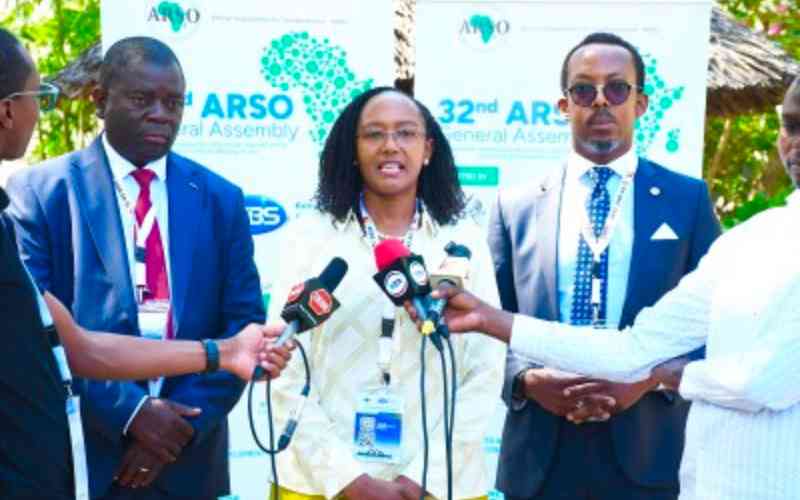
The experts attending the African Organisation for Standardisation (ARSO) Council meeting and general assembly in Mombasa this week sought ways to accelerate the harmonisation of standards under the African Continental Free Trade Area (AfCFTA).
According to officials, delayed adoption of harmonised standards will slow down the implementation of continental trade through non-tariff barriers, as products will not freely move through countries with different standards.
Kenya Bureau of Standards (Kebs) Managing Director Esther Ngari said harmonised standards will allow products certified in one African country to access other markets without undergoing repeated testing and certification.
She said products are currently subjected to testing at different borders, adding unnecessary costs and delays for manufacturers and traders.
The harmonised system seeks to achieve the principle of one standard, one test and one certificate accepted across the continent, making it easier for businesses to move their products from one African market to another.
Ngari said the initiative is critical in boosting intra-African trade, which currently stands at about 16 per cent.
“As Africa, we cannot remain disjointed; we need one harmonised certificate working for us in the bigger African market. Without harmonised standards, products cannot move from one country to another. It will require multiple tests, which will add extra cost to trade, and this is not necessary,” she told the meeting.
“Once we adopt standards, products tested in Nairobi will access the market in South Africa or Ghana,” Ngari added.
Kenya has signed the AfCFTA agreement, with officials saying the implementation of harmonised standards will be a key driver in unlocking the benefits of the continental free trade agreement.
Kebs is hosting the meetings under the theme “Standards Enabling Intra-African Trade: One Certificate Working for You.”
ARSO Secretary General Dr Hormogen Nsengimana said more than 2,700 standards have already been harmonised based on continental trading patterns.
However, he said the standards currently cover about 28 per cent of the submitted tariff lines under AfCFTA, leaving a significant gap that still needs to be addressed.
Stay informed. Subscribe to our newsletter
He said harmonisation of standards alone is not enough, as countries are required to adopt and implement them to facilitate continental trade.
Nsengimana said the Africa Quality Mark has so far been launched in nine countries, which facilitates cross-border trade, with 10 more in the pipeline.
“Strengthening testing laboratories and conformity assessment facilities is also being prioritised to improve countries' capacity to verify compliance,” he explained.
However, Nsengimana noted that 10 out of the 54 African countries are yet to join ARSO despite a 2014 resolution by heads of state calling for all countries to become members.
“Ten countries are yet to join ARSO. We need those countries to come on board,” he urged.
Nsengimana said the initial focus was on agro-processing, while standards are also being developed in sectors, including automotive, pharmaceuticals, transport and services, and textiles and leather.
ARSO champions chairman and Zambia Bureau of Standards Executive Director Nathan Sing'ambwa said the countries yet to join are being encouraged to participate in the development and harmonisation of continental standards.
Sing'ambwa said common standards will make it easier for businesses to trade across borders and remove technical barriers that have continued to hinder intra-African commerce.
For manufacturers and entrepreneurs, Sing’ambwa said compliance with standards should not be viewed simply as an additional cost but as value-added to products and services.
They argue that certification adds value to products, improves consumer confidence and enhances the competitiveness of businesses seeking access to both local and international markets.
“We are going to engage ARSO members to adopt and implement harmonised standards so that we do away with technical barriers to intra-Africa trade. We want ARSO members to adhere to harmonised standards because they do not add cost but instead add value to products,” he stated.
With ARSO members seeking to create a single continental market, stakeholders said harmonised standards will be critical in ensuring that African businesses can trade more efficiently, competitively and at lower cost.





Subscribe to our newsletter and stay updated on the latest developments and special offers!









 join
join