×

The Standard e-Paper
Home To Bold Columnists
 The Standard Group Plc is a
multi-media organization with investments in media platforms spanning newspaper
print operations, television, radio broadcasting, digital and online services. The
Standard Group is recognized as a leading multi-media house in Kenya with a key
influence in matters of national and international interest.
The Standard Group Plc is a
multi-media organization with investments in media platforms spanning newspaper
print operations, television, radio broadcasting, digital and online services. The
Standard Group is recognized as a leading multi-media house in Kenya with a key
influence in matters of national and international interest.

Audio By Vocalize
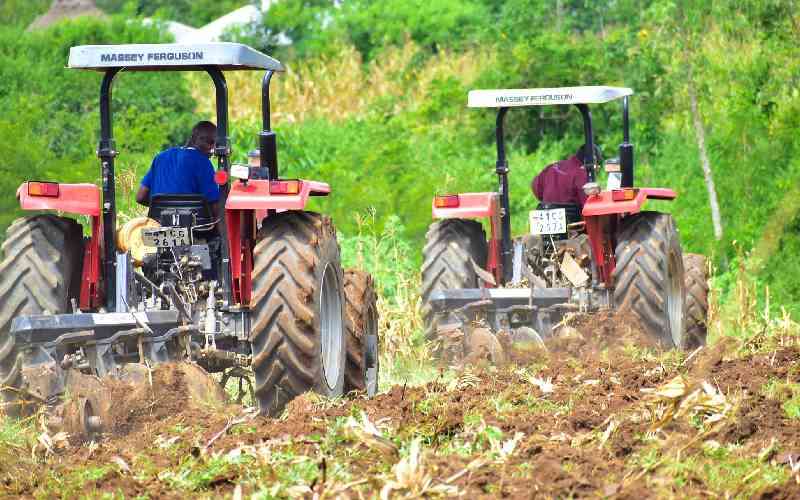
Tractors ploughs farms in Siaya county. [Olivia Odhiambo, Standard]
Between June 8 and 10, Nairobi will host more than 1,000 farmer leaders, policymakers, researchers, investors, and development partners from around the world for the World Farmers’ Organisation (WFO) General Assembly.
More than just another international conference, the forum presents a unique opportunity for Kenya and Africa to help shape the future of agriculture from an African perspective.
Agriculture remains the backbone of many African economies, and nowhere is this more evident than in Kenya.
The sector contributes approximately 22 per cent of GDP directly and a further 27 per cent indirectly through its linkages with manufacturing, trade, transport, and other sectors.
Export earnings
It accounts for more than 60 per cent of export earnings and supports the livelihoods of over 70 per cent of the rural population. Women and youth form a significant part of this workforce.
Women contribute an estimated 60 to 80 per cent of agricultural labour across Africa, while more than 60 per cent of the continent’s population is under the age of 25.
Unlocking the potential of these groups will be critical to the future of African agriculture.
The challenges facing farmers are significant. Climate change, rising production costs, limited access to finance, and market inefficiencies continue to constrain productivity and profitability.
Yet these challenges are not unique to Kenya. They are shared by farming communities around the world. That is precisely why the WFO General Assembly matters.
For four days, Nairobi will become a global meeting point where farmers themselves—not just governments and development agencies—help shape conversations on food systems, climate resilience, trade, innovation, and investment.
At a time when food security has become a global priority, ensuring that farmers have a stronger voice in decision-making is more important than ever.
Anchoring these discussions is the Assembly’s theme: “Future Fields: Investing in Farmers’ Organisations and Empowering Communities for Sustainable Agriculture.”
The theme recognises a simple but powerful truth: sustainable agricultural transformation begins with strong farmer organisations.
Stay informed. Subscribe to our newsletter
Globally, the WFO provides a platform for farmers to influence policy and contribute to solutions on food security and sustainable development.
Farmers’ voices,
In Kenya, the Kenya National Farmers Federation (KENAFF) plays a similar role by amplifying farmers’ voices, promoting knowledge sharing, and strengthening farmer representation.
Investing in such organisations is essential to ensuring farmers remain at the centre of agricultural development.
Several issues will be particularly important for Africa. Empowering women farmers, increasing youth participation, expanding access to technology, and strengthening agricultural value chains are all critical to the continent’s future. Kenya’s leadership in digital and financial inclusion
demonstrates how technology can connect farmers to markets, weather information, extension services, credit, insurance, and digital payments.
The challenge now is ensuring these innovations reach all farmers, especially women, youth, and rural communities.
Perhaps most importantly, Kenya’s hosting of the Assembly offers Africa an opportunity to move from the margins to the centre of global agricultural conversations.
Too often, discussions on food systems, climate change, and agricultural investment are shaped without sufficient representation from the farmers most affected by these issues.
Yet African farmers possess valuable experience in adapting to environmental uncertainty, managing scarce resources, and building resilience.
Africa’s challenges
The Assembly provides a platform not only to highlight Africa’s challenges but also to showcase its solutions, innovations, and leadership.
The success of the 2026 WFO General Assembly should not be measured by the number of delegates who attend or speeches delivered from conference podiums.
It should be measured by the partnerships formed, investments mobilised, policies influenced, and opportunities created for farmers long after the event concludes.
As the world turns its attention to Nairobi, Kenya has an opportunity to demonstrate that the future of agriculture will not be shaped for African farmers—it will be shaped with them.
-The writer is Chief Executive Officer, Kenya National Farmers’ Federation







Subscribe to our newsletter and stay updated on the latest developments and special offers!