×
App Icon
The Standard e-Paper
Join Thousands Daily
★★★★ - on Play Store
Download App

Taking care of environment is part of religious leaders' work

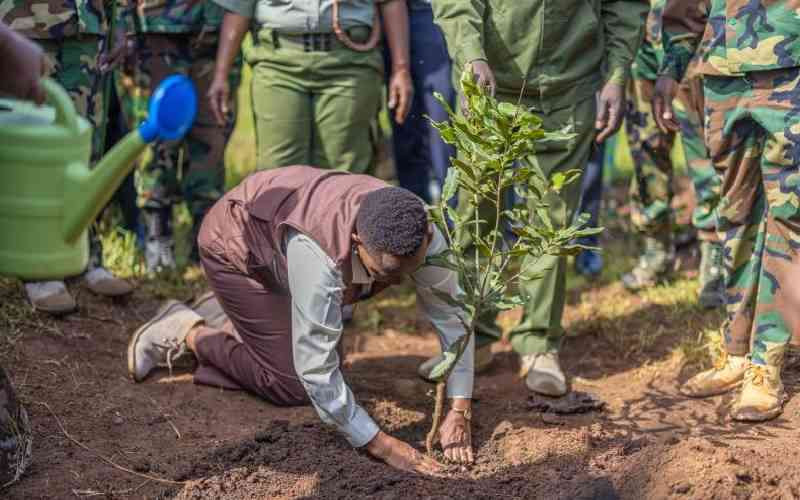
First Lady Mama Rachel Ruto during a tree planting exercise at Shikuse prison in Kakamega County on June 8, 2023. [PCS, Standard]

Last year, on a trip to Ethiopia, my Tanzanian colleague Amani Shayo and I had the pleasure of meeting  Wassie Alemayehu, an incredible conservation leader and a foremost authority on the Ethiopian Church Forest programme.

As we sat with him and his team from ORDA-Ethiopia to help them strategise, they described their work. I was fascinated, not just by the interplay between faith and conservation, but by Ethiopia's enduring allure for those of us whose parents were in the Mau Mau Freedom Movement.

For my family, it was a place of refuge for freedom fighters, a mythical landscape that swallowed up heroes. It was where General Stanley Mathenge, one of our most storied Mau Mau leaders, went in search of arms in 1955 and was never seen again, dissolving into the country’s vastness, becoming more legend than man.

Many will remember the kerfuffle after President Mwai Kibaki came to power, when an Ethiopian elder, Mr Lema Ayanu, was brought to Kenya, presented as the long-lost General. To visit Ethiopia was, in a small way, to search for a piece of our own lost history.


In the highlands, I found a different kind of sanctuary. Dr Alemayehu spoke of the church forests, and though I did not see the ones in Amhara, his description was picturesque. From the air, they are emerald islands in a sea of brown.

On the ground, they feel like portals to another time. At the heart of each forest is a church, its walls painted with saints and angels. These ancient pockets of biodiversity have survived for centuries because they are sacred. But they are more than that; they are also the final resting places for the community.

The dead are buried here, their bodies returning to the soil, shaded by the same ancient trees that shelter the church. The forest becomes a bridge between the living and the ancestors, a physical manifestation of the spiritual realm.

As I listened to Alemayehu, it struck me that this was not a “conservation project” as we know it, with donor logos and five-year plans. This was a living covenant between faith and the forest. The community wasn’t protecting the forest for its carbon sequestration value, but because it was the sacred cloak around their church—the living cathedral that housed both the divine and the dead. The forest was not a resource; it was a sanctuary.

The idea that faith can be a powerful organising mechanism for conservation is not unique to Ethiopia. It’s a truth we have known here at home. I think of the Kaya forests along our coast, the sacred groves of the Mijikenda people, which are so much more than just trees. They are the final resting places of ancestors and sites of sacred rituals. For generations, these forests were protected not by fences, but by a powerful system of cultural and spiritual beliefs. This is conservation written not in policy documents, but in the hearts of the people.

I also think of the Marian National Shrine in Subukia. In the early 1990s, when the surrounding hills of the Bahati forest were being stripped bare, it was the Catholic faithful, led by the indefatigable Fr. John Jones, who began the slow work of rehabilitation. They planted trees not for payment, but as an act of devotion, understanding that the “healing waters” of the shrine were inseparable from the health of the watershed. They were practising a theology of place.

So why, in a world awash with climate reports, do we so often ignore this powerful framework for stewardship? Faith-based approaches can complement existing policies by embedding conservation within cultural and spiritual contexts that resonate deeply with communities. When faith and policy work together, they reinforce each other, making environmental actions more meaningful and sustainable.

This is not a romantic notion; it is a practical one. The legitimacy of a village priest, an imam, or a council of elders is often more deeply rooted and trusted than that of any government agency. The core teachings of the world’s great faiths convey a powerful ecological message. The Bible begins in a garden, with a mandate to “work it and take care of it” (Genesis 2:15). The Quran speaks of a world created in perfect balance (mīzān) and instructs believers to “walk on the earth humbly” (Quran 25:63), recognising they are stewards, not masters. The Bhagavad Gita sees the divine in all of creation, teaching that to harm nature is to dishonour its source.

This wisdom is the bedrock of countless African indigenous traditions, from the sacred groves of Ghana and Nigeria to the philosophy of Ubuntu, which teaches that our own humanity is inextricably bound to the well-being of the whole community of life.

We are at a moment of profound ecological crisis. The land is speaking to us in the harsh language of drought, flood, and famine. We need more than new technologies; we need a moral and spiritual awakening, a rediscovery of the stewardship language already present in our traditions.

This is a call to action for every faith leader. Look to your scriptures. The call to care for creation is a core part of your spiritual inheritance. You have the trust of your communities and the moral authority to speak not just about the world to come, but about our sacred duty to this one. Lead your congregations into the living world. Organise your people to grow trees, clean rivers, and protect the soil. Make the care of creation a central part of your ministry.

The solutions to our environmental crisis will not come from global conferences alone. They will come from the ground up, from communities inspired to act. Faith has always been one of the most powerful mobilising forces in human history. It is time to unleash that power for the healing of our planet, and to remember that the cathedral and the seed, the sacred text and the living soil, are one and the same.