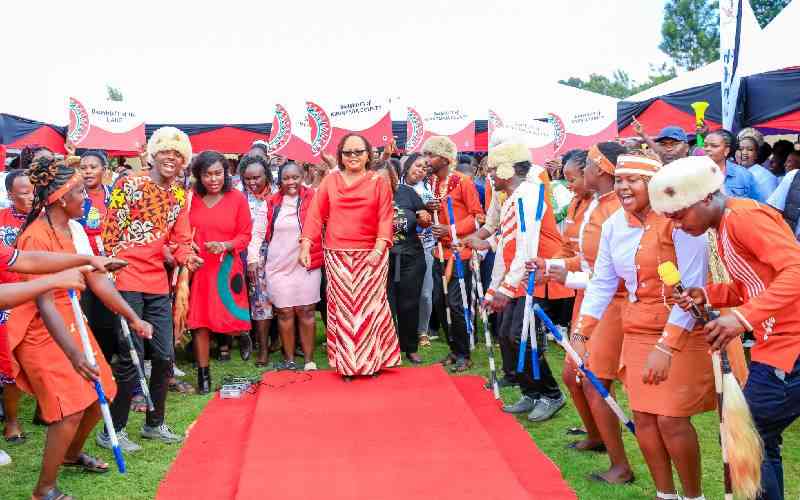
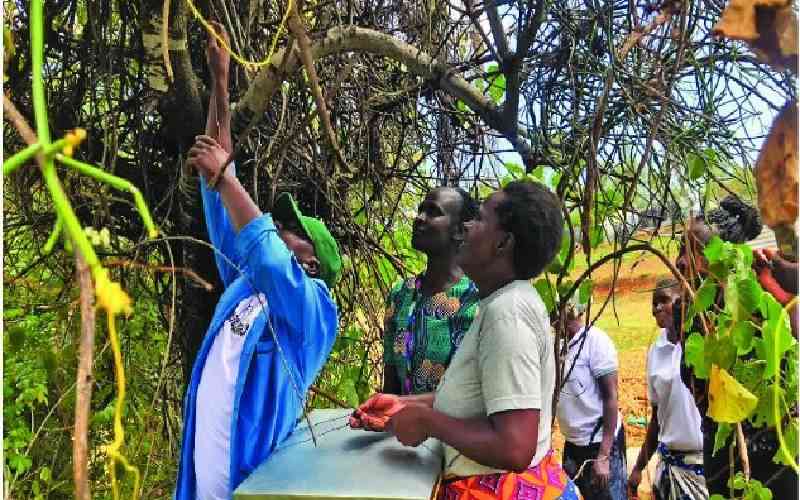
Kirinyaga Governor Anne Waiguru joins Muthigi cultural dancers during the launch of She campaign bus aimed at attracting more to seek elective positions come 2027, on December 18, 2025. [Jane Mugambi-Standard].
Politically speaking, Kirinyaga County occupies a unique and often misunderstood place in Kenya’s power matrix. The seat of Mwenenyaga, the deity of the Gikuyu, is a symbolic no man’s land in the ongoing contest for the political heart and soul of the larger Mt Kenya region. Its politics are layered, cautious, and at times deliberately opaque—qualities that make Kirinyaga both pivotal and perplexing.

This reality hits you in private conversations with many aspiring politicians positioning themselves for the 2027 elections, and who, interestingly, project a potent mix of quiet confidence and deep uncertainty.
Historically, Kirinyaga has been the silent centre of executive power in Mt Kenya since independence. When Jomo Kenyatta died, it was a powerful mandarin from Kirinyaga—Geoffrey Kareithi Karekia, then Head of the Civil Service—who knew with certainty that the President was dead, long before the nation was formally informed. That quiet proximity to power has defined the county for decades.
The county has produced men and women who controlled power either quietly, like former intelligence chiefs James Kanyotu and Michael Gichangi or loudly, like James Njiru, once in charge of the Orwellian-sounding docket of “National Guidance and Political Affairs.”
Kirinyaga is also the home of Martha Karua—a political icon and one of the foremost heroines of Kenya’s second liberation; a vocal and stubbornly resilient presence in both county and national politics
Alongside her legacy are those of lesser-known freedom fighters, including first liberation heroes, like Kassam Njogu—famous for his trademark one leg—who attempted to rise above the region’s deeply entrenched coffee and tea politics to assert their place in history. Yet such is the viciousness of Kirinyaga politics that even Kassam’s liberation credentials were persistently questioned.
With the 2027 election around the corner, a good number of aspiring politicians from the region claim to be ‘quietly’ mobilising grassroots support and “listening to the ground.” In private, many will admit that they are yet to decide which political party they will use. Some say they have been ‘advised’ to keep their party cards hidden until the political horizon clears.
This vagueness is characteristic of Kirinyaga politics. Critics often argue that the county cannot be politically defined—not even through the lens of the wider Mt Kenya region. As narratives of splitting the Mt Kenya vote between East and West gain momentum, Kirinyaga finds itself trapped inside a chasm of political indefiniteness.
If Mt Kenya West refers to counties that formed the former Central Province, and Mt Kenya East to the larger Meru and Embu bloc, then Kirinyaga—a hybrid of both—fits nowhere neatly.
One could even argue it should secede politically to form “Mt Kenya Central.” Historically, this would not be far-fetched. Formerly Kirinyaga District, the county was carved out of both sides of the mountain, at one point falling under Eastern Province through Embu District, which once extended a few kilometres from Nyeri.
In the political engineering currently unfolding in the Mt Kenya, Kirinyaga sits snugly in the middle—geographically, culturally, and politically. Even linguistically, the Kirinyaga accent of Gikuyu carries hints of Kikamba, Kimeru, Kiembu, and the richer Nyeri and Murang’a inflections.
In the simmering East–West battle for Mt Kenya supremacy, Kirinyaga remains a no-man’s land. Former Deputy President Rigathi Gachagua, educated in Kirinyaga’s iconic Kianyaga Boys High School, can credibly claim close ties to the county. Yet Murang’a, to the south, can make an equally strong claim—sharing towns like Sagana and reinforced by marriage ties, with Governor Anne Waiguru herself married to Kamotho Waiganjo, a prominent son of Murang’a.
Word on the ground is that Waiguru is working on her biography as her second term draws to a close. Hopefully, it will offer a roadmap for navigating the murky waters of Kirinyaga politics. Until then, any would-be successor can be forgiven for keeping their cards firmly under the table. For the people of Kirinyaga, much like the masses in Carl Sandburg’s poem, 'I am the people, the mob', may appear politically docile for long stretches—only to awaken suddenly and change course entirely, and overnight.
Stay informed. Subscribe to our newsletter