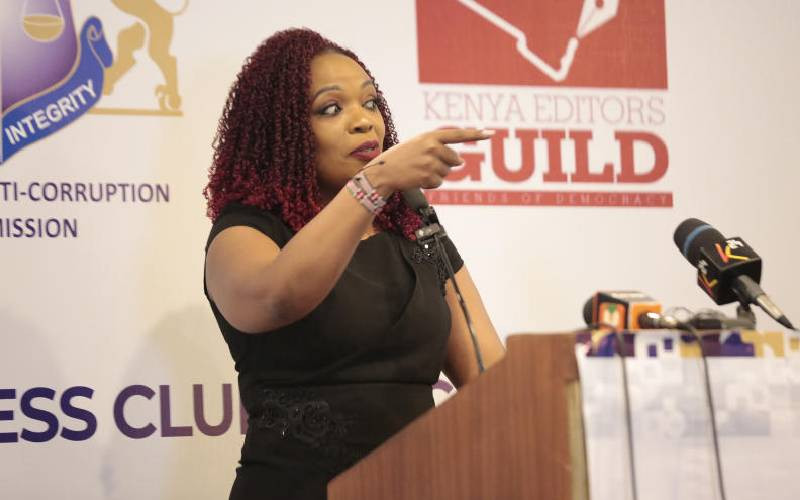
Kenya Editors Guild (KEG) President Zubeida Kananu addressing participants during the Press Club Luncheon on April 3, 2025.[Boniface Okendo, Standard]


Dutchman Johan Thorbecke famously cautioned that trust arrives on foot but leaves on horseback.
Today in the media sector, the crisis isn’t just technology but shrinking trust in the news. That’s why it’s heartening to see trust feature in next week’s Kenya Editors Guild (KEG) Convention agenda.
Themed ‘Truth, trust and technology: The place of journalism,’ the Kilifi summit is expected to offer a deep reflection on Kenya’s journalism landscape. When gurus meet, they help us tackle burning questions. Now, how can journalists mitigate public anxiety? How can they rebuild trust? Can the industry usefully navigate Artificial Intelligence? How about the social media onslaught in the age of junk information? Then sustainability, convergence and of course, the role of those ‘predatory’ big techs behaving like ogres. These aren’t ordinary times. Donald Trump’s tiff with the BBC over a documentary about the January 6 attack on the US Capitol attack offers a glimpse into the media’s larger ‘civil war’ over accountability and trust. But these shouldn’t suggest the global media industry is passive. In Australia and South Africa, regulators have literally pushed back against tech firms’ Trump-like bullying over content monetisation.
At the Media Council of Kenya summit last April, it was all a cautious optimism. A report tabled by CEO David Omwoyo showed that journalists are resilient despite threats to their welfare, assault on freedom, effects of technology and shifting audience preferences. Still, the report showed that ‘some trust’ in the local media stood at 51 per cent. Then ‘a lot of trust’ polled at a paltry 23 per cent. Globally, trust in the news averages 40 per cent, according to the latest Reuters Institute’s Digital News Report, and is largely influenced by differing cultural, political and media systems. Today, the fragility of trust in our own Kenyan news brands is laid bare when public officials call their credibility into question. Like the case of ICT Cabinet Secretary William Kabogo who recently claimed that headlines are crafted elsewhere then sent newsrooms for processing. No one has answered him yet. But even when accusations are politically motivated, openness to feedback builds credibility. What if Mr Kabogo had a point?
Ahead of next Wednesday’s KEG summit, and the February 2026 Africa Editors Congress in Nairobi, here’s my two cents: Trust in the news must be protected. The industry’s credibility is only as sturdy as the audience’s faith in it. It’s also important to note that the Fourth Estate’s foremost asset is the few who can still believe in it. News avoidance is a disaster in waiting.
I suggest an end to neutrality. Newsrooms should take a stand on issues of national importance. There’s no harm being biased. Meanwhile, statutory regulation is cool but not enough. Newsrooms must embrace self-regulation as a living discipline. Can MCK enforce ethics 24/7 when they don’t sit in editorial meetings where content decisions are made? We must empower journalists to ‘police’ themselves. Similarly, there shouldn’t be obstructive stylebooks. Meanwhile, perception is a bigger ‘elephant in the room’ which stings far more than truth. For instance, President William Ruto is a champion of free press yet his scheduled appearance at KEG convention raises questions on mass media’s watchdog role. The guest list raises the guild’s profile but can fatally dent its values. To Wanjiku, the image of gatekeepers swapping smiles with the powers they claim to ‘watchdog’ is hard to stomach. On July 12, 2013, some editors enjoyed breakfast at State House. Three years later, a colleague was targeted over a mere editorial. In 2018, TV stations were shut for 13 days despite court orders. What became of the ‘partnership’?
That said, President Ruto impressed me when he told Al Jazeera that press freedom is sacrosanct under his leadership. Ruto held that under our democracy, a president can’t monopolise public opinion, or even garner 98 per cent votes. Media and State need not be adversaries, but must avoid blind companionship. In Kilifi, may editors bring fresh ideas to our besieged industry in this absurd era where even college graduations of editors count as breaking news. Godspeed!
The writer is a communications practitioner. X:@markoloo