×

The Standard e-Paper
Stay Informed, Even Offline
 The Standard Group Plc is a
multi-media organization with investments in media platforms spanning newspaper
print operations, television, radio broadcasting, digital and online services. The
Standard Group is recognized as a leading multi-media house in Kenya with a key
influence in matters of national and international interest.
The Standard Group Plc is a
multi-media organization with investments in media platforms spanning newspaper
print operations, television, radio broadcasting, digital and online services. The
Standard Group is recognized as a leading multi-media house in Kenya with a key
influence in matters of national and international interest.

Audio By Vocalize
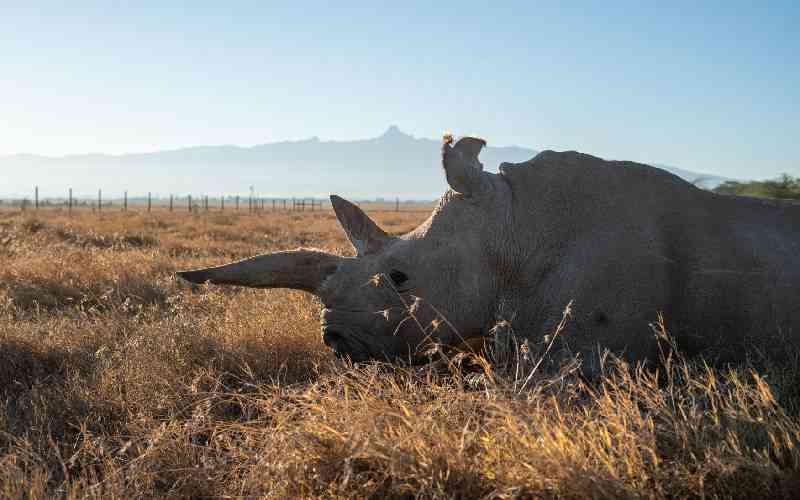
Najin, one of the world’s last two northern white rhinos, rests inside her protected enclosure at Ol Pejeta Conservancy in Laikipia County. [Amos Kiarie, Standard]
Civil unrest and poaching have reduced the northern white rhino from a species that once roamed across Central Africa to just two ageing females living under round-the-clock protection in Kenya.
Once found in Uganda, Chad, Sudan, the Central African Republic and the Democratic Republic of Congo, the northern white rhino was devastated by years of conflict and poaching across its natural range. The subspecies is now considered extinct in the wild, with only Najin and her daughter Fatu left.
The two females are the living remnants of a population that conservationists once hoped could be saved by moving the last survivors to safety in zoos in the Czech Republic and US.
Four northern white rhinos — Najin, Fatu, Sudan and Suni — had been kept at Dvůr Králové Zoo in the Czech Republic, where repeated breeding attempts failed. Conservationists then turned to Africa, hoping that returning the animals to a more natural environment would give them a better chance of reproducing.
On December 20, 2009, the four were airlifted to Kenya and later driven by truck to Ol Pejeta Conservancy. Najin was about 20 years old at the time, while Fatu was nine.
They were accompanied by their caregivers from the Czech Republic who trained the Kenyan team on how to care for the animals, understand their behaviour and help them settle into their new surroundings.
The plan was simple but urgent: return the animals to an environment closer to the one in which their ancestors evolved and give them another chance to breed.
But nature could not undo decades of human destruction. Suni died in 2014, followed by Sudan, the last male northern white rhino, in March 2018.
With the two males gone and veterinary examinations showing that the surviving females could not reproduce naturally, conservationists were left with an extraordinary problem: how to create a new generation from two females who could not carry a pregnancy.
Najin's problem is partly physical. Years spent on a concrete floor at the zoo in the Czech Republic contributed to deformities in her hind legs, leaving them unable to bear the additional weight associated with pregnancy. She eventually retired from the egg-collection programme in 2021.
Fatu, meanwhile, has a uterus that prevents her from carrying a pregnancy to term.
But her ovaries continue to provide viable eggs, making her central to efforts to preserve the northern white rhino's genetic future.
Those eggs, combined with preserved sperm from northern white rhino males, have produced embryos.
The BioRescue Consortium, an international alliance of scientists working on the project, has so far produced 39 northern white rhino embryos, which remain part of a painstaking attempt to produce a calf through assisted reproduction.
Stay informed. Subscribe to our newsletter
The embryos cannot simply be implanted into Najin or Fatu.
Scientists need suitable southern white rhino surrogate mothers to carry the pregnancies.
That is where the story of the two surviving females becomes even more complicated — because their lives inside the protected enclosure are not simply about feeding and protection.
They are also about behaviour, relationships and learning.
In 2018, a southern white rhino named Tauwo was introduced to Najin and Fatu. The intention was to give the northern white rhinos the opportunity to learn behaviours they might need in a natural environment.
Tauwo became particularly close to Fatu. Instead of simply acting as a teacher, however, she formed a strong bond with Fatu, at times separating her from Najin even though the three animals continued to live together in the 100-acre enclosure.
For Jeremy Kimathi, who has watched the animals for years, such relationships are part of what makes his work so fascinating.
“Najin and Fatu have different personalities, and as caregivers, we have learnt to understand each of them. Najin is generally calm and familiar with us. She can sometimes have a bad temper, but when I call her, she responds and comes to me,” he said.
“Fatu, on the other hand, is more sensitive to disturbance. She does not like noise, shouting or too much activity around her. So, when caring for them, we have to understand their behaviour and character because every animal is different.”
Najin is also the larger of the two, with a longer back and a big, long horn, while Fatu is smaller.
“We look at their behaviour and character before everything else. You have to know the animal well to notice when something has changed,” Kimathi added.
He noted that they graze on grass, rest, drink water and move around the enclosure. Unlike black rhinos, which are browsers and feed mainly on leaves, shoots and twigs, white rhinos are grazers, using their wide mouths to crop grass.
The animals also sharpen their horns as part of their normal behaviour, rubbing them against hard surfaces and using them in interactions with their environment.
“Rhinos have their own ways of keeping themselves and their environment in order. They sharpen their horns by rubbing them against hard surfaces such as stones, hard soil and trees. They also have what we call a rhino midden, or toilet area, where they deposit their dung and urine in one area instead of spreading it across the grassland,” he said.
“This helps keep the areas where they feed clean because they do not want to spoil their feeding ground. They have their own routine — they feed, move around, rest and sleep. In a day, they can sleep for about eight hours.”
Kimathi has learnt to recognise these ordinary behaviours because any change can signal a problem.
Every morning, the five caregivers begin by checking where the rhinos spent the night, their body condition, feeding, movement and behaviour. They inspect the water and fences and look for signs that another animal or intruder has entered the enclosure.
“We are five caregivers, and every morning when I wake up, I have only one thing on my mind — how are the two rhinos doing? Before I even have my breakfast, I rush to the 100-acre enclosure where they are protected. When I see them alive, healthy and moving around, I always smile. It gives me a feeling that we are doing something right to keep them alive,” he said.
The ground itself can tell a story. Scratches on their bodies and marks where the animals have slept, moved or rubbed themselves can help caregivers understand what happened when nobody was watching.
But Kimathi's relationship with the rhinos goes beyond checking their health. He loves watching them play.
One of his greatest moments is seeing Najin and Fatu enjoying themselves in the rain. For a few moments, there is no talk of extinct populations, failed breeding attempts, embryos or the genetic future of a subspecies.
His relationship with rhinos began long before he was entrusted with Najin and Fatu.
“I started as a rhino monitor in 2000, but in 2003, I was injured by a black rhino while I was out in the wild monitoring them. After that, I moved from monitoring to night guarding, where I continued looking after and protecting the rhinos,” he said.
In 2009, he was among the caregivers selected to welcome the four northern white rhinos to Kenya after their transfer from the Czech Republic.
“That is how we started learning to take care of these animals and understand their needs,” he recalls.
Technology now works alongside that experience. CCTV cameras, night-vision motion sensor enabled cameras and infrared systems help rangers monitor the animals and their surroundings, particularly when darkness makes direct observation difficult. Electric fencing provides another layer of protection, helping keep the rhinos within their secure enclosure while deterring intruders.
“The technology does not replace the caregiver who knows the animals; it extends the caregiver's reach,” he said.
At night, another team takes over, keeping watch over the enclosure until the caregivers return the following morning.
For Kimathi, the round-the-clock protection carries a painful reminder of how the northern white rhino reached this point.
“We have lost two males, this is caused by humans, and it is humans now working very hard to save them from extinction,” Kimathi said.
That effort has moved far beyond protection.
The 39 embryos now held by the international breeding programme represent an attempt to preserve a future for the subspecies after natural reproduction became impossible. Fatu continues to provide eggs for the programme, while Najin's physical condition means she can no longer take part in egg collection.
On September 22, the world will mark World Rhino Day under the theme “Keep the Five Alive”. For the northern white rhino, the challenge is already at its most extreme. There are no wild populations left to protect and no male remains alive. There are only Najin and Fatu — and the genetic material scientists hope can eventually produce another generation.
Until then, Kimathi's task remains deliberately ordinary: watch them, understand them and protect them.
“People need to understand why these animals are important, not only because they are part of our natural heritage, but also because they play an important role in the ecosystem. Rhinos help shape the environment through their grazing and movement, and their presence contributes to maintaining healthy grasslands. If we do not sensitise the public, especially the younger generation, they may grow up without understanding what we have lost," said Kimathi.
"We have seen what happened to the northern white rhino, and we do not want to repeat the same mistake with other rhinos. When people understand their value and the threats they face, they are more likely to support their protection,” he said.







Subscribe to our newsletter and stay updated on the latest developments and special offers!







 join
join