×

The Standard e-Paper
Kenya’s Boldest Voice
 The Standard Group Plc is a
multi-media organization with investments in media platforms spanning newspaper
print operations, television, radio broadcasting, digital and online services. The
Standard Group is recognized as a leading multi-media house in Kenya with a key
influence in matters of national and international interest.
The Standard Group Plc is a
multi-media organization with investments in media platforms spanning newspaper
print operations, television, radio broadcasting, digital and online services. The
Standard Group is recognized as a leading multi-media house in Kenya with a key
influence in matters of national and international interest.

Audio By Vocalize
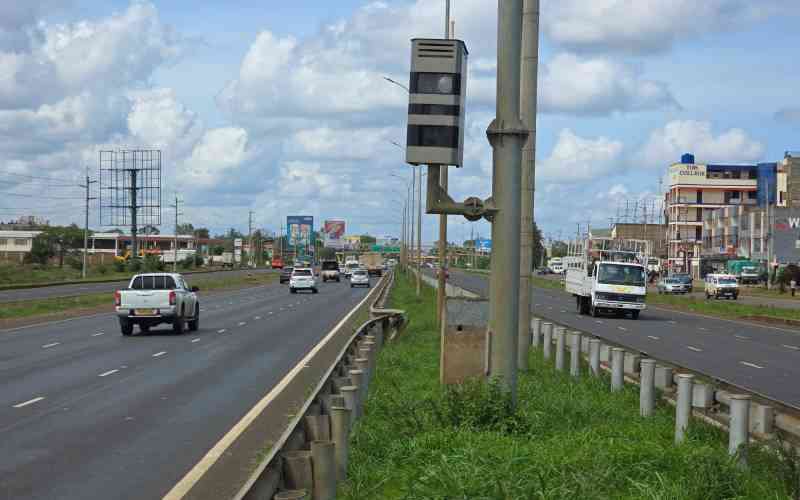
One of the speed enforcement cameras installed by the National Transport and Safety Authority along Thika Superhighway. [Gitau Wanyoike, Standard]
Experts have now faulted the new push by the government to roll out instant fines and cameras as the magic bullet to ending road carnage.
They argue that while the interventions are laudable, full implementation of the existing policies in addition to defensive driving training would supplement the efforts.
Binta Sako, technical officer for violence and injuries at WHO Africa, said speed cameras save lives by helping ensure drivers stay within the speed limits, but argued they are not the only solution.
“Reducing speed is crucial to boosting road safety and speed cameras can really help with this. Yet installing cameras is just the start. The authorities must be able to manage and use them effectively as a deterrent against speeding, rather than just for punishment,” said Ms Sako.
She added: “Yet cameras should also improve enforcement and the authorities must ensure buy-in from the population. If the will is there to roll out cameras rapidly across Kenya's national highways, then this could save lives. Yet there is no silver bullet in reducing road deaths overall.”
The government is now banking on highway cameras and instant fines to reduce road carnage, which has led to at least 5000 deaths.
The instant digital fines are applied in developed countries in Europe, and even near home in Kigali, Rwanda, and Kenya is planning to copy best practices.
In Kigali, CCTV cameras and automated traffic surveillance systems are extensively used on roads and on major highways to enhance road safety, reduce accidents, and enforce traffic laws.
These cameras monitor speed, traffic flow, and violations, enabling authorities to track offenses and reduce reliance on manual traffic policing and human interaction.
NTSA has already started installing the CCTV cameras on major highways like the Thika Superhighway and aims to install 1,000 high-definition smart cameras consisting of 700 fixed units and 300 mobile units to monitor major highways across the country.
The system integrates with the Second-Generation Smart Driving Licence (e-DL) to issue instant digital fines via SMS.
Traffic violations, which include speeding above posted limits, road obstruction, driving on pavements and footpaths, mobile phone use while driving and illegal PSV boarding and alighting, will now be captured in real-time, cross-referenced with the national vehicle registry, and automatically updated on the motorist’s NTSA portal account.
Payments will be processed through mobile money, USSD codes, or banking channels, removing the requirement for physical police stops or court appearances for minor infractions.
Stay informed. Subscribe to our newsletter
In her argument, Sako said road safety requires a range of good policies, laws and regulations that cover all key risk factors for road crashes, such as the use of motorcycle helmets, the use of seat-belts and measures against drink-driving and distracted driving that are backed up with good road policing.
According to Habel Amakobe, CEO and managing director of Pioneer Road Safety Consultants, the nature of Kenyans may not allow the cameras to stay long and may suffer vandalism.
He says defensive driving, first-line inspection and fatigue management for long-distance drivers are key to reducing road crashes.
Defensive driving training aims to reduce road crashes by teaching advanced hazard perception, emergency braking and collision-avoidance techniques.
"So for me, training of drivers is what has converted the behavioral change. First of all, every organisation needs to be empowered or influenced for lack of a better word, to come up with a road or transport safety management policy that addresses the do's and the don'ts while they're on the road, so that they work within the parameters of that policy and then we look at what are the obligations of the vehicle owners, drivers and the government as per the policy," said Amakobe.
He added: "But training becomes so essential, so that people must be trained on what the effects are to you as a person when you speed, as a road user and your passengers."
Amakobe said it is the defensive training that has seen reputable companies' drivers in Kenya, like DHL, East Africa Breweries Ltd(EABL), record little or no accidents at all because their companies invest a lot in it.
"How many trucks can you remember that were involved accident while carrying beer and when? The only difference is that breweries would not load their beer on a truck, which is being driven by a driver who is not a very defensive driver, trained, but they are trained by internationally accredited trainers and because there's also no school for accredited defensive driver trainers in this country," said Amakobe, whose company does do road safety training.
According to Duncan Musalia, a 56-year-old driver with no accident record, there is a need for specialised courts along the highways to handle traffic-related offenses.
“I propose special courts to be established along the highways to handle road-related matters, so that traffic offenses are handled quickly,” said Musalia during a recent interview at Standard Group offices along Mombasa Road.
He added: “If a vehicle is found to have been overloaded, which is now a common occurrence, both the excess passenger, driver and conductor should be arrested and the two crew later fined heavily the same amount.”
Musalia now wants driving schools deregistered and reapply for registration afresh, only after meeting the necessary stringent requirements.
“Among them is that the instructor should be someone from the National Youth Service(NYS) and should have all types of vehicles for test drive," said Musalia.
"This is because you find someone has done training for light heavy commercial vehicles and after graduation, he goes ahead to drive a heavy-duty commercial vehicle like a trailer,” said Musalia, asking the writer whether he has seen any driving school with a trailer," he added.
Musalia also wants the government to establish national drivers’ training schools in the eight regions.
“Just like police officers have the Kenya Police Training College, Kiganjo, doctors have the Kenya Medical Training College(KMTC), lawyers have the Kenya School of Law (KSL), drivers need one," said Musalia.
This, he said, so that after drivers have passed the private schools training, they will go to the government school for a final test and be issued a certificate after only passing by an officer, who will test the driver during the day and night on a long-distance drive.
He said this will eliminate a situation where someone who has been tested from Kibra to Ngong Road can later be found driving from Nairobi to Western or Murang'á yet he has no long-distance travel experience.
On drunk driving by PSV drivers, he is proposing that the driver and the sacco of the matatu be charged the same high amount of at least Sh50,000 or face a ban from driving if he fails to get the money.
“Charging the two will imply that the sacco did not enforce rules against drunk driving of its staff,” he said.
On first-line inspection, Amakobe says it will help with various items on the vehicle and their effective performance.
"Because if you're driving in heavy rain and your tires are worn out, do you expect them to assist you when you want to brake? Or your wipers are not working, do you expect to have better visibility? No, you can't. But again, if you have a driver who is trained, when the rains are heavy, the only thing that you need to do is delay the journey, delivery of the goods but not get into a suicidal mode of wanting to drive in heavy flooding rains," he said.
And on fatigue management for long-distance drivers, he says there is a need to introduce roadside stations so that they can drive and then stop either after two hours of continuous driving for 15 to 30 minutes to break, instead of parking along the roads, which then becomes a hazard.
To reduce road crashes, she said the country has a good National Road Safety Action Plan (2024–2028), which needs implementation.
Launched by the NTSA on April 17, 2024, it aims to curb high accident rates through improved infrastructure, stricter enforcement, and better vehicle standards, and aims to reduce road fatalities by 50 percent by 2030.
“We see good and clear progress, but the challenge, like so many countries, lies in fully implementing all aspects of the plan nationwide. This also requires more investment," said Ms Sako.
"Like many other countries, Kenya's growing motorcycle fleet presents challenges, and a greater emphasis on providing good and safe public transport will save lives, boost safety and give people more transport options. It will also help cut congestion and reduce air pollution for the good of everyone," she added.






Subscribe to our newsletter and stay updated on the latest developments and special offers!





 join
join