×
App Icon
The Standard e-Paper
Join Thousands Daily

★★★★ - on Play Store
Download App

Insured on paper but exposed in reality, the burden of riders after crashes

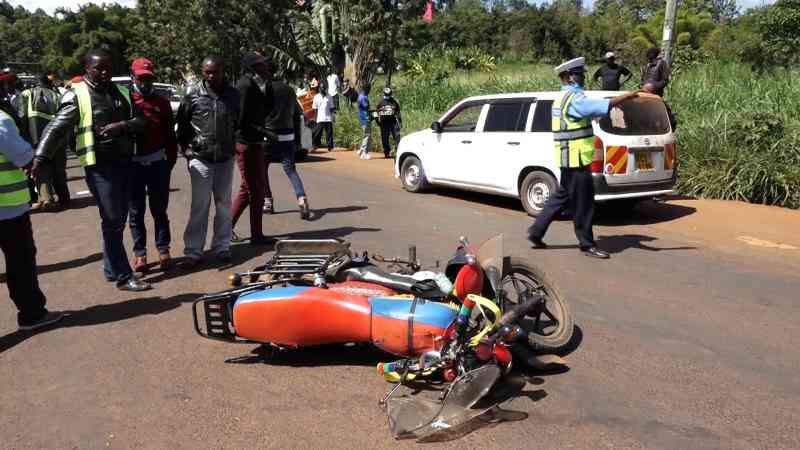
As motorcycle transport continues to grow across Africa, the gap between insurance on paper and protection in practice remains a serious concern. [File, Standard]

When a boda boda rider crashes, survival is only the first battle. The next is navigating an insurance system many say is stacked against them.

Known as boda boda, piki piki, or bajaj in East Africa or okada in West Africa, motorcycle riders are among the most exposed road users.
Despite mandatory motor insurance, riders across the country report being abandoned by insurers after accidents, exposing deep gaps between policy promises and real-world protection.

Some riders complain that covers are too expensive, while others say the terms are unclear, with most riders signing policies without fully understanding what is covered.


In October 2025, boda boda rider Aggrey Adika lost control of his motorcycle while riding home in the evening after heavy rainfall made the roads slippery.

When the motorcycle fell on his left hand, he thought his only concern would be the healing process. What followed, however, proved even more painful. Despite believing he was insured, Adika found himself paying medical bills out of pocket because his policy did not cover him.

“It was around 5 pm, and I was going back home because my shift starts at 5 am and ends at 5 pm. I was around 200 meters from my house when the accident happened. Police officers who were nearby rushed me to the hospital because I was unconscious,” he said.

After an X-ray, his arm was placed in a cast. He paid cash for treatment and was advised to keep the cast until the end of January or even February as doctors monitored the healing.

On insurance cover, Aggrey says he only had third-party insurance, which did not cover his medical expenses.

He now wants insurance companies to simplify policy terms so riders can easily understand what they are signing.

For Sebastian Kamau, a boda boda rider in Nairobi’s Mathare area, the consequences of an accident continue to affect his life years later.

Kamau, who has been riding since 2013, says his accident was a hit-and-run.

“I had my helmet on, but my head still had an injury from the impact. My hands were badly injured," he said. "I was unconscious, but my fellow boda boda riders took me to the hospital; some waited until I regained consciousness.”

Doctors later informed him that both his hands were fractured. “My left hand still has metal inside. My head is not painful, but once in a while there’s a swelling on my head near the ear,” he added.

He stayed at home for a month, but his condition worsened. “My fingers were shrinking; I sought a second opinion. We started treatment from scratch. So they removed the plaster and I felt so much relief,” he said.

Initially, the hospital bill stood at Sh300,000, which he could not afford. He later transferred to another facility where his family helped him settle a Sh100,000 bill.

“There’s a metal inside my arm, but it does not function well; I feel pain once in a while,” he said.

A month after the accident, Kamau approached his insurance company to file a claim, but was told he needed a police report. Even then, another obstacle emerged.

“I took everything they needed but they told me my driving licence is for a vehicle and not a motorcycle. I gave up,” he said.

After recovering, Kamau continued paying for comprehensive insurance. However, following a minor accident in which he hit a vehicle and broke one of its lights, he says he was still required to pay Sh10,000 and repair the vehicle before compensation could be considered.

“I was disappointed, so I stopped getting the comprehensive cover. Now I just have insurance in case the police stop me, they can see I have insurance, but not because it will help me on a rainy day,” he said.

Like Aggrey, Kamau is calling for the simplification of insurance policy terms, noting that many riders sign contracts without fully understanding them.

According to data from the National Transport and Safety Authority (NTSA), 1,148  motorcycle-related deaths were reported in 2025, up from 1,055 in 2024. Pillion passenger deaths also rose, from 375 in 2024 to 432 in 2025.

Dr Mark Lutomia Lumbasi, an orthopaedic surgeon, says the most common injuries among motorcycle riders are long bone fractures.

“The leg bone is called the tibia and the thigh bone is called the femur. While others will get four arm bone injuries,” he said.

He added that head injuries significantly increase the risk of death.

“Quite a number of them used to get head injuries, and what we realised is that when they got these long bone fractures, together with head injuries, their death rates skyrocketed,” he said.

Dr Lutomia noted that inadequate care at the accident scene is a major contributor to fatalities.

“The care that you will get by the time you have a head injury is very crucial; you need quite some specialised care. And that is hardly possible in many of the institutions that are available,” he said.

According to Boda Boda Association president Kevin Mubadi, many riders do not have insurance at all, largely because of mistrust in insurers.

“The main issue is that most of the insurance companies do not pay the riders once they get an accident,” he said, adding that some riders obtain covers through brokers whose offices they cannot trace.

“Someone meets you at the stage where you operate from, he sells you a cover, but you don't know where the office is. So, if you get an accident, you don't even know where to go. You can't find the person,” Mubadi said.

Another challenge, he added, is that some riders obtain insurance without holding valid driving licences.

“But you see the bureaucracy of these insurance companies. They always find a way not to pay. So, if the rider doesn't follow up or use the lawyers, he will not be paid. Many riders don't know that you need to be following up that insurance cover case for even more than two to three years,” he said.

Mubadi says the association is now working on a centralisation programme in partnership with insurance companies so claims can be handled directly through their offices.

At the National Transport and Safety Authority, road safety manager Samuel Musumba says accidents involving boda boda riders are often caused by speeding, overloading and failure to wear helmets.

“But of course, the regulation is there, which we have really been pushing them to adopt. But the uptake on some of these things has been a bit slow, particularly uptake of helmets, and insurance,” he said.

Musumba added that riders fear insurance because they believe they will not be compensated, given that the sector is viewed as high risk.

Following complaints that insurance covers are expensive, Musumba said the authority has encouraged insurers to design fairer products and allow riders to pay premiums in instalments.

“So, what we have done as government is train the riders and have them licenced. They're able to understand why this law, is about their safety, the insurance is about helping them, the helmet is there to safeguard them,” he said.

He added that riders are encouraged to form groups of at least 100 licensed members.

Addressing claims disputes, Sanlam Allianz General Insurance Chief Operating Officer Sylvester Nzioka admitted the industry has shortcomings.

“The public is right, as an industry, we are guilty as charged. Now we are sensitising the public on what is insured and what is not insured,” he said in an interview with Spice FM.

He said insurers sometimes focus on closing sales without explaining exclusions.

Nzioka added that some insurers fail to pay claims due to weak capital bases.

“But we are backed with very strong shareholders, very strong capital base and we make sure that pricing that we charge is correct that we are able to pay your claims,” he said.

Human rights lawyer Micheal Oyaro says many riders lose compensation because they lack valid licences.

On reporting accidents, Oyaro explained: “They report the case to the police, where they will do a police abstract. The abstract with medical receipts and medical reports is what is taken to the advocate.”

The advocate then files a case in court after notifying the insurance company.

“This will not be the motorcycle's insurance company. you are filing a case on the on the proposition the other party, who according to the police abstract was the one who did the damage,” he said.

If the rider dies, Oyaro said, their next of kin can file a case as the estate of the deceased.

As motorcycle transport continues to grow across Africa, the gap between insurance on paper and protection in practice remains a serious concern.

For boda boda riders, insurance is meant to be a safety net. Bridging this gap will require clearer policies, better education, fair pricing, and stronger collaboration between insurers, regulators, and rider associations so that when accidents happen, riders are protected not just by law, but in reality.