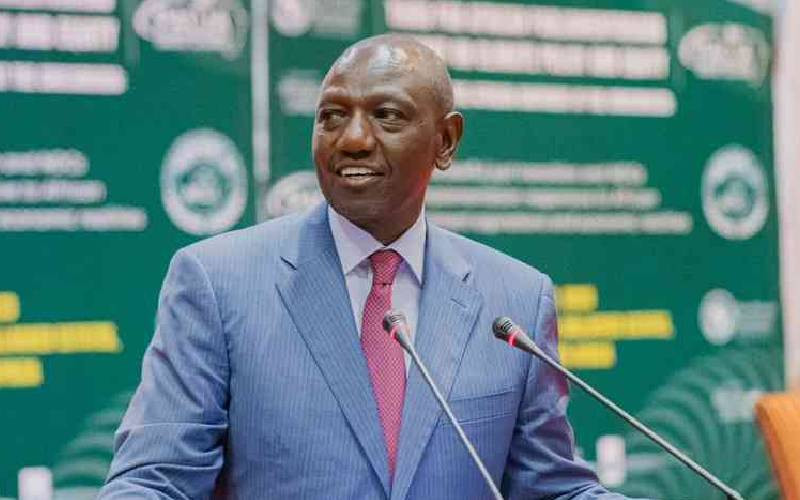
President William Ruto has welcomed Malaysia’s decision to scrap tariffs on agricultural products and beef, describing it as a major milestone that will open new market opportunities for Kenyan farmers and reinforce the commercial partnership between the two nations.
Dr Ruto, who hosted Malaysia’s Prime Minister Anwar Ibrahim at the State House in Nairobi, on an official visit to Kenya, reaffirmed the government’s commitment to removing tariff and non-tariff barriers.
These, he said, will expand Kenyan exports to Malaysia and deepen cooperation in digital technology and high-tech manufacturing.
The Head of State said the removal of these tariffs by Malaysia is significant, given the structure of Kenya’s current trade, where the main exports to Malaysia include tea, coffee, flowers, avocados and titanium ores.
Imports from Malaysia consist primarily of edible oils and fats, chemical products, electronics, agricultural chemicals and rubber.
“Our engagements have culminated in the signing of key cooperation instruments which include a Bilateral Air Services Agreement (BASA) to expand connectivity, ease travel and boost trade and tourism and an MoU on tourism cooperation to strengthen two-way tourism, investment and joint destination marketing,” Ruto said.
The two leaders witnessed the signing of a memorandum of understanding between the Kenya National Chamber of Commerce and Industry and the National Chamber of Commerce and Industry of Malaysia to deepen private-sector partnerships and unlock new business opportunities.
They also witnessed the signing of a Letter of Intent on the twinning of Nairobi and Kuala Lumpur. This will enhance city-level cooperation in urban planning, technology and service delivery, stating that these instruments mark the beginning of a broader and deeper strategic partnership for mutual benefit.
“We’ve agreed that Malaysia will explore partnerships and investments across our priority areas, including collaboration in science, technology, engineering and mathematics (STEM) and in research and development. The Prime Minister will engage with key education stakeholders as part of this effort,” said Ruto.
The two leaders agreed to strengthen the semiconductor bilateral relationship as part of Kenya’s human capital development and industrialisation agenda, where, through a strategic partnership, Malaysia will support Kenya to grow and expand its semiconductor technology and manufacturing capabilities, including with Kimathi University, already a leader in this field.
Power generation
Ruto said that as part of the broader transformation agenda, Malaysian private-sector actors have been invited to participate in public–private partnerships, including investments in road network expansion through tolling, power generation and expansion under Public Private Partnership arrangements and dam construction.
“We encourage Malaysian companies to take advantage of Kenya as a manufacturing hub for the African Continental Free Trade Area(AfCTA). Additionally, we exchanged views on regional peace, security and multilateral cooperation,” said Ruto.
Ruto and Ibrahim further reaffirmed a shared commitment to the reform of the global financial architecture and the reform of the United Nations, with Africa demanding two permanent seats on the UN Security Council with full rights, including the power of veto, as well as two additional non-permanent seats.
Ibrahim said that Kenya and Malaysia have a lot to learn from each other and that he believed that Kenya has a huge unexploited potential that can make it one of the most developed countries globally.
Stay informed. Subscribe to our newsletter
“There is a lot to showcase to the world that collaboration between countries is great for development. It is unacceptable to have trade agreements that are not beneficial to states, and that is why Malaysia and Kenya are working together for the benefit of our citizens,” said Ibrahim.
Ibrahim said Malaysia is focusing on economic transformation, making it one of the fastest-growing economies in the world despite humble beginnings six decades ago.