×

The Standard e-Paper
Stay Informed, Even Offline
 The Standard Group Plc is a
multi-media organization with investments in media platforms spanning newspaper
print operations, television, radio broadcasting, digital and online services. The
Standard Group is recognized as a leading multi-media house in Kenya with a key
influence in matters of national and international interest.
The Standard Group Plc is a
multi-media organization with investments in media platforms spanning newspaper
print operations, television, radio broadcasting, digital and online services. The
Standard Group is recognized as a leading multi-media house in Kenya with a key
influence in matters of national and international interest.

Audio By Vocalize
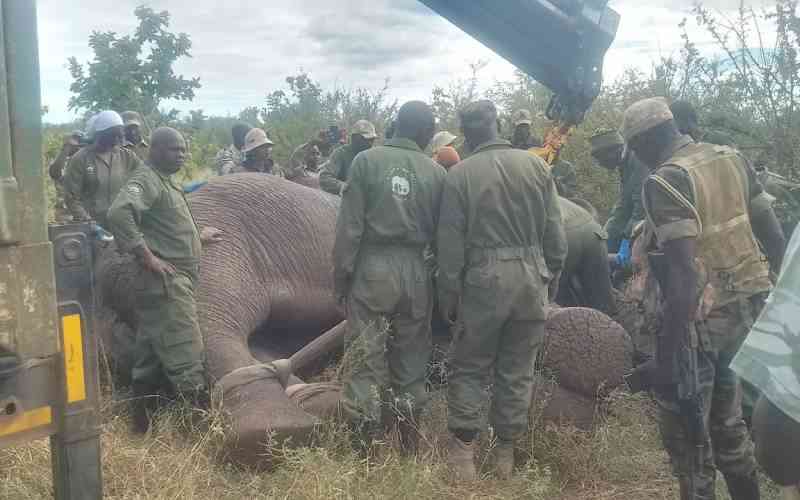
A sedated elephant lies calmly before being loaded for relocation to Tsavo as part of efforts to reduce human-elephant conflict. [Courtesy, KWS]
As day broke over the vast wilderness of Meru Rhino Sanctuary, a team of wildlife officers waited for giants they had come to know all too well.
The elephants were not a poacher's target, nor were they sick. They had simply become too familiar with people.
They had breached the Sanctuary’s fence, wandered into farms in the Kanjoo-Murera area, causing crop destruction across communities living on the edge of protected wildlife areas. This was a symptom of a deeper crisis unfolding across Kenya's wildlife landscapes.
A sedated elephant lies calmly before being loaded for relocation to Tsavo as part of efforts to reduce human-elephant conflict. [Courtesy, KWS]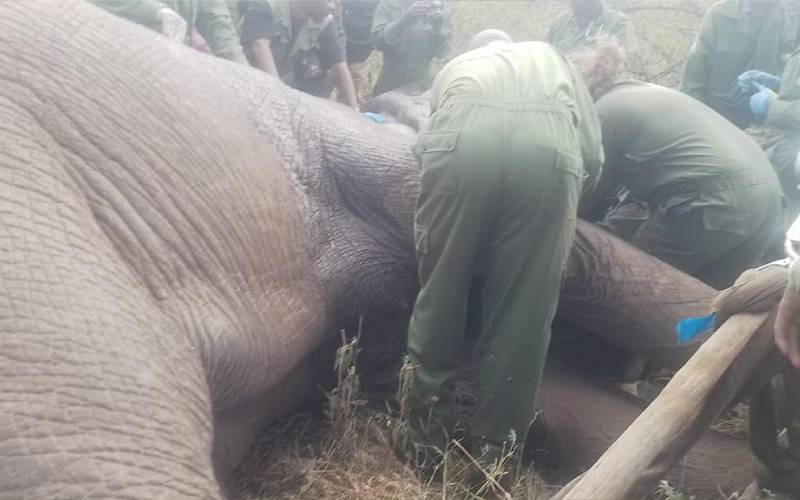
On Saturday, May 30, 2026,
Kenya Wildlife Service (KWS) officers, led by the specialised Capture Unit and veterinary teams, carefully immobilised and loaded the jumbos into a transport crate before setting off to Tsavo, one of Africa's largest wildlife ecosystems.
According to John Wambua, KWS Senior Assistant Director Eastern Region, two elephants were moved from the Meru Rhino Sanctuary after repeatedly breaking through the sanctuary's fencing and destroying crops in neighbouring farms.
A day later, another three elephants were translocated from the Rapsu area as part of efforts to reduce rising human-elephant conflict.
"We translocated two elephants that were notorious for breaking the Meru Rhino Sanctuary fence and causing crop destruction in community farms," said Wambua.
"Again, Sunday, May 31, we translocated three elephants from the Rapsu area to reduce human-elephant conflict."
The operation, though appearing straightforward from a distance, is among the most delicate wildlife interventions undertaken by conservation authorities.
On the ground, rangers first identify and track the target animals, often after monitoring movement patterns.
"The ground team had already known the targeted elephants and their role was to spot the two jumbos," Wambua explained.
"The veterinary doctor then did the darting to immobilise them before undertaking the other procedures and loading each elephant into crates for transportation."
Stay informed. Subscribe to our newsletter
Leading the capture operation was Dr Mijele and a specialised veterinary team trained to sedate some of the world's largest land mammals without compromising their welfare.
The process requires precision.
Too little sedative can leave an elephant dangerously active. Too much can threaten its survival.
During transport, veterinary teams continuously monitor breathing, stress levels and overall condition, making regular stopovers to assess animal welfare before continuing the journey.
"They are trained veterinary doctors and have protocols to follow," said Wambua.
"They keep monitoring the animals during transit since they usually have stopovers to counter-check animal welfare."
Stretching across thousands of square kilometres, Tsavo East and Tsavo West National Parks remain among the few places in Kenya capable of absorbing large wildlife populations while offering sufficient space, forage and water.
"One of the reasons is because of the vastness of the two parks and the availability of forage and water," Wambua said.
Yet even as trucks carrying the elephants disappear, conservationists understand that translocation is not a permanent cure or solution to human-elephant conflict (HEC).
It is often a last resort, after exploring other ways of mitigating HEC and has proved to be successful.
Across Kenya, shrinking wildlife corridors, expanding settlements, infrastructure development and changing land use patterns have intensified encounters between people and elephants. Traditional migratory routes that once allowed animals to move freely between ecosystems are increasingly blocked, forcing wildlife into farms and settlements.
In Meru and other conflict hotspots, elephants are frequently drawn to cultivated crops.
"The elephants prefer crops that are softer than natural vegetation," Wambua said.
What begins as crop raiding can quickly escalate.
"Upon getting outside and the communities react by making noise through screams and shouts, they become angrier and cause serious damage, including killing or destroying property."
The consequences are often devastating on both sides.
For families, a single night raid can wipe out months of investment and food security.
For elephants, retaliatory actions, stress and displacement create additional threats to survival.
That is why KWS increasingly relies on multiple approaches before considering relocation.
Among them is Problem Animal Control (PAC), where rangers respond to elephant invasions by driving animals away from farms using vehicles, foot patrols and in some cases, helicopters.
Communities are also being encouraged to report elephant movements early and avoid confrontations.
KWS has expanded wildlife service sub-stations closer to conflict-prone communities, strengthened patrols and promoted alternative deterrents such as beehive fences.
The idea is remarkably simple.
Elephants fear bees.
Rows of strategically placed beehives can create natural barriers that discourage elephants from entering farms while simultaneously providing income through honey production.
Electric fencing has also played a significant role in reducing conflict.
According to Wambua, fences around Meru have proven effective despite the enormous cost of installation and maintenance.
"Where electric fences exist, conflict reduces," he said.
"However, elephants also adapt and learn how to break the fence using their tusks or dry wood."
In some cases, the animals become so skilled at overcoming barriers that they effectively teach others. They are known to be incredibly intelligent and learn through observation.
Wildlife managers have documented instances where habitual fence-breaking elephants repeatedly target protected areas and community farms, creating long-term management challenges.
Wambua insists the fence is effective, especially when well-maintained, and are currently repairing the damage.
Alternative mitigation measures encouraged by Wambua for HEC include involving the NGAOs (National Government Administration Officers), such as chiefs, to report any invasion, as well as installation of Predator Deterrence Lights around livestock bomas to deter predators.
For relocated elephants, the journey does not end after release.
Many are fitted with tracking collars that allow KWS teams to monitor movement patterns and intervene early if they begin moving towards conflict zones.
"There is a post-release monitoring of the translocated elephants," said Wambua.
"The elephants are collared for ease of monitoring and scaring them early before they cause destruction."
Even then, success is never guaranteed.
Elephants possess extraordinary memory and navigational ability. Some travel hundreds of kilometres and occasionally return to the very landscapes from which they were moved.
"Sometimes the elephants find their way back, especially when the areas are close to each other since elephants are long-range animals covering many kilometres," Wambua acknowledged.
That reality places immense pressure on the men and women tasked with responding whenever conflict erupts.
They are often called after crops have been destroyed, after property has been damaged or after communities have spent sleepless nights guarding their farms.
Yet much of their work unfolds away from public attention.
"We really appreciate communities for their support, especially when elephants have caused destruction," said Wambua.
"I request more support from them since some elephants are outside the parks and stay on community land."
His message was also a reminder that coexistence remains one of conservation's greatest tests.
Kenya has intensified efforts to compensate victims of human-wildlife conflict, with billions of shillings having been allocated in recent years to address injuries, deaths and property losses linked to wildlife encounters. Victims are required to report incidents promptly for verification and processing. Wambua urges affected communities to report any damages to KWS offices within 24 hours for verification and compensation.
For communities living alongside wildlife, however, compensation alone rarely erases fear.
For conservationists, moving elephants is not simply about protecting animals.
It is about preserving an uneasy peace between people and one of Kenya's most iconic species.
As the country reflected on Madaraka Day and the meaning of national heritage, another kind of service unfolded quietly in the wilderness.
No crowds gathered.
No speeches were delivered.
Only a team of rangers, veterinarians and wildlife officers standing beneath the dust of Meru, guiding five giants towards a new home and hoping, once again, that coexistence remains possible.






Subscribe to our newsletter and stay updated on the latest developments and special offers!






 join
join