×

The Standard e-Paper
Kenya’s Boldest Voice
 The Standard Group Plc is a
multi-media organization with investments in media platforms spanning newspaper
print operations, television, radio broadcasting, digital and online services. The
Standard Group is recognized as a leading multi-media house in Kenya with a key
influence in matters of national and international interest.
The Standard Group Plc is a
multi-media organization with investments in media platforms spanning newspaper
print operations, television, radio broadcasting, digital and online services. The
Standard Group is recognized as a leading multi-media house in Kenya with a key
influence in matters of national and international interest.

Audio By Vocalize
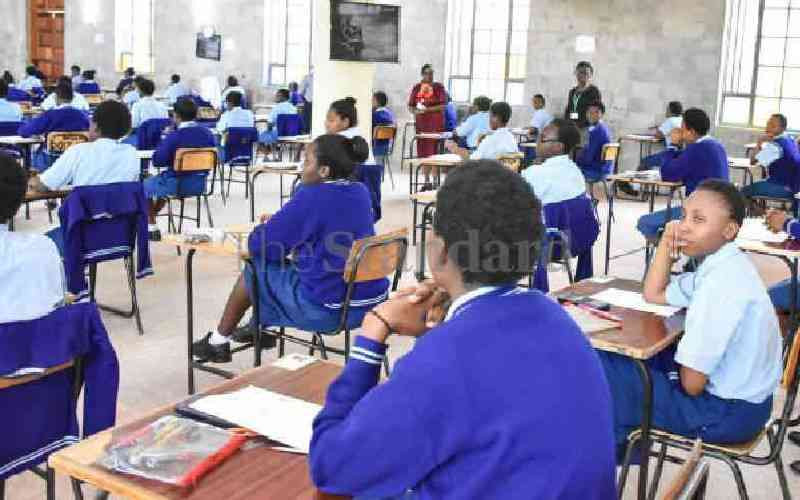
The Kenya National Examinations Council (Knec) has issued what could be the final opportunity for thousands of Kenyans who have never sat the Kenya Certificate of Secondary Education (KCSE) examination.
The council also is calling on those wishing to improve their previous grades, urging them to register for the 2027 examinations before the country fully transitions to the Competency-Based Education (CBE) system.
The 2027 KCSE examination will mark the end of an era, becoming the final national secondary school examination under Kenya's 8-4-4 education system that has been in place since 1985.
Knec Chief Executive Officer David Njeng'ere said the Council wants all eligible learners who have not previously sat KCSE to seize the opportunity because there will be no similar examination once the country fully migrates to the CBE curriculum.
"This will be the last KCSE examination under the 8-4-4 system. Anyone who has never sat KCSE or wishes to improve previous results should take advantage of this opportunity because there will be no other KCSE examination under the current curriculum after 2027," said Dr Njeng'ere.
The appeal targets several categories of candidates.
First are learners who completed secondary school but, for one reason or another, never registered or sat the KCSE examination.
The second category comprises candidates who previously sat KCSE but are dissatisfied with their grades and wish to improve their academic qualifications for employment, college admission or university entry.
The Council is also targeting learners who joined secondary school without Kenya Certificate of Primary Education (KCPE) certificates or equivalent primary school qualifications and therefore require regularisation before sitting the final KCSE examination.
To facilitate this process, Knec announced that it will administer a KCSE Qualifying Test in September 2026.
The examination is intended for learners planning to sit the 2027 KCSE but who do not possess KCPE certificates or equivalent documentation.
According to Knec, the qualifying test will mainly benefit three groups of learners: students admitted into secondary schools under Ministry of Education guidelines despite lacking KCPE certificates; learners who missed the 2023 KCPE examination but later joined Form One; and candidates who underwent alternative or non-traditional primary education whose academic records require verification.
Dr Njeng'ere said school principals have a critical role in ensuring no eligible learner misses the final KCSE examination because of documentation challenges.
"We urge principals to identify all Form Three learners in 2026 who lack KCPE certificates or equivalent qualifications and guide them through the qualifying test process early enough. Failure to comply could delay or affect registration for the 2027 KCSE examination," he said.
Stay informed. Subscribe to our newsletter
Applicants for the qualifying test will be required to submit an application letter together with supporting academic documents, including report cards and any available proof of attendance in primary school.
The Council says the exercise is aimed at safeguarding the integrity of the national examination while ensuring deserving learners are not unfairly locked out because of missing documentation.
The announcement comes as Knec revealed that a record 1,049,276 candidates have registered for the 2026 KCSE examination, compared to 995,860 candidates who sat the examination in 2025.
The increase marks the first time in Kenya's history that the number of KCSE candidates has surpassed one million, reflecting continued growth in secondary school enrolment and improved transition rates from primary to secondary education.
Education stakeholders say the final KCSE examination will carry historical significance as Kenya concludes nearly four decades of the 8-4-4 education system.
Introduced in 1985, the 8-4-4 system comprises eight years of primary education, four years of secondary education and a minimum of four years of university education. Knec has administered the KCSE exam to 14,486,378 graduates who have joined the country's workforce, universities and technical institutions over the past 40 years.
The Competency-Based Education system, which is replacing 8-4-4, shifts the focus from examination performance to acquisition of practical skills, competencies and talents.
Under the new structure, learners progress through two years of pre-primary education, six years of primary school, three years of junior school, three years of senior school and tertiary education based on their career pathways.
With the first cohort of senior school learners expected to complete their studies under the new curriculum in the coming years, Knec says the 2027 KCSE examination represents the final opportunity for learners seeking certification under the traditional examination system.
National Parents Association chairman Silas Obuhatsa say the Council's appeal is important even for adults who postponed sitting KCSE due to financial difficulties, illness, early pregnancies, family responsibilities or other personal circumstances.
“For many, the examination remains a critical requirement for career progression, university admission and access to professional courses,” he said..
Knec has therefore urged all eligible candidates and school administrators to begin preparations early to ensure no learner misses what will be the final chapter of one of Kenya's most recognised national examinations.
"The transition to the Competency-Based Education system means this is the last window for anyone wishing to obtain or improve KCSE certification under the 8-4-4 curriculum. We encourage all eligible candidates to take advantage of this opportunity," Dr Njeng'ere said.






Subscribe to our newsletter and stay updated on the latest developments and special offers!