×

The Standard e-Paper
Smart Minds Choose Us
 The Standard Group Plc is a
multi-media organization with investments in media platforms spanning newspaper
print operations, television, radio broadcasting, digital and online services. The
Standard Group is recognized as a leading multi-media house in Kenya with a key
influence in matters of national and international interest.
The Standard Group Plc is a
multi-media organization with investments in media platforms spanning newspaper
print operations, television, radio broadcasting, digital and online services. The
Standard Group is recognized as a leading multi-media house in Kenya with a key
influence in matters of national and international interest.

Audio By Vocalize
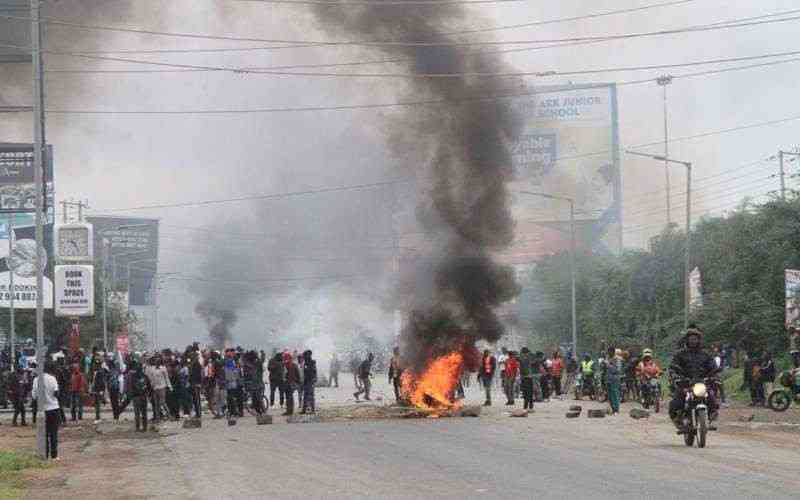
Tension flared once again at the disputed 1,200-acre Samburet Estate along the Kericho–Nakuru border on Friday after rival groups claiming ownership of the land clashed, leaving several youths injured and five boda boda motorcycles torched.
The latest violence, which erupted at about 10 a.m., underscores the growing insecurity surrounding the contested property that has been the subject of prolonged legal battles and competing ownership claims.
Londiani Sub-County Police Commander Phinius Ringera confirmed the incident, saying security officers had been deployed to the area to restore calm and prevent further violence.
"Five motorcycles were burned as the two groups clashed while trying to block each other from accessing the parcel of land. An unknown number of youths were also injured," said Ringera.
Police did not immediately provide the exact number of casualties, but witnesses said several injured youths were rushed to nearby health facilities for treatment.
For decades, the rolling tea fields and forests of Samburet Estate in Kericho County have symbolised the prosperity of Kenya's tea industry. Today, however, the 1,200-acre property has become the centre of one of the country's most complex land disputes, where competing ownership claims, court battles, environmental concerns and rising tensions threaten lives, livelihoods and investments.
The latest sign of the growing conflict came last week when a huge pile of timber stored at the estate was set ablaze by suspected arsonists, forcing police officers, Kenya Forest Service personnel, county firefighters and Brown East Africa Plantations' emergency team to battle the flames before they spread into the neighbouring South West Mau Forest.
Police in Londiani have launched investigations into the night-time fire, which destroyed timber that had earlier been confiscated after it was allegedly transported without the required permits.
Ringera said detectives were pursuing those behind the attack, describing the incident as a serious criminal offence.
Forest officers remained on high alert as the fire threatened one of Kenya's most important water towers.
"We monitored the situation closely to ensure the fire did not spread into South West Mau Forest," said Kericho Ecosystem Conservator James Kwambai.
The arson incident is only the latest chapter in a dispute that has steadily intensified over ownership of Samburet Estate.
At the heart of the conflict are at least three groups, each insisting it is the rightful owner of the land.
Brown East Africa Plantations PLC (BEAP), which operates the estate, maintains it is the lawful occupier and continues to run tea production on the property.
Another group comprising about 200 individuals claims the government allocated them the land in 2008 and says their ownership rights were upheld by the Environment and Land Court earlier this year.
Stay informed. Subscribe to our newsletter
A third claim comes from members of the Ogiek community and local Samburet residents, who argue that the land is their ancestral home from which they were displaced during the colonial era to pave the way for multinational tea companies.
Each side insists its claim is legitimate, making the dispute one of the most complicated land ownership battles in the South Rift.
The Kenya Tea Growers Association (KTGA) says the matter is already before the Environment and Land Court and that a Court of Appeal order restrains any activities on the disputed land until the case is determined.
However, KTGA accuses individuals claiming ownership of entering the estate, erecting fences, intimidating workers and neighbouring residents, and cutting down trees, including young seedlings planted under the government's 15-billion-tree programme.
KTGA Chairman Silas Njibwakale says the continued activities violate existing court orders and threaten the stability of Kenya's tea sector.
According to the association, employees have faced intimidation while access to Samburet Primary School and health facilities has been disrupted, affecting hundreds of families that depend on the estate.
The association also warns that continued destruction of trees undermines environmental conservation efforts and weakens investor confidence in one of Kenya's leading export industries.
Those laying claim to the land dismiss the allegations.
Speaking at the disputed property, their spokesperson Samuel Cheruiyot accused rival groups of destroying a barbed-wire fence worth more than Sh2 million that they had erected around the land.
"We are the lawful owners. The land was allocated to us by the government and our ownership has been confirmed by the court," he said.
Another claimant, Dennis Rono Langat, said they had reported the destruction to Chepseon Police Station and vowed to challenge anyone claiming ownership through the courts.
"We will defend our rights through the law," he said.
The group has appealed to the government to guarantee their security and protect what they consider legally acquired property.
For many residents of Samburet, the dispute goes far beyond title deeds.
Community leaders insist the land historically belonged to local families and members of the Ogiek community before they were displaced during the colonial period.
Kapsaos MCA Paul Bii argues that independence should have restored the land to the original inhabitants.
"Samburet residents became landless because of colonial policies. It is only fair that the land returns to its rightful owners," he said.
Ogiek elder William Mitei warned that the community would continue defending what it considers ancestral land, while other residents accused successive governments of neglecting their historical land claims.
The growing tension has also attracted national attention.
Speaking in Parliament, Kipkelion East MP Joseph Cherorot described Samburet as "a ticking time bomb" and called for comprehensive investigations into the competing ownership documents.
"I urge the National Assembly's Petitions Committee and the Departmental Committee on Lands to intervene and help establish the genuine owners once and for all," he said.
Beyond the legal arguments lies a conflict affecting conservation, agriculture, investment and community relations.
The estate borders the ecologically sensitive South West Mau Forest, making any unrest a potential environmental threat.
Thousands of workers and their families depend directly or indirectly on tea production, while local schools, health facilities and businesses rely on the estate's continued operations.
As court cases continue and rival groups hold firmly to their claims, the latest violence and the recent timber-yard fire serve as stark reminders that unless a lasting solution is found, Samburet risks becoming more than just another land dispute—it could become one of the country's most volatile flashpoints over land, history and justice.







Subscribe to our newsletter and stay updated on the latest developments and special offers!