×

The Standard e-Paper
Kenya’s Boldest Voice
 The Standard Group Plc is a
multi-media organization with investments in media platforms spanning newspaper
print operations, television, radio broadcasting, digital and online services. The
Standard Group is recognized as a leading multi-media house in Kenya with a key
influence in matters of national and international interest.

Audio By Vocalize
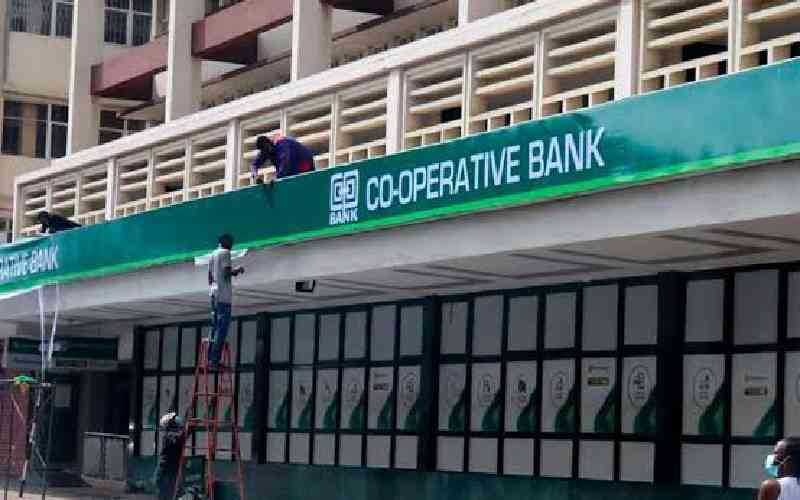
Co-operative Bank of Kenya (Co-op Bank) has cemented its position as the country’s most visible lender on social media, according to new industry data.
This comes as tier-one banks increasingly pivot their marketing strategies to capture Gen Zs who are bypassing brick-and-mortar branches for any sort of engagement, analysts say.
Beyond the follower counts, the data signals a strategic shift with direct consequences for market share, customer acquisition costs and the long-term viability of expensive branch networks, as the first point of contact between a bank and its future customers migrates from the physical counter to the smartphone screen.
Industry data compiled for June 2026 shows Co-op leading its peers on TikTok with 468,000 followers, nearly six times the 82,800 held by KCB Group and more than thirteen times Equity Bank’s 35,700.
On Facebook, Co-op commands 2.2 million followers against KCB’s 1.5 million and Equity’s 1.3 million.
On X, Co-op holds 744,900 against KCB’s 633,100 and Equity’s 494,500. On YouTube, Co-op’s 88,000 subscribers dwarf KCB’s 49,600 and Equity’s 19,600.
Equity holds a narrow lead only on Instagram, with 94,400 followers versus Co-op’s 87,000. NCBA and Absa trail significantly across all platforms.
Each platform serves a distinct corporate purpose.
Facebook remains the broadest reach channel for brand awareness and customer service across age groups.
X functions as a real-time reputation and complaint-resolution tool.
YouTube supports longer-form financial literacy and product explainers. Instagram drives visual brand affinity.
TikTok, however, is the critical frontier for Gen Z engagement, where short-form video content and algorithmic discovery bypass traditional advertising entirely.
The shift is driven by hard demographic and technological realities.
Stay informed. Subscribe to our newsletter
According to the World Bank’s Global Findex database, 49 per cent of Kenyan youths hold only a mobile money account, with no formal bank account.
For the banking sector, the customer acquisition pipeline is no longer the branch queue, analysts say; it is the smartphone screen.
Young consumers are bypassing brick-and-mortar branches entirely, not just for transactions, but for product discovery, financial literacy and brand engagement, according to bankers and marketers.
Co-op Bank said its digital strategy is designed to build a community around youth entrepreneurship, careers, innovation and financial literacy.
“We have established the strongest digital footprint among Kenyan banks, demonstrating leadership in both digital discovery and customer engagement, a combination unmatched by peers,” Co-op Bank said.
It added that this “offers a strong competitive advantage through TikTok leadership, a key platform for Gen Z engagement.”
Central Bank of Kenya (CBK) data underscores the rapid migration to digital channels.
Mobile money subscriptions grew 22 per cent to 51.4 million in 2025, and active mobile money agents expanded by 24 per cent to 473,536.
Meanwhile, the regulator reported a 2.66 per cent decline in the number of Automated Teller Machines to 2,228, noting a clear shift toward digital convenience.
The demographic pressure is acute.
The Kenya Bankers Association (KBA) 2025 Customer Satisfaction Survey found that mobile banking is now the preferred channel for 60.1 per cent of customers, with internet banking at 49.7 per cent.
Traditional marketing, radio, print and billboards, is no longer sufficient to reach a cohort that increasingly treats social platforms as its primary interface with financial institutions.
Globally, banks are racing to adapt.
Industry research indicates that 62 per cent of Generation Z consumers consult “finfluencers”, social media personalities who offer financial advice and product recommendations, before ever walking into a bank.
In Kenya, the competitive stakes are substantial.
The banking sector reported a 17.7 per cent increase in profit before tax to Sh306.3 billion in 2025, with total net assets rising 10.3 per cent to Sh8.35 trillion.
As lenders compete for a share of the Sh6.12 trillion deposit base, the battle for the first impression is increasingly being fought on the “For You” page, the algorithmic, endlessly scrolling feed on TikTok that serves as the primary discovery engine for its users.
For Co-op Bank, early investment in content tailored to individual platforms- short-form videos for TikTok, real-time updates on X and visual storytelling on Instagram- has created a significant competitive advantage.
For its rivals, the data suggests that closing the gap will require more than just a presence on the platform; it will require a fundamental recalibration of how they communicate with the customers of tomorrow, who may never walk into a branch at all, analysts say.








Subscribe to our newsletter and stay updated on the latest developments and special offers!