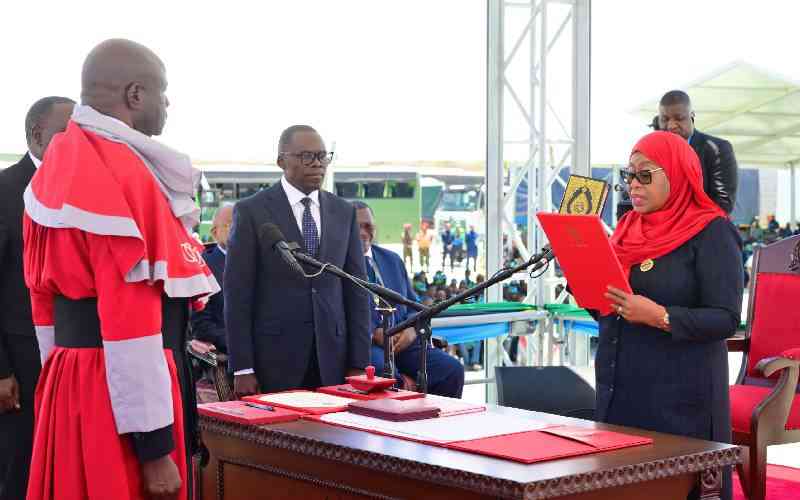
Tanzania’s President Samia Suluhu Hassan during her inauguration in Dodoma, on November 3, 2025. [Courtesy]
Flawed elections and absence of accountability in East Africa increasingly place in doubt the legitimacy of the regimes in power.

Legitimate governments derive their moral authority only from the consent of the governed. Voluntary acceptance by the people has no substitute. An illegitimate State, for its part, throws the governed into a crisis. Should they obey its illegal governance?
This was the central concern in the English philosopher John Locke’s work in the 17th Century. Locke (1632–1704) is regarded as the father of liberal democracy. His aphorisms are breathtaking. “Wherever law ends, tyranny begins, if the law is transgressed to another (person)’s harm.”
Even rulers and magistrates operate under the power of the law. Accordingly, any State officer exceeding his authority under the law, loses protection by the law. Such an individual “…ceases to be a magistrate,” Locke says. He can be opposed, just like any other man, who invades the rights of other people. East Africa’s senior State officers increasingly violate the governed. The subversion is mostly through grabbing power in sham elections. To add insult to injury they are maiming and even killing those who protest against this subversion. What options does a subversive State leave for us?
Article One of the Constitution of Kenya is unambiguous. “All sovereign power belongs to the people of Kenya and shall be exercised only in accordance with this Constitution. The people may exercise their sovereign power either directly or through their democratically elected representatives.”
When an individual manipulates elections so that the outcome favours them, they have no mandate to govern. They become lawbreakers in power. These reflections are critical in this season of marking independence in Kenya and Tanzania; and preparing for elections in Uganda, next month. What does the consent of the governed mean to East Africans? Do the governments believe in accountability to the governed? Does consent matter to them?
The independence observed in this season is a factor of our refusing imposed foreign rule. Foreigners illegitimately established colonial authority over us. Our forefathers rejected this illegality. In the fullness of time, our people established sovereign republican rule. We exercise this sovereignty through free and fair elections, the rule of law, and accountability by those who govern. Also critical is public participation. When any one of these components is absent, the claim to popular consent is false. Such is the case when elections are manipulated, and the president is inaugurated in secrecy, in State House, or in military barracks.
Except for 2002, every presidential election in Kenya since 1992 has lacked credibility. There has been no faith in the electoral commission. And elections have been violent. There can be no popular consent in violent elections, intimidation, and fear. Nor is there consent in elections informed by voter bribery. Those declared winners are in essence illegitimate. Kenya’s 62-year-old independence rings hollow in absence of accountability. Good words may be said, such as President Ruto said on Friday. But they are just words. Uganda is, of course, a military regime in civilian guise. Even President Museveni’s representative during Kenya’s Jamhuri celebrations referred to the President as “General Museveni.”
Tanzania has recently joined the club. Kenya remains a consent-seeking State, where it should be consent-secured. Uganda is a consent-escaped State, and Tanzania a consent-escaping State. The recent by-elections in Kenya had the character of a pilot effort. The State tested electorate’s response to money, violence, and other forms of electoral illegalities and irregularities. The examples from Malava, Mbeere North, and Kasipul, worked well for them.
Locke’s “Second Treatise of Government” reminds us that legitimate political authority is founded in natural rights, consent and limited government. We, the people, are naturally free. We are all equal before the law. This includes being equal to those who govern us. Like the rulers, we have a right to life, liberty, and property.
Those who seek to buy our votes through bribery erode our dignity. Those who destroy our life, and property, and those who unlawfully limit our liberty, are not different from the masters of military coups. Tanzanians have shown that resistance against State violation does not have to be violent. On Tuesday, they shut down the country without throwing a single stone.
-Dr Muluka is a strategic communications adviser. www.barrackmuluka.co.ke