×

The Standard e-Paper
Smart Minds Choose Us
 The Standard Group Plc is a
multi-media organization with investments in media platforms spanning newspaper
print operations, television, radio broadcasting, digital and online services. The
Standard Group is recognized as a leading multi-media house in Kenya with a key
influence in matters of national and international interest.
The Standard Group Plc is a
multi-media organization with investments in media platforms spanning newspaper
print operations, television, radio broadcasting, digital and online services. The
Standard Group is recognized as a leading multi-media house in Kenya with a key
influence in matters of national and international interest.

Audio By Vocalize
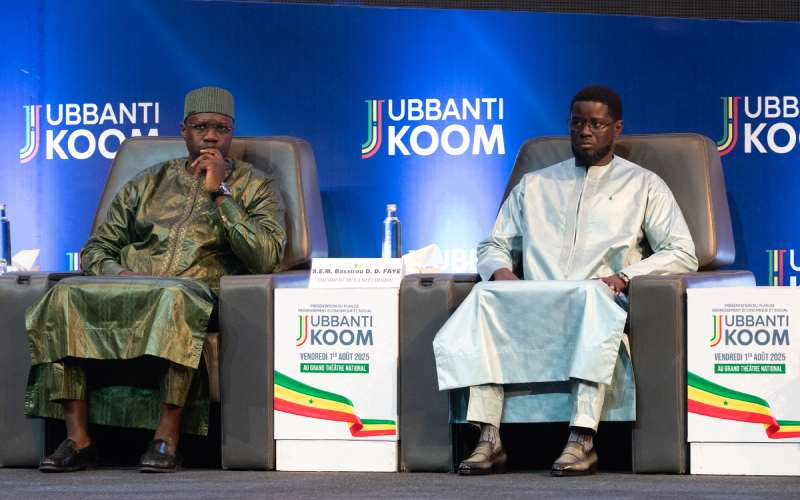
Senegalese Prime Minister Ousmane Sonko (L) and Senegalese President Bassirou Diomaye Faye (R) [AFP]
Senegal President Bassirou Diomaye Faye sacked Prime Minister Ousmane Sonko and dissolved the government on Friday after months of tensions, deepening a crisis in the debt-laden west African nation.
The shock announcement was made on state television in a decree read out by presidential aide Oumar Samba Ba, who said Faye "has ended the duties of Ousmane Sonko... and consequently those of the ministers and secretaries of state who are members of the government".
No details were provided on the appointment of a new prime minister.
"Alhamdulillah (praise be to God). Tonight I will sleep soundly in the Keur Gorgui neighbourhood," Sonko posted on Facebook after his dismissal, referring to the Dakar district where he lives.
Sonko arrived home shortly after midnight, where he greeted hundreds of supporters who had gathered to cheer him on, according to AFP journalists.
Senegal is in the unusual situation of having a president who owes his position in large part to the prime minister, who would almost certainly have taken the top job had he not been barred from running in the last presidential election due to a defamation conviction.
The relationship between Faye and the charismatic Sonko, his one-time mentor, has soured in recent months.
Their Pastef party won outright in the first round of 2024 elections on a promise of a profound political shake-up, vowing to fight what they said was corruption and inheriting an economy mired in debt.
Despite Sonko's popular appeal, Faye holds all the real power as president and can fire his head of government with a simple decree.
Sonko generated a passionate following among Senegal's disaffected youth ahead of the 2024 elections.
He struck a chord in particular with his pan-Africanist rhetoric and tough stance on former colonial power France.
His dismissal came hours after Sonko condemned what he described as a tyrannical West trying to "impose" homosexuality on the rest of the world, following the passage of a new law to toughen sentences for same-sex relations.
The prime minister said that after the law was approved he had heard heavy criticism of Senegal in foreign countries, particuarly France.
"If they have opted for these practices, it's their problem, but we don't have any lessons to take from them, absolutely none," he said.
Stay informed. Subscribe to our newsletter
Growing discord
Discord between the president and prime minister has been on display for months, making their governing alliance increasingly uncertain.
At the start of May, Faye criticised Sonko's "excessive personalisation" within the ruling party.
"As long as he remains prime minister, it is because he has my confidence. When that is no longer the case, there will be a new prime minister," Faye declared in a televised interview.
Sonko has accused Faye of a "failure of leadership" for not backing him up against his critics.
Since coming to power in 2024, the country's leaders have had to contend with a worrying economic situation, inheriting colossal debt from the previous government.
With debt levels that have reached the equivalent of 132 percent of its GDP, according to the International Monetary Fund (IMF), Senegal is now the second-most indebted country in sub-Saharan Africa.
Its parliament approved a bill last month that opens the way for Sonko to run in the next presidential elections, slated for 2029.
The reform amended Senegal's electoral code, which had stipulated that a defamation conviction made a candidate ineligible.

Subscribe to our newsletter and stay updated on the latest developments and special offers!