×
App Icon
The Standard e-Paper
Read Offline Anywhere
★★★★ - on Play Store
Download Now

In east DR Congo, minors face systematic risk of sexual violence

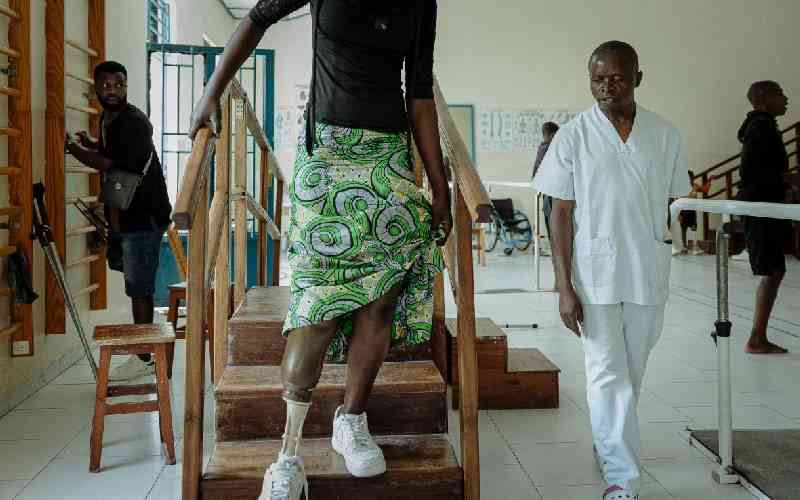
A patient tests her new prosthesis, going up and down therapeutic stairs as technicians observe, at the Shirika la Umoja centre in Goma, on November 19, 2025. [AFP]

Sabine was 15 years old when she was raped by a stranger on the outskirts of a displacement camp in eastern DR Congo, where UNICEF said sexual violence against children has reached "alarming levels".


A year later, Sabine -- not her real name -- cradled a baby girl born from the assault whom she was taking care of despite disparaging looks from some in her community.

Her name and those of other rape victims have been changed for this story to protect their identities.


"Sexual violence against children in the Democratic Republic of Congo remains a pervasive and deeply destabilising crisis," the United Nations Children's Fund (UNICEF) said in a report released Tuesday.

Thirty years of conflict in eastern DRC -- where the Rwanda-backed M23 anti-government group recently seized swathes of territory -- is a major factor in the violence, according to UNICEF.

But it also reported widespread abuse outside of conflict zones.

"Despite decades of sustained national and international efforts, violations continue at alarming levels across the country," the report said.

This includes "in provinces that are relatively stable, revealing major gaps in protection mechanisms and legal accountability", it added.

Sabine lives in the Rhoo displacement camp in the savannah-covered hills of northeastern Ituri province, a region gripped by a bloody intercommunal conflict between the Hema and Lendu.

For her Hema community, venturing even a few metres from the camp, which is guarded by UN peacekeepers, means risking being killed or raped by CODECO militiamen.

The armed group claims to defend the Lendu community and regularly attacks camps housing displaced Hema.

But like other child victims of rape that AFP spoke to, Sabine said she had no choice but to wander outside the camp to find food for her family.

In the Rhoo camp, many minors "are responsible for the household, while others care for elderly people who are unable to work", said Rachel Mwisi, a health worker specialising in caring for minors who are victims of sexual violence.

Mwisi said she had spoken to dozens of families in Rhoo, both to warn them of the risks and to prevent them from rejecting their children who have been raped.

Few young victims of rape dare tell their parents, often until a pregnancy betrays their secret and risks them being rejected by their family or community.

"I was ashamed in front of people and I often covered myself with cloth to hide," Antoinette told AFP. She was raped near the Rhoo camp aged 13 while gathering vegetables in the fields.

Sabine was able to stay with her family. "The girls who got married are helped by their husbands, but my parents take care of me, and I'm embarrassed about that," she told AFP.

The DRC's legal system, plagued by slowness and corruption, is largely absent in conflict-ridden rural areas such as Rhoo.

Instead, victims' families resort to informal settlements with perpetrators, who usually do not admit to the rape but agree to pay for some support, said Silas Gashoke, a lawyer in the nearby provincial capital of Bunia who represents victims of sexual violence.

He said the practice, which is prohibited under Congolese law, creates a "vicious cycle" that promotes impunity.

"You cannot go a day without hearing about such cases, even in the city," said Joelle Kahindo, a psychologist with Sofepadi, an NGO that cares for victims of sexual violence in Bunia.

To avoid scandal, families may arrange a forced marriage between the victim and the rapist.

"The victim has no say, and her dignity is never taken into account," Kahindo said.

In his small office tucked away on the upper floor of a Bunia clinic, Gashoke said cases of abuse perpetrated by armed men were outnumbered, however, by crimes committed within camps or neighbourhoods, often by members of the victim's own community.

Many such cases, he said, were paid sexual relations driven by extreme poverty that are considered "consensual" by the perpetrators, despite Congolese law.

"I knew of a case where a young girl had sex for 2,000 francs (less than $1)," Gashoke said indignantly.

In a country wracked by violence which is also one of the poorest in the world, minors are "in a situation of great vulnerability," he said.